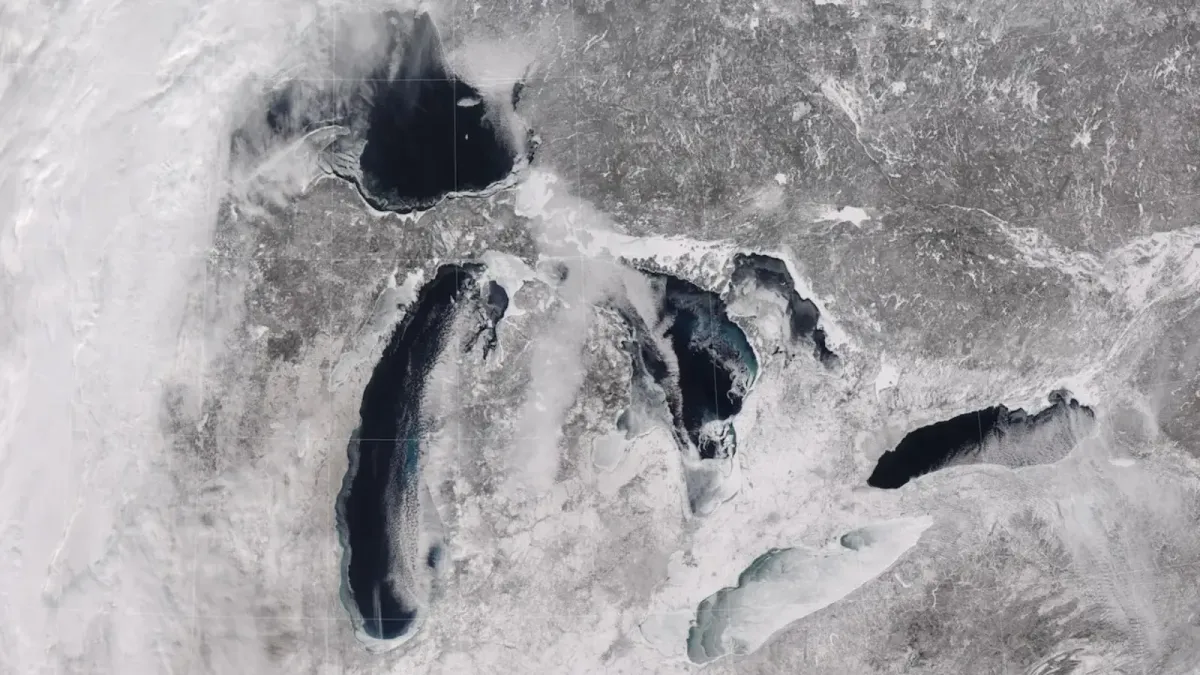
Michigan researchers have reconstructed over a century of ice cover patterns on the Great Lakes — a dataset that didn't exist until now. By mining historical temperature records from weather stations dating back to 1897, they've filled a crucial gap in our understanding of how the region's winters have shifted, and what comes next.
The work matters because it connects three things most people care about: safety, culture, and the survival of species that depend on winter ice. Lake whitefish populations have declined sharply in recent decades. Recreational ice fishing and winter travel depend on predictable ice conditions. And the data itself — published last month in Scientific Data — now gives researchers a baseline to measure against as the climate continues to warm.
"Lake ice is really part of the system, part of our life," said Ayumi Fujisaki-Manome, associate director for the Cooperative Institute for Great Lakes Research at the University of Michigan. "It matters for our culture, regional weather, safety, everything."
We're a new kind of news feed.
Regular news is designed to drain you. We're a non-profit built to restore you. Every story we publish is scored for impact, progress, and hope.
Start Your News DetoxWhy this gap existed
Satellites have tracked Great Lakes ice reliably for about 45 years. Before that, the record goes quiet. Data buoys get pulled out because winter conditions are too harsh. What researchers did have were temperature readings — lots of them, scattered across weather stations around the lakes since the 1890s.
The insight was simple: ice forms when you have several cold days in a row. Air temperature is a reliable proxy. So researchers selected stations with the most consistent records and worked backward, calculating ice cover from temperature data. The result is a continuous 120-year picture of when ice formed, how thick it likely grew, and how long it lasted.
What the data reveals
The picture is one of increasing volatility. Average regional temperatures have risen noticeably in the last two decades. Frost seasons are shortening. Heavy snow and rainstorms are becoming more frequent — the kind of extreme swings that characterize a warming climate.
Last winter, ice cover was close to average. The winter before that, it hit historic lows. This winter, recent cold snaps produced some of the highest ice cover in years, according to the U.S. National Oceanic and Atmospheric Administration. "These really extreme years where we have really cold weather or really warm weather is just a sign that long-term climate is changing," said Katelyn King, the study's lead author and a fisheries research biologist for the Michigan Department of Natural Resources.
King is using the dataset to study whitefish decline — a species that's culturally and economically important to the region. Much of what happens to fish under ice remains poorly understood. Now researchers have a historical baseline to work from, a way to understand not just what conditions were like, but what conditions should look like in a stable system.
The data will also improve winter forecasting, making ice safer for people who travel on it or fish through it. For a region where ice is woven into winter identity and livelihood, that kind of predictability matters.