So, you've heard about GLP-1 drugs and their uncanny ability to make weight vanish. But where does it actually go? Is it just poof — all of you, shrinking proportionally? Or is your body making some strategic choices about what to jettison?
Turns out, it's the latter. New research suggests that when you shed pounds with treatments like semaglutide and tirzepatide, your body is overwhelmingly choosing to ditch the fat, leaving most of your hard-earned muscle right where it belongs.
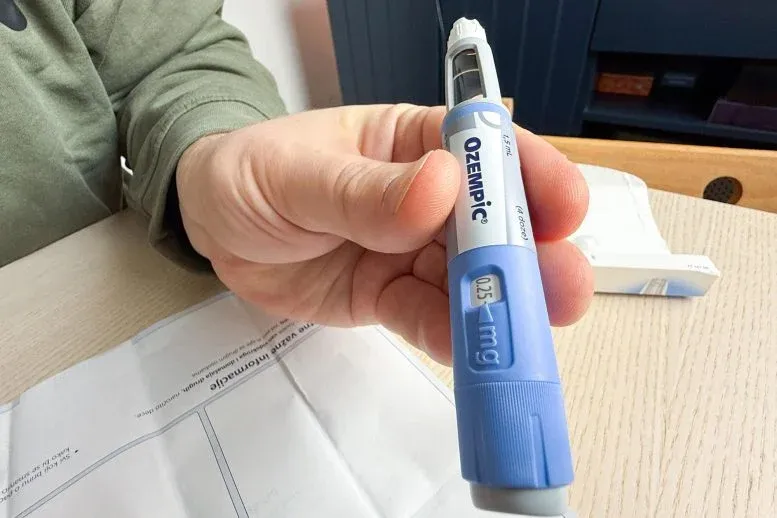
This isn't just a hopeful guess. A study presented at the European Congress on Obesity (ECO2026) peered into the actual body composition changes. They looked at the big players in the GLP-1 world — semaglutide and liraglutide — plus tirzepatide, which is a bit of a dual-threat, targeting both GLP-1 and GIP receptors. We knew these drugs helped with weight loss, but the exact fat-to-muscle ratio was a bit of a black box.
We're a new kind of news feed.
Regular news is designed to drain you. We're a non-profit built to restore you. Every story we publish is scored for impact, progress, and hope.
Start Your News DetoxThe Electrical Current Never Lies
To figure out what was really going on, researchers in Vienna employed something called bioelectrical impedance analysis (BIA). Imagine a quick, non-invasive test that sends a tiny electrical current through you. It's like a very polite, invisible bouncer checking your body's VIP sections: fat, muscle, and water.
They zapped 486 adults with obesity, mostly women (82%), averaging around 50 years old. Participants were on various GLP-1 treatments and also received advice on exercise. The researchers tracked changes over periods ranging from under six months to over two years, using computer models to make sure they were comparing apples to apples, accounting for things like age, sex, and starting BMI.
After an average of 14 months, patients lost about 9.9% of their total body weight. Here's the satisfying breakdown:
- Fat mass: Dropped by a hefty 9.0 kg (that's roughly 19.8 lbs), a cool 18% reduction.
- Skeletal muscle mass: Decreased by a mere 1.2 kg (about 2.6 lbs), a relatively modest 5%.
Let that satisfying number sink in: over 70% of patients either maintained or even increased their relative muscle mass. The statistical wizards confirmed that muscle mass pretty much held steady once fat loss was factored in. This suggests the weight loss is leading to some genuinely positive body composition shifts, not just a general shrinkage.
So, while the scale is certainly moving, it seems your body is making smart choices about what to let go of. Which, if you think about it, is both impressive and slightly terrifying that a drug can be that discerning. While the study has its caveats (real-world data, mostly women, no placebo), it offers a pretty compelling picture of what's disappearing, and what's sticking around.
[European Congress on Obesity 2026 (ECO2026)]