When Elizabeth I sat for a portrait, she rarely actually sat. Instead, she handed artists a template—an approved "face pattern" that projected exactly the image she wanted the world to see. It was control disguised as art.
Now, researchers studying portraits at Hever Castle have discovered something remarkable: that same template didn't just appear in paintings of Elizabeth. It shows up in posthumous portraits of her mother Anne Boleyn, her half-sister Mary I, and her great-grandfather Edward IV. All painted by the same artist. All wearing Elizabeth's face.
It sounds like a forgery. It's actually something more calculated: visual propaganda.
We're a new kind of news feed.
Regular news is designed to drain you. We're a non-profit built to restore you. Every story we publish is scored for impact, progress, and hope.
Start Your News DetoxThe problem Elizabeth inherited
Anne Boleyn, Elizabeth's mother, was beheaded in 1536 on charges of adultery and treason—charges most historians now consider fabricated. King Henry VIII, eager to move on to wife number three, ordered portraits of Anne destroyed. He wanted her erased.
What survived were fragments. A sketch by court painter Hans Holbein the Younger, drawn from life in the 1530s, shows Anne with reddish hair and a rounder face. A medal from the British Museum. A handful of posthumous paintings created decades after her death, each one different from the last. No clear image. No consensus on what she actually looked like.
Elizabeth inherited not just a throne but a legitimacy problem. Her mother had been officially disgraced. Her father had tried to erase her from history. By the time Elizabeth became queen in 1558, she needed to prove she was the rightful heir—that she belonged in the line of succession not as an accident or a scandal, but as the inevitable continuation of Tudor rule.
The face that launched a dynasty
Elizabeth's answer was her face itself. In the 1560s, her adviser William Cecil declared that no artist had yet captured her properly. The crown then did something unprecedented: it banned new portraits of the queen "for a time" until an official template could be created and distributed to every artist in the realm. One approved face. No variations. No unflattering angles.
This wasn't vanity, though Elizabeth certainly had that. It was strategy. A unified image projected stability. It said: this is what legitimate power looks like.
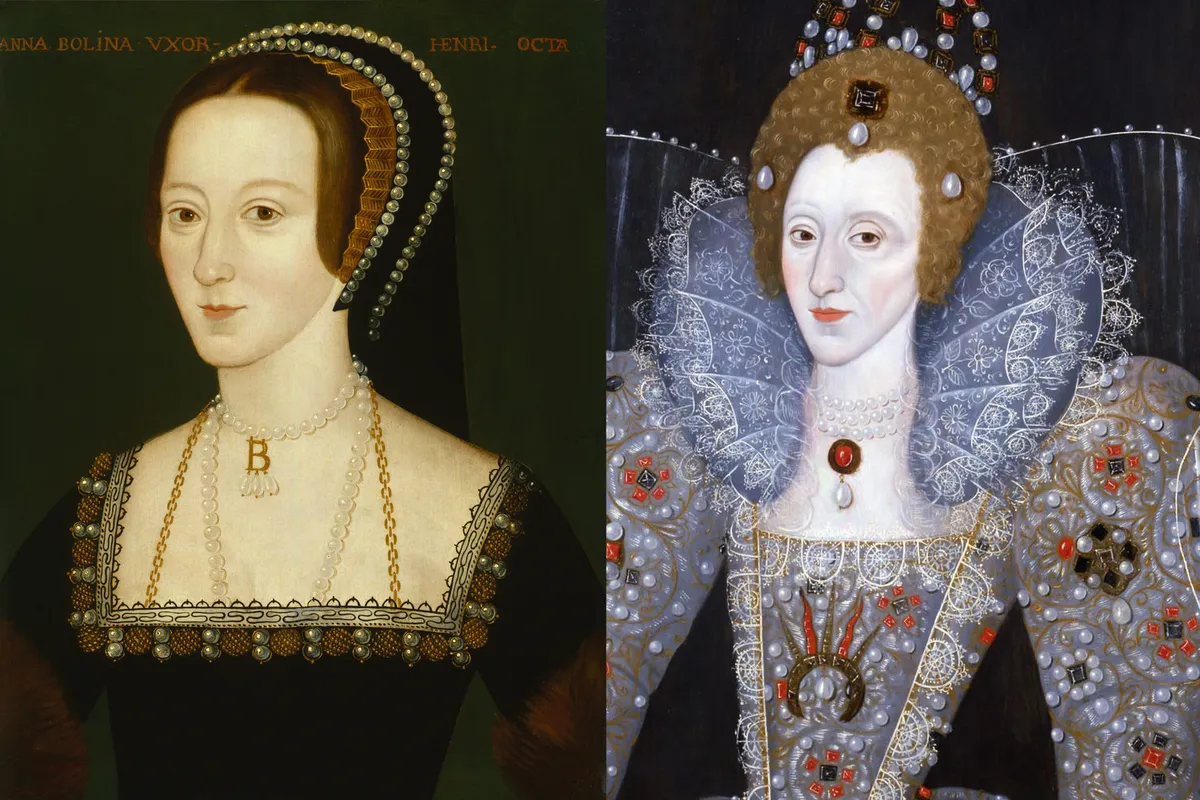
But Elizabeth went further. According to assistant curator Owen Emmerson's research at Hever Castle, she and her regime used that face pattern to paint over history itself. When a workshop in the late 16th century created posthumous portraits of Anne Boleyn, Mary I, and Edward IV—all of them dead, all of them unable to object—they used Elizabeth's facial geometry as the template. Same bone structure. Same proportions. Same eyes.
"It's one artist doing a series of portraits of monarchs and putting on the face of the reigning queen, Elizabeth, to show a legitimate and God-ordained line of succession," Emmerson explains. The message was visual and unmistakable: Elizabeth didn't just belong on the throne. She was the inevitable echo of those who came before her.
What we actually know
The irony is sharp: in trying to prove Elizabeth's connection to her mother, the regime may have obscured Anne's actual appearance forever. Contemporary accounts describe Anne as having a swarthy complexion, a long neck, a wide mouth, and striking black eyes. The Holbein sketch suggests auburn hair and a rounder face. But the most famous portrait of Anne—the one housed at the National Portrait Gallery in London—shows her with Elizabeth's face.
We may never know what Anne Boleyn actually looked like. What we do know is how Elizabeth's regime wanted her remembered: as a mirror of the queen who defeated her enemies and ruled for 45 years. In the language of portraiture, that was a kind of resurrection. Anne's face became a tool of her daughter's power.
The exhibition "Capturing a Queen: The Image of Anne Boleyn" opens at Hever Castle on February 11, 2026, bringing together more than 30 likenesses of Anne across four centuries—a visual record of not just how artists imagined her, but how each era needed to imagine her.