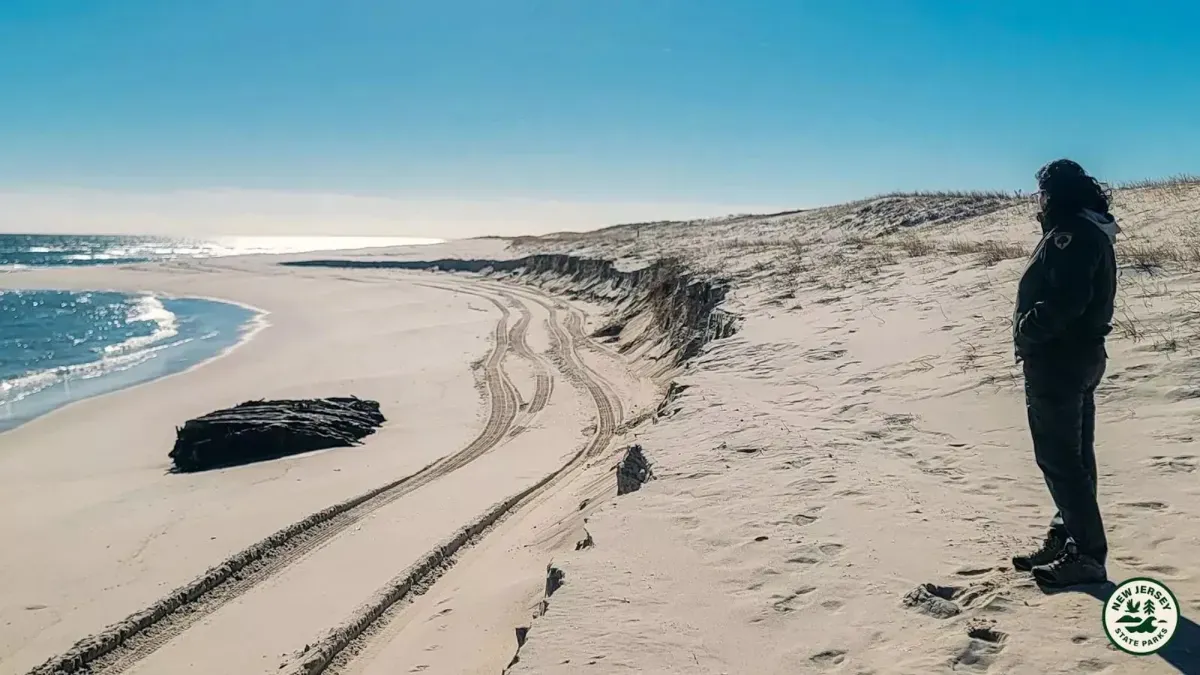
A pile of weathered wood on Island Beach State Park's shoreline turned out to be far more than driftwood. After weeks of heavy winds and intense surf stripped away sand, park officials discovered the remains of the Lawrence N. McKenzie, a schooner that sank in 1890 — nearly 136 years ago.
The ship's story is brief but telling. Built in Essex, Massachusetts in 1883, the 98-foot schooner spent less than seven years at sea before meeting the Atlantic. On March 21, 1890, the McKenzie was nearing the end of a 1,600-mile journey with eight crew members and a hold full of oranges bound for New York City. Heavy fog near Barnegat, New Jersey, changed everything. The ship became stranded and took on at least six feet of water. Rescuers managed to save the entire crew and captain (who shared the ship's name), but the vessel itself was lost to the ocean. At the time, the McKenzie was valued at around $9,000, with roughly $2,000 worth of citrus cargo aboard.
A Natural Cycle Reveals History
For over a century, the wreck lay hidden beneath the sand. But winter erosion at Island Beach State Park operates on a predictable rhythm. High-energy waves and seasonal storms scour away the shoreline each winter, narrowing beaches and steeping their profiles. Summer months typically restore what winter takes, but this year's conditions exposed something few living people had ever seen.
We're a new kind of news feed.
Regular news is designed to drain you. We're a non-profit built to restore you. Every story we publish is scored for impact, progress, and hope.
Start Your News DetoxPark officials described the discovery as "a glimpse into the park's maritime history," and they're treating it carefully. Staff are monitoring the wooden framework while maritime archaeologists prepare to examine it more closely. The park also issued a clear warning: the wreck is protected by law. Touching or removing any part of it can result in summonses from New Jersey State Park Police.
The McKenzie's reappearance is a reminder that coastlines are dynamic — constantly shaped by wind and water, constantly revealing what was buried. As conditions shift with the seasons, more pieces of maritime history may yet emerge from the sand.