India has made great strides in protecting its Bengal tigers. Now, the country needs to help these growing tiger populations move safely as they spread out from protected areas into places where people live. This is happening even as poaching increases and forests are destroyed.
Protected forest corridors are vital. They help connect tiger habitats that have been lost or separated. This allows tigers to mix genetically, preventing isolated groups from inbreeding.
India has built more wildlife crossings than any other country in Asia. This includes the world's ten largest underpasses and overpasses for wildlife. However, even as India reconnects habitats, it is also rapidly building new roads. Even protected forests remain at risk.
We're a new kind of news feed.
Regular news is designed to drain you. We're a non-profit built to restore you. Every story we publish is scored for impact, progress, and hope.
Start Your News DetoxIn Rajaji Tiger Reserve in northern India, the Teen Pani (Three Waters) underpass is about 1,300 feet long. It allows animals, from mice to elephants, to safely cross under National Highway 72. This underpass is also used by T8, a Bengal tiger (Panthera tigris tigris). T8 was one of five tigers moved to Rajaji in May 2025. He now roams widely, often in areas with people, staying safe from traffic above.
The expressway above was built in 2021. It replaced an older, busy road connecting Delhi to Haridwar and Dehradun.
India's population is 1.4 billion, and its economy has grown quickly. Despite this, the jungle in places like Rajaji has survived and even recovered.
As India builds new infrastructure, wild tiger numbers have grown so much that existing protected areas are no longer enough. The big cats need to spread out to find new territories. Roads can break up habitats. For some animals, roads are barriers. For others, like big cats and elephants, roads can become deadly routes.
India's National Tiger Conservation Authority has identified four key tiger landscapes where corridors are crucial. These corridors allow tigers to roam, hunt, and find water. They connect tiger populations, allowing them to spread their genes. These corridors offer hope against extinction risks from environmental and human factors.
Bilal Habib, a scientist at the Wildlife Institute of India, says India has built more wildlife crossings than any other Asian country. Since 2017, India has created the world's ten largest wildlife underpasses and overpasses. Habib notes that no other developing country has spent as much money on wildlife conservation mitigation.
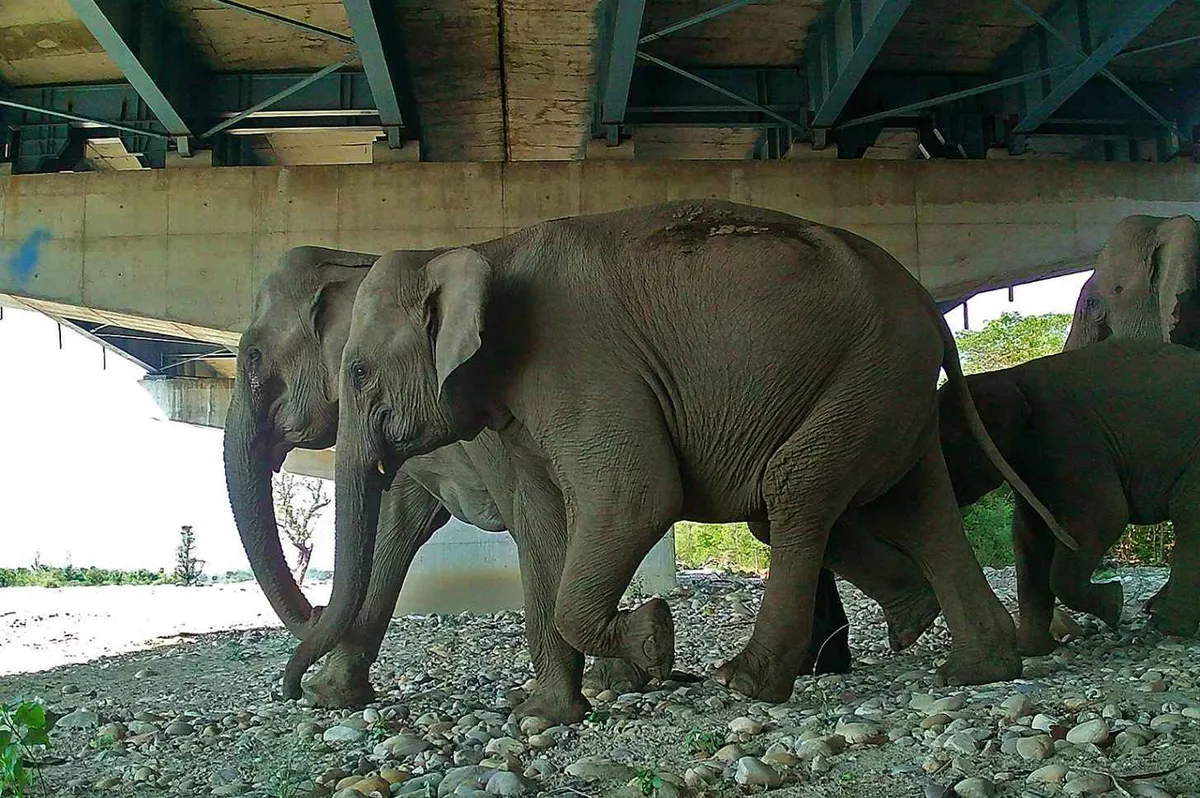 A small elephant herd crosses under the Delhi-Dehradun Expressway at Mohand, Rajaji Tiger Reserve. Courtesy of Wildlife Institute of India
Tigers Need Room to Roam
Tigers naturally roam to find and establish their own territories. A male tiger's home range can be up to 77 square miles. This depends on prey, habitat, and how many other tigers are nearby. They mark and defend their territories. Females have smaller territories but are also protective of them.
In Rajaji Tiger Reserve, tigers face challenges moving around. A deep canal, highways, a railway, and towns cut through the forests. This disrupts the western part of the Terai Arc landscape. This 19,700-square-mile area stretches along the Himalayas and into Nepal. It has 19 corridors that tigers use, but experts say ten of them need attention.
These narrow jungle corridors, which go under and over highways, through fields, and around towns, are vital. They connect larger, healthy habitats for wildlife. These pathways are now essential for wild tigers across India.
Tiger numbers have more than doubled since 1972. From an estimated 1,827, they reached about 3,682 in the 2022 census. This number may be even higher now. The Terai Arc is a success story for tiger conservation. This area, centered around Corbett Tiger Reserve, now supports about 560 tigers. This is more than three times the number from 20 years ago. Project Tiger, launched by former Indian prime minister Indira Gandhi in 1973, is credited with saving India's tigers.
India is now the last true stronghold for tigers. It accounts for about 75% of all wild tigers left on Earth. Its Bengal tigers have the best chance of long-term survival among the six subspecies.
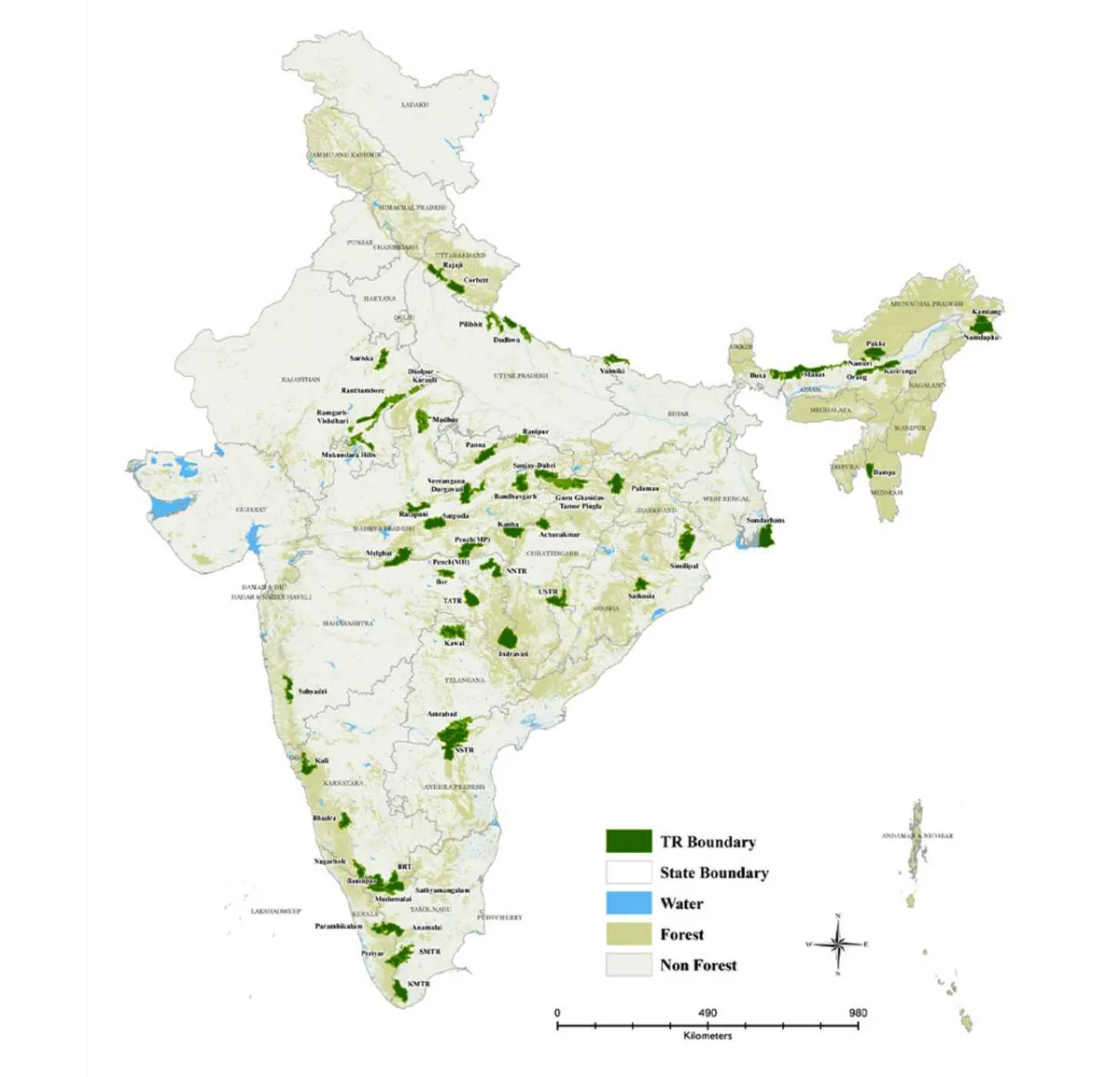 India is the world’s last stronghold for tigers, home to about 70% of all that remain. Since Indira Gandhi’s Project Tiger launched in 1973, its tiger reserves have grown from 9 to 58. Courtesy of National Tiger Conservation Authority
Other tiger subspecies are struggling. The South China tiger only exists in captivity. Only about 750 Amur tigers (Panthera tigris altaica) remain in the Russian Far East. Fewer than 150 Malayan tigers are left. In mainland Southeast Asia, the Indochinese subspecies has disappeared from Laos, Cambodia, and Vietnam. Thailand's Western Forest Complex is the only bright spot for them.
India has greatly increased its tiger numbers. Its tiger reserves have grown from nine in 1973 to 58 today. They now cover over 32,600 square miles, an area the size of Austria. However, tiger density is uneven. Some reserves are full, while others may have no tigers. Experts estimate that about 35% of India's wild tigers live outside protected areas.
These tigers need places to go. Young tigers leave their mothers to find their own homes. Without safe pathways between habitats, gene flow is cut off. This leads to inbreeding and fighting among tigers. But as tigers move into human areas, the risk of conflict with people or poaching rises sharply. These threats endanger their long-term survival.
Roads and railways are not the only problems for wildlife corridors. As human populations grow, many tiger reserves are surrounded by urban areas. Many corridors have become degraded, fragmented habitats. Forest land merges with human-dominated areas, bringing domestic animals like cattle and dogs.
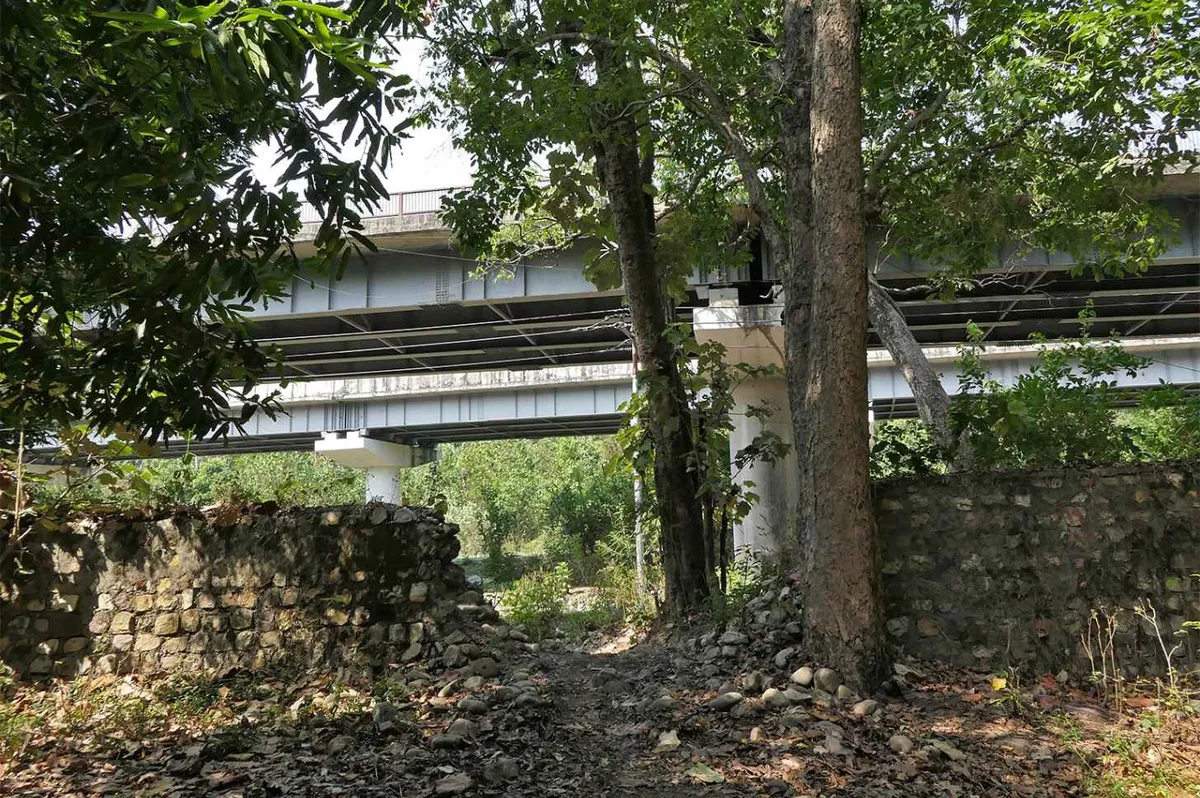 Teen Pani, or Three Waters underpass in Rajaji Tiger Reserve allows wildlife to move beneath the heavily trafficked National Highway 72 that runs northeast out of Delhi. Nirmal Ghosh/Mongabay
Challenges and Solutions
Chandrapur district in Maharashtra is a hotspot for human-tiger conflict. It's an industrial and mining hub, but also home to Tadoba Tiger Reserve. Tiger numbers there rose from 30-40 in 2006 to 220-300 today. The district has about 2.5 million people.
Close contact between people and tigers causes suffering for both. Between 2021 and May 2025, 150 people in the area were killed by tigers. In May 2026, a female tiger was killed by a freight train in Chandrapur. This was one of at least 19 tigers killed on that route in just three years.
Tiger poaching is a constant threat across India and has been increasing in Maharashtra and Madhya Pradesh. Tigers are also killed by illegal electric fences meant to stop other animals from raiding crops. Meanwhile, tigers continue to lose habitat, even in protected areas, due to mines and infrastructure.
These projects often get approval at the highest levels. The National Board for Wildlife, which reviews projects in critical habitats, recently approved a mining project near Phen Wildlife Sanctuary. This sanctuary is next to Kanha Tiger Reserve, famous for George Schaller's tiger studies.
Prakriti Srivastava and Prerna Bindra documented how the National Board for Wildlife has become a "rubber-stamp" body. It has approved 97% of project proposals in protected areas, eco-sensitive zones, and wildlife corridors over the past 12 years.
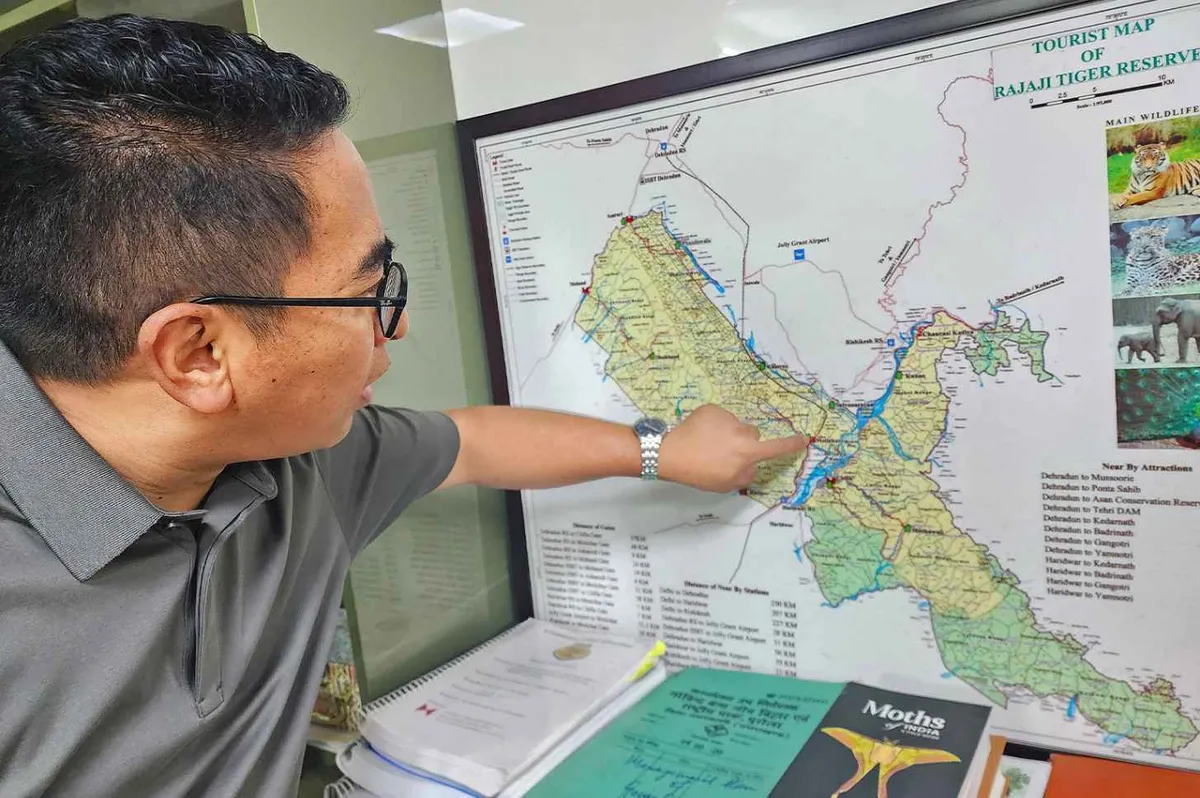 Rajaji Tiger Reserve director Koko Rose points to the location of an overpass that allows wildlife to move safely beneath National Highway 72, which bisects the park. Nirmal Ghosh/Mongabay
In Odisha, officials redrew forest maps to allow bauxite mining in areas used by elephants and tigers. In Maharashtra's Gadchiroli district, a mining project will take about 3.6 square miles of forest from a tiger corridor. The Ken-Betwa project, a controversial river-linking scheme, would flood 22 square miles of Panna Tiger Reserve. This would displace wildlife and squeeze animals into smaller habitats.
These ongoing pressures make functional wildlife corridors even more vital. However, experts say corridors should not just be quick fixes for damaged core habitats. Ullas Karanth, a top tiger expert, says India needs to strengthen core habitats. It also needs to encourage local people to live alongside wildlife, for example, by seeing tiger tourism as an opportunity.
Karanth believes there is still plenty of space for tigers. He estimates about 155,000 square miles of potential tiger habitat where they once roamed. But only a small part of that land currently supports breeding tigers.
Connecting habitats successfully requires planning for the entire landscape. While large structures for animals to cross roads are impressive, Karanth says animals will only use them if there's a reason to cross, meaning healthy habitat on the other side. "To me, the context is first to secure the core habitat," he says. "India could, in fact, accommodate up to 10,000-20,000 tigers if habitats are adequately protected."
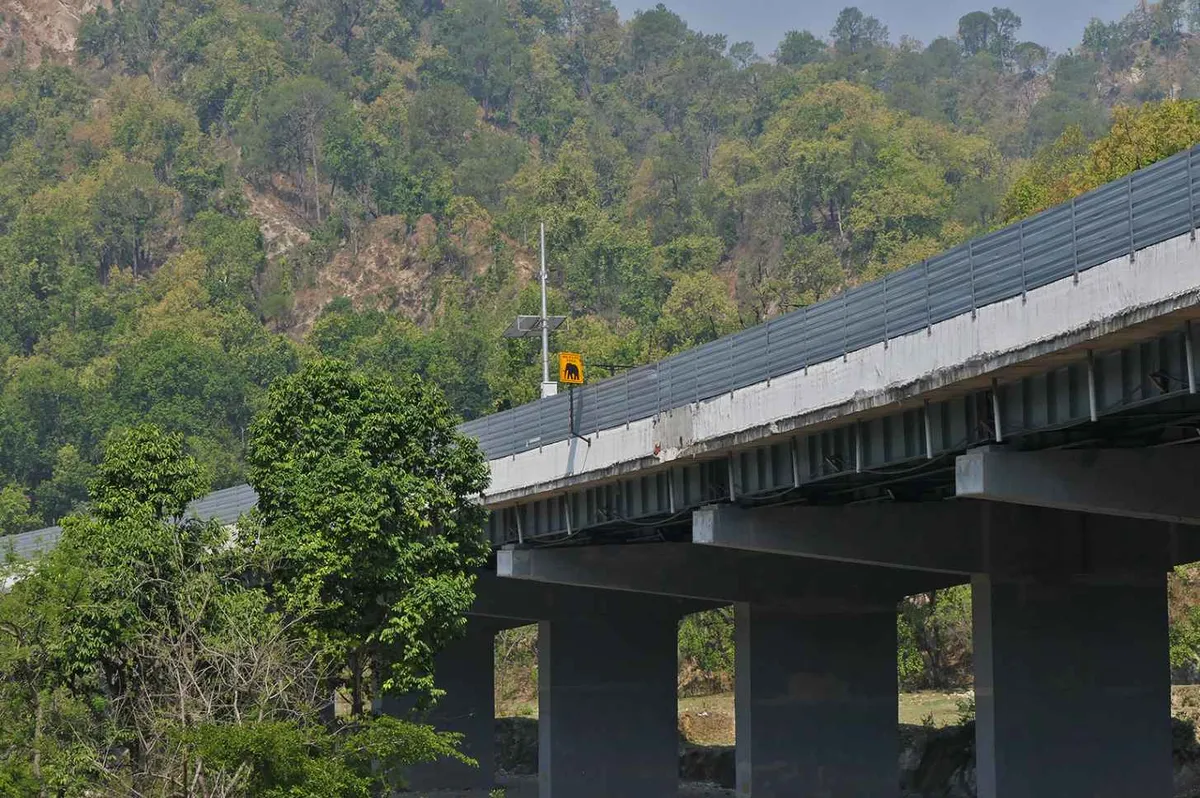 Ganeshpur Expressway and underpass at Mohand, Rajaji Tiger Reserve. Nirmal Ghosh/Mongabay
Bridging Gaps for Wildlife
Historically, wildlife scientists and transportation agencies have had different goals. Conservationists have long argued that civil engineering for roads is not compatible with ecology. Environmental impact assessments for big projects are often seen as a burden, not a key part of the process.
Wildlife biologist Ravi Chellam says it's a common mistake to think animals stay only in narrow corridors. "Animals don't limit their movements to corridors. They use a matrix of habitats available in the landscape."
Amrita Neelakantan, a conservation scientist with the Coexistence Consortium, says conservation groups can help bridge the gap between government agencies. These agencies often have different mandates and ways of looking at landscapes. Prachi Thatte, a conservation scientist with the Coalition for Wildlife Corridors, agrees that coordination is needed. "We need to think of shared space management in terms of conflict that happens while tigers move through spaces shared by people," Thatte says.
The vast jungles of central India, the setting for The Jungle Book, now have patchy forests. Critical corridors connect viable habitats and absorb wandering tigers. These jungles hold about 40% of India's estimated 3,682 wild tigers. However, habitat is disappearing quickly. A new study found that forest cover in six key tiger reserves shrank by about 5% between 2005 and 2015, while agriculture and settlements grew.
One crucial area is the Kanha-Pench corridor, which crosses between Madhya Pradesh and Maharashtra. The latest census found 105 tigers in Kanha Tiger Reserve and 77 in Pench. There is clear evidence of tigers using and breeding in the lush Balaghat forest corridor that connects them.
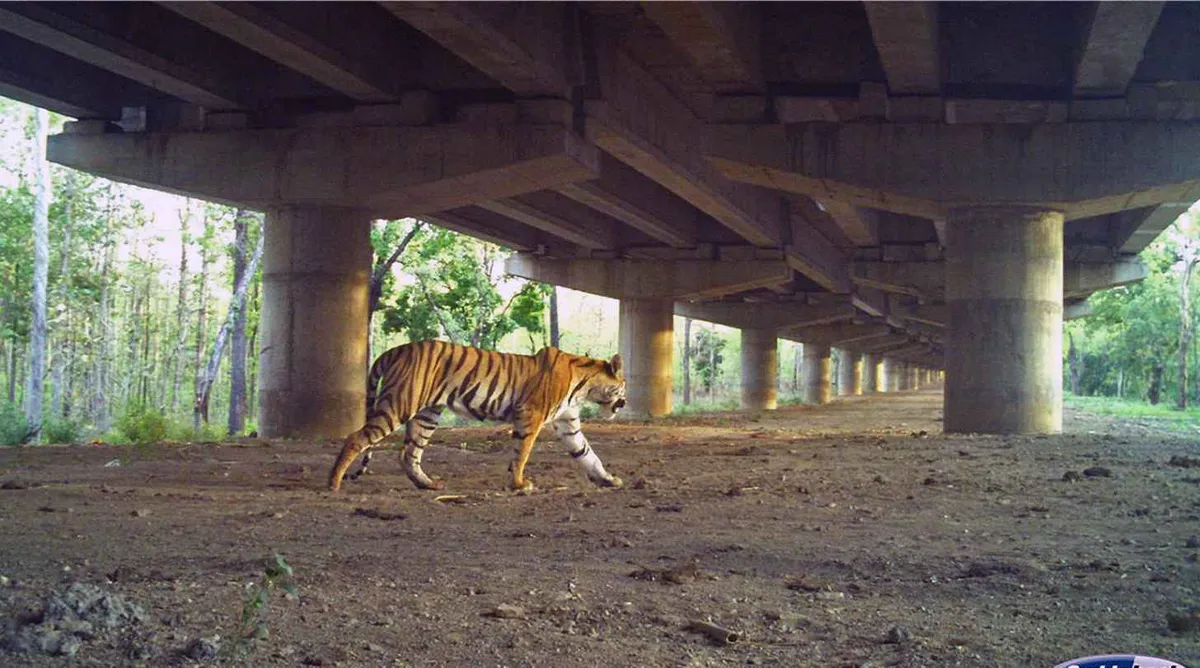 Tigress negotiating an underpass beneath National Highway 44. It’s India’s longest highway. This section runs through Pench Tiger Reserve, which is home to tiger, gaur, Indian pangolin and other threatened species. Courtesy of Wildlife Institute of India
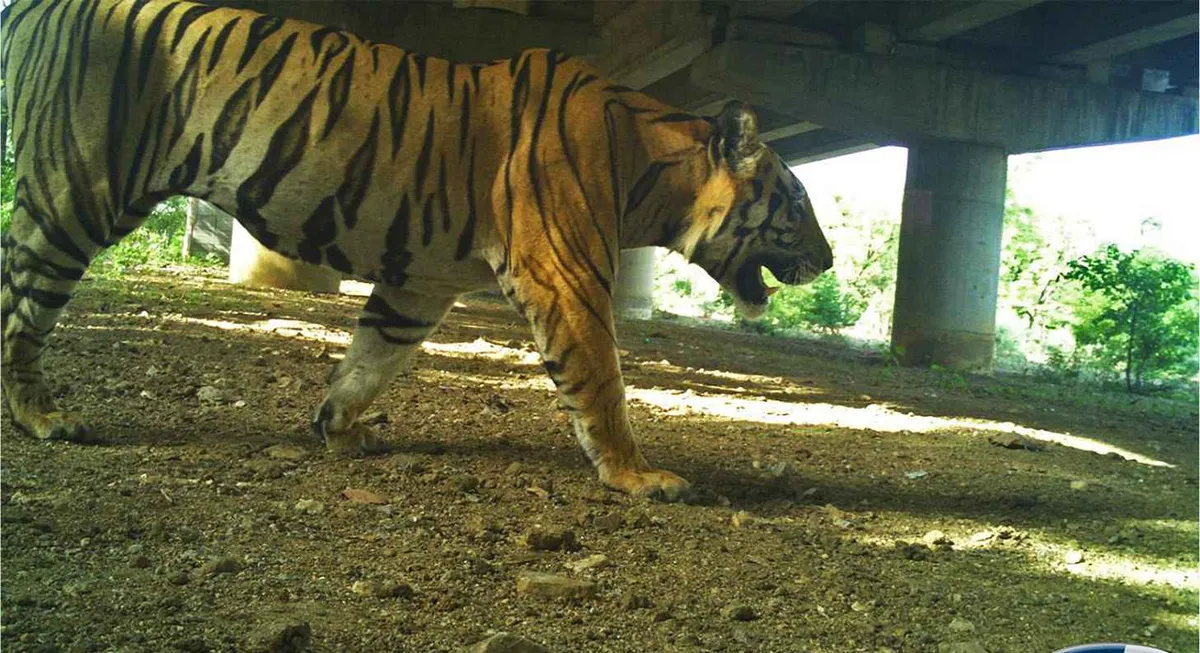 India constructed nine overpasses along National Highway 44 (NH 44), which passes through Pench Tiger Reserve, home to an estimated 77 tigers. These crossings are critical: A Wildlife Conservation Trust study found that “not a single tiger subpopulation in the Central Indian Landscape is genetically viable in the long run by itself.” Courtesy of Wildlife Institute of India
Tigers Reclaim Old Territories
Tigers are increasingly seen in places where they haven't been for a long time. Sometimes they travel very long distances from where they were born. In 2023, a tiger was spotted at about 7,000 feet in Binsar Wildlife Sanctuary in the Indian Himalayas. These big cats are simply returning to their historical ranges. Around 1900, about 100,000 tigers roamed India. But humans have since occupied and changed many of these areas.
For example, the human population around Bandhavgarh and Sanjay Dubri tiger reserves has changed dramatically. In 1901, there were about nine people per square kilometer. Today, there are about 223 people per square kilometer.
Tigers can travel vast distances. In January 2024, a tiger traveled about 77 miles from Sariska Tiger Reserve to agricultural fields near Delhi, a huge urban area with 60 million people. The tiger injured two people, but officials left it alone because its radio collar showed it was heading back to Sariska. Other tigers have left Sariska since then and will continue to do so.
WII's Habib sees road development as a conservation opportunity. While new roads are unavoidable, he says they can be built better with wildlife in mind. Road upgrade projects often face opposition due to tree cutting. However, some of these efforts offer greater long-term benefits. "It's about restoring the landscape, restoring ecological connectivity. We are giving land back to the ecosystem," Habib says.
Indian states have also started working together, which was not always the case. This cooperation is important as tigers and elephants increasingly cross state borders.
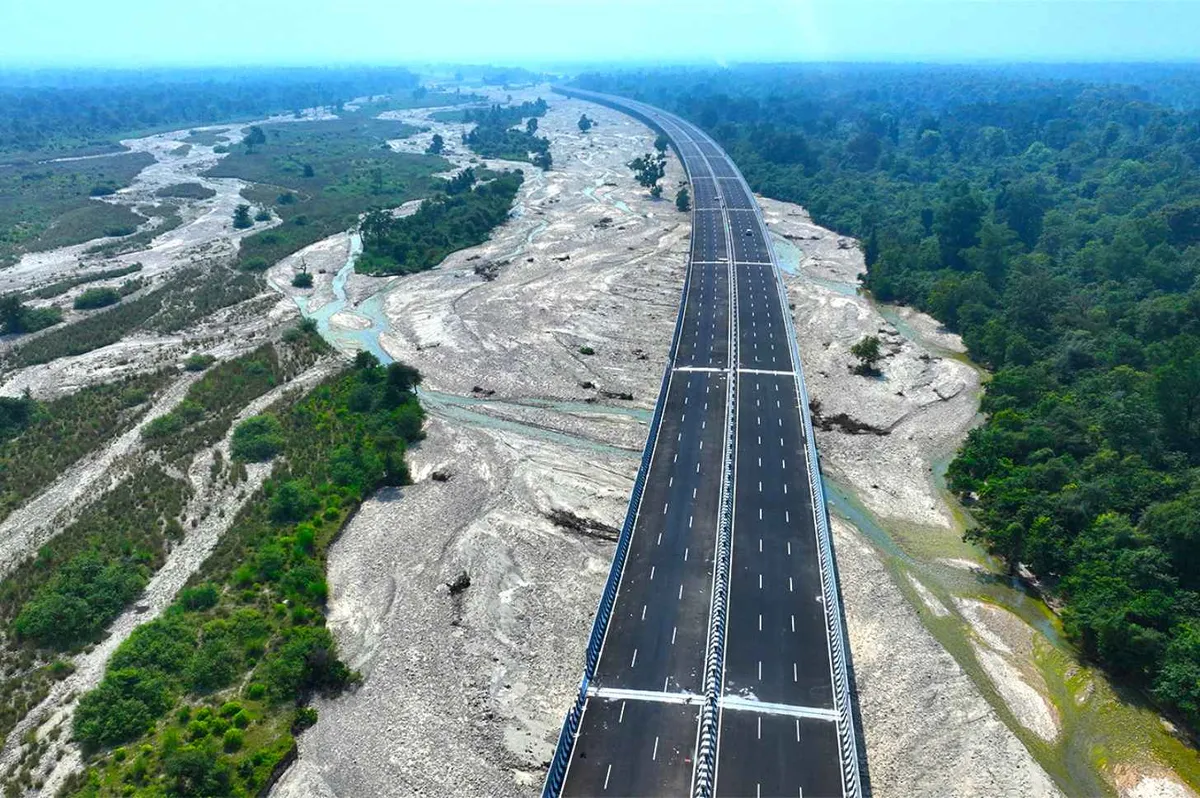 *An aerial view of Ganeshpur section