Feeding the world is a Herculean task, and while we often fixate on what's happening on terra firma, the ocean has quietly been doing some heavy lifting, providing sustenance for billions. The catch? We've been treating it less like a pantry and more like a trash can. Roughly 60% of marine ecosystems are currently damaged or, at best, being used in ways that suggest we haven't quite grasped the concept of "sustainable."
But Ghana, it seems, has had enough. On April 14th, the West African nation officially declared the Greater Cape Three Points Marine Protected Area (MPA) – its very first marine reserve. Let that satisfying number sink in.

This new MPA spans a hefty 704 square kilometers (that's about 272 square miles, or roughly the land area of New York City if you need a visual). The idea is to hit two birds with one very large, protected stone: bring back vital ocean life and, crucially, safeguard the livelihoods of 21 coastal communities who depend on healthy seas.
We're a new kind of news feed.
Regular news is designed to drain you. We're a non-profit built to restore you. Every story we publish is scored for impact, progress, and hope.
Start Your News DetoxGhana's New Blue Horizon
This isn't just about drawing lines on a map; it's a foundational piece of Ghana's grand vision for a "blue future." That's a fancy way of saying they want their ocean to be a thriving engine for a diverse, sustainable economy, rather than a depleted resource.
Ghana's move also puts it ahead of the curve in a global effort to protect at least 30% of the world's oceans by 2030. Currently, only about 10% of our watery planet is protected, and even less is actually managed with any real teeth. So, while Ghana is busy doing its part, the rest of the world has some serious catching up to do. They're hoping others take note.
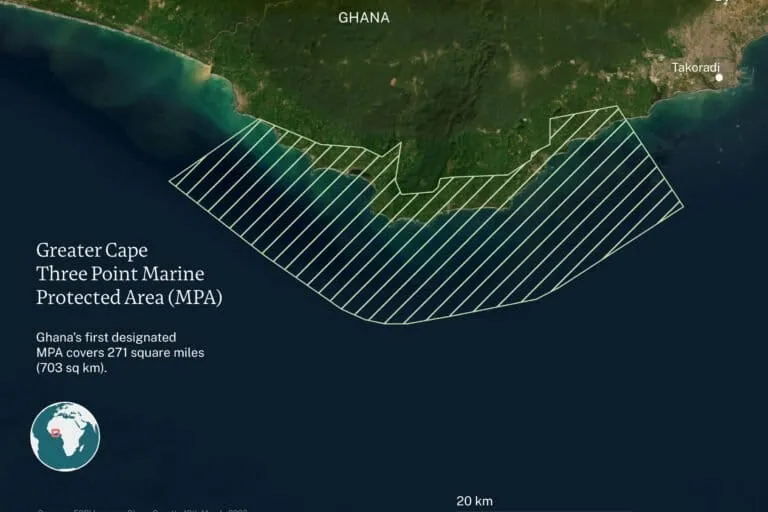
And why this particular chunk of ocean? The Greater Cape Three Points area is basically a VIP lounge for marine life. Its nutrient-rich waters make it a prime breeding and nursery ground for essential fish like sardinella, anchovy, and mackerel. Which, if you think about it, is a pretty smart place to start if you're serious about protecting your future.