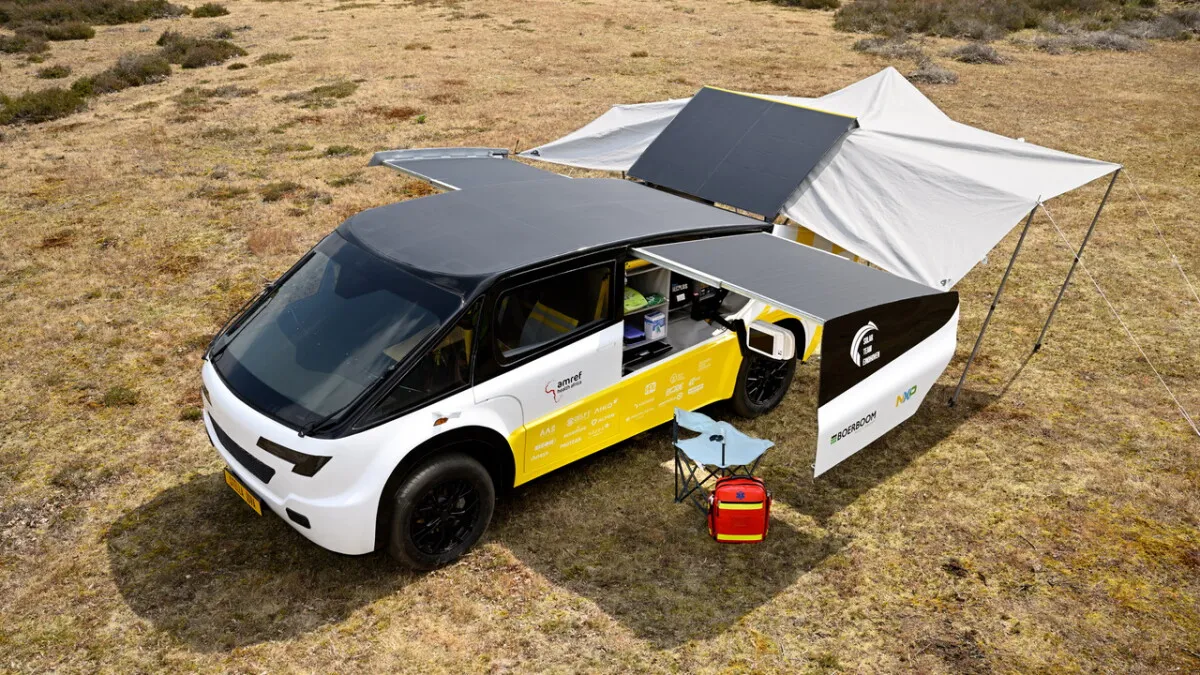
Student engineers at Eindhoven University of Technology have created the Stella Juva, the world's first solar-powered ambulance. This vehicle can travel to remote, off-grid areas to provide healthcare. It will now be tested in Africa.
Team Solar has a history of developing solar-powered transport. Their "Stella" vehicles have ranged from family cars to off-roaders. The latest student team is now focusing on humanitarian aid.
The Stella Juva is a research prototype. It is not designed for high-speed trips to urban emergency rooms. Instead, it works as a self-sustaining mobile clinic.
We're a new kind of news feed.
Regular news is designed to drain you. We're a non-profit built to restore you. Every story we publish is scored for impact, progress, and hope.
Start Your News DetoxBringing Healthcare to Remote Areas
The goal is to bring hospital-level medical care to about one billion people worldwide. These individuals live in remote areas without reliable roads, electricity, or fuel.
Powering both an off-road vehicle and sensitive medical equipment in harsh conditions was a challenge. The 23-student team had to use advanced solar technology.
The Stella Juva uses advanced photovoltaic cells called All Back Contact. These high-efficiency cells are made by AIKO. All electrical contacts are on the back of the cells. This design removes front-facing grid lines, maximizing energy capture even when it's partly cloudy.
The team needed to power a vehicle in unpredictable off-road environments. The All Back Contact cells were very efficient. This allowed the compact vehicle to get maximum energy from daylight. The panels also have integrated copper and silver-free metal. This makes them more durable and reduces damage from off-road vibrations.
A 50-kWh lithium battery pack stores energy from the solar roof. This provides power for night operations or long storms.
The vehicle's electrical system separates the driving parts from the medical cabin. This means if the vehicle runs out of driving power, the battery still prioritizes life-saving equipment. Pure sine wave inverters manage clean energy delivery. This prevents voltage changes from harming delicate diagnostic tools.
Minimizing weight is important for solar vehicle range. This was a challenge because the vehicle needed to carry heavy medical machinery. The team used lightweight, aerospace-grade carbon-fiber-composite for the chassis and body. This kept the total weight at 1,350 kg (about 3,000 lb). A typical ambulance weighs between 3,500 kg and 6,350 kg (7,700 lb - 14,000 lb).
The Stella Juva has an aerodynamic teardrop shape to reduce wind resistance. The students expect it to travel up to 715 km (444 miles) on a sunny day. It can reach top speeds of 120 km/h (75 mph).
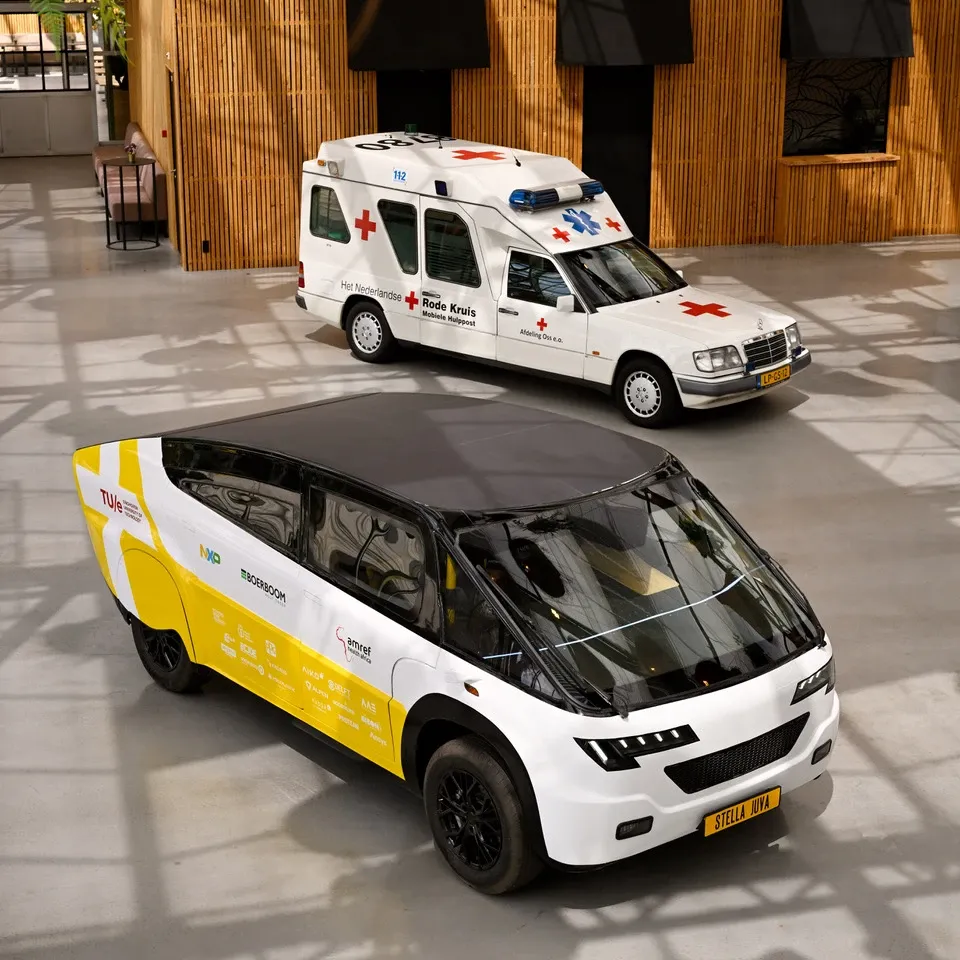
A Mobile Emergency Room
Inside, the climate-controlled medical cabin acts as a stand-alone emergency room. It includes a specialized X-ray machine for tuberculosis screening and ultrasound equipment for prenatal care. There are also rapid testing facilities for malaria and automated external defibrillators. A high-efficiency refrigeration unit keeps vaccines and medications stable in extreme temperatures.
The Stella Juva is a university project and will not be mass-produced. However, it is a proof-of-concept prototype. Its engineering blueprints are open-source. The goal is to show car manufacturers and health organizations that zero-emission, off-grid medical transport is possible.
The team wants to show that a sustainable future offers reasons for hope. As a non-profit student team, they rely on funding from corporate sponsors, academic support, and non-profit partnerships.
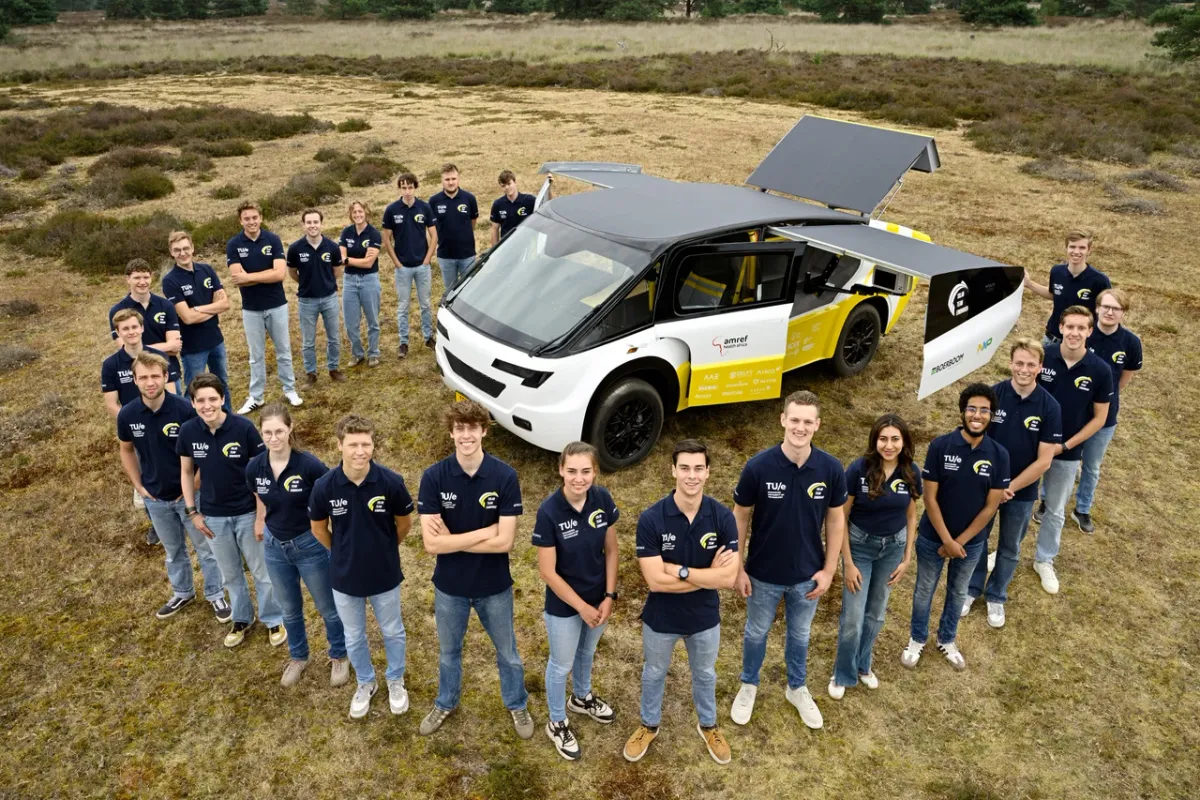
Solar Team Eindhoven builds a new solar vehicle every two years. Their previous projects have won the World Solar Challenge in Australia four times in the family car class. In 2021, they built the Stella Vita, a solar-powered camper, and drove it across Europe.
In 2015, students built a solar family car. In 2023, another group drove the Stella Terra, the world’s first off-road solar car, 1,000 km (more than 600 miles) from northern Morocco to the Sahara.
The Stella Juva will undergo field testing in Kenya this month. Solar Team Eindhoven is working with the non-profit Amref Health Africa. They will test the vehicle in real medical situations across challenging terrain. The team hopes this project will help shape the future of rural healthcare worldwide.
Deep Dive & References: Solar Team Eindhoven