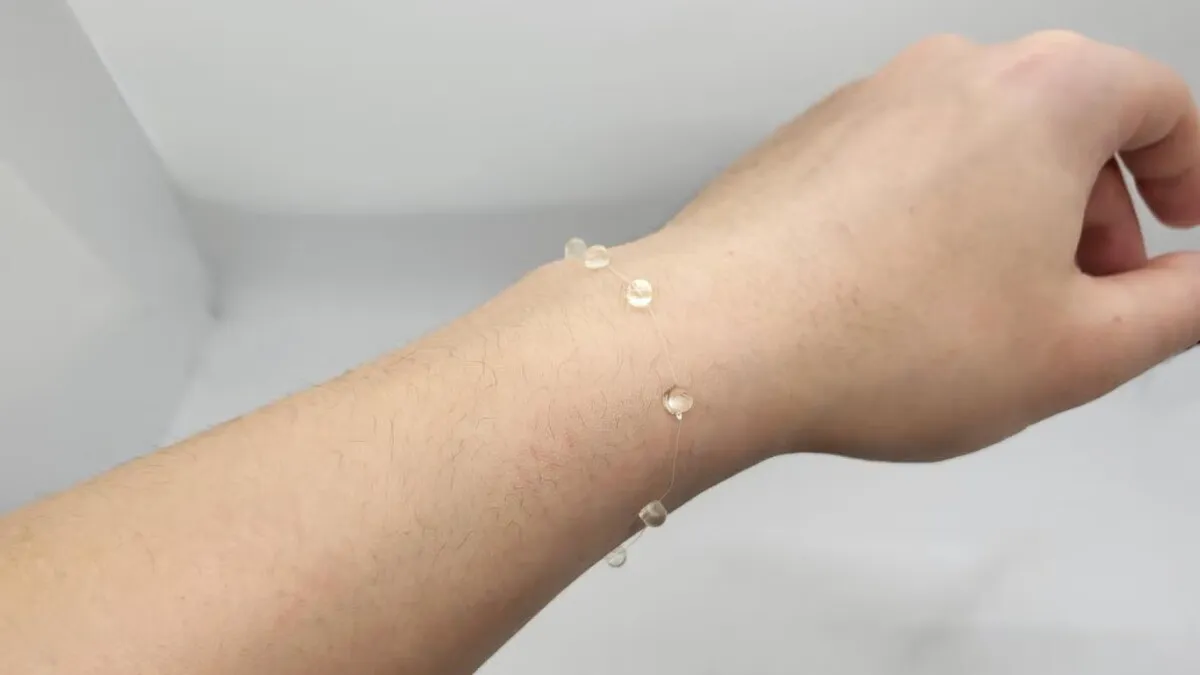
Some people feel uncomfortable using technology if it draws attention to them. This feeling can be even stronger when the technology is for medical monitoring.
Researchers at Tufts University have developed a new wearable technology that is so small and flexible, users barely notice it. This innovation, called "thread-ectronics," could make medical monitoring much more discreet.
Introducing Thread-ectronics
While many Americans use smart rings and watches for health tracking, Tufts' breakthrough is in smart threads. These are tiny, flexible electronic circuits.
We're a new kind of news feed.
Regular news is designed to drain you. We're a non-profit built to restore you. Every story we publish is scored for impact, progress, and hope.
Start Your News DetoxProfessor Sameer Sonkusale and his team described their work in Applied Materials and Interfaces. They created these thread-ectronics using sensors, transistors, and other components.
To show how well they work, the team demonstrated that these sensors could pick up subtle body signals. For example, a sensor near the temple could detect blinking, and one on the chest could track breathing changes. These signals could indicate stress or illness.
These thread-ectronics are designed to be flexible. They can coil, stretch, and bend without breaking. This means they can be easily integrated into clothing like athletic wear or work uniforms. They can even be attached directly to the skin to monitor health or improve athletic performance.
Sonkusale explained that moving electronics from flat patches to free-form threads opens new possibilities for wearable bioelectronics. He said they are "more like fibers than hardware."
How Thread-ectronics Work
This new medical technology is designed to move naturally with the body. This is different from older, rigid monitoring devices that required people to adapt their movements. Sonkusale noted that thread-ectronics could even be used like sutures to monitor internal body processes. They could also track breathing in adults and infants, assess fall risks, and create movement profiles to identify physical and cognitive decline.
Thread-ectronics contain flexible micro-transistors attached to gold-coated filaments. These transistors are partly made from a plastic-like conductor. This conductor connects the gold-coated filaments, allowing them to control the flow of electrons.
The system also uses eutectogels. These create a tiny gap between the thread-ends to manage electron flow through resistors, capacitors, or other parts. While cutting the threads will destroy them, eutectogels are stable and soft enough for skin contact. Transistors can even be repaired by applying low heat.
Manufacturing thread-ectronics does not require the complex, high-temperature processes or clean rooms typically used for integrated circuits. Because they work well with textile materials and soft polymers, future production should be low-cost.
Wenxin Zeng, the lead author and a Tufts electrical engineering PhD candidate, said the technology is still in its early stages. However, the team expects to improve fabrication speed and precision. They also aim for the thread-based circuits to perform more complex functions.
Tufts' thread-ectronics join other new medical monitors, such as paintable tattoos and skin stickers.
Deep Dive & References
Devising the Complex Integrated Circuits of Thread-ectronics from Sensors, Transistors, and Other Components - Applied Materials and Interfaces, 2016