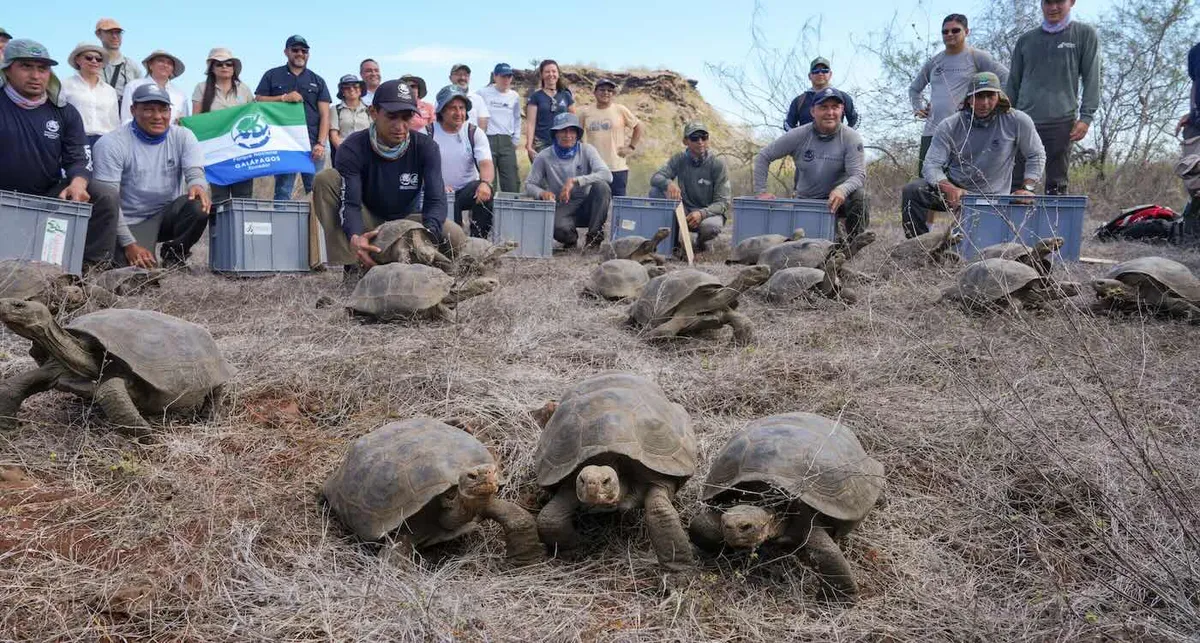
For the first time since the 1840s, giant tortoises are walking Floreana Island again. This week, 158 juvenile tortoises were released into their ancestral habitat—the largest rewilding effort the Galápagos has ever attempted.
The Chelonoidis niger niger vanished from the island generations ago, hunted to extinction by whalers and early settlers. Their return represents something quieter than rescue: it's the careful undoing of a loss, built on 15 years of genetic detective work and breeding programs that tracked down the last living descendants of the Floreana lineage on a distant volcano.
How a Lost Species Came Home
In the early 2000s, researchers studying tortoises on Wolf Volcano—hundreds of miles away on Isabela Island—made an unexpected discovery. Some of these animals carried Floreana ancestry in their DNA, likely descendants of tortoises offloaded by whaling ships centuries ago. That genetic thread became the foundation for everything that followed: a carefully managed breeding program that raised a new generation as close as possible to the original population.
We're a new kind of news feed.
Regular news is designed to drain you. We're a non-profit built to restore you. Every story we publish is scored for impact, progress, and hope.
Start Your News Detox"By identifying tortoises with Floreana ancestry and breeding their descendants, we are returning this species in a form that closely reflects the original lineage," said Hugo Mogollón, President of Galápagos Conservancy. It's the kind of work that doesn't make headlines until the moment it does—years of lab analysis, breeding records, and patient waiting compressed into one week of releases.

Why This Island Matters
Floreana is home to about 160 people who depend on the island's health—through fishing, agriculture, and tourism. They've been central to this project from the start, joining planning workshops and committing to long-term monitoring. Their involvement isn't decoration; it's the reason this works. "Their return shows what is possible when a community leads and many partners come together with a shared purpose," said Verónica Mora, the community's representative.
The island has already seen one rewilding success: the Galápagos Rail, a rare bird, was rediscovered after vanishing since Charles Darwin's visit. The tortoises are expected to accelerate that recovery.

An Ecosystem Rebuilt from the Ground Up
Giant tortoises are what ecologists call a keystone species—remove them and the whole system shifts. For 180 years, Floreana evolved without them. The tortoises shaped vegetation, dispersed seeds, created wallows that became micro-habitats, and maintained the open landscapes that other species depend on. Their absence altered ecological processes in ways that rippled through the island.
Their return won't fix everything overnight, but it sets off a chain reaction. "By dispersing seeds, shaping vegetation, and influencing how landscapes regenerate, they help rebuild ecological processes that many other species depend on," said Rakan Zahawi, Director of the Charles Darwin Foundation. The next phase includes reintroducing the Floreana Mockingbird, racer snake, Vegetarian Finch, and Little Vermilion Flycatcher—species that have been waiting for the habitat to be ready.
There's also a marine angle. Healthy seabird populations, supported by improved nesting and feeding conditions, contribute nutrients to surrounding ocean ecosystems. Better coral reefs and fisheries follow.

Floreana will become the largest ecological restoration project ever undertaken in the Galápagos—a place where nature recovery and human livelihoods are strengthening together. The next phase of rewilding is already being evaluated. What happens here matters beyond these islands: it's a template for what's possible when local communities, global expertise, and sustained commitment align around a shared vision.