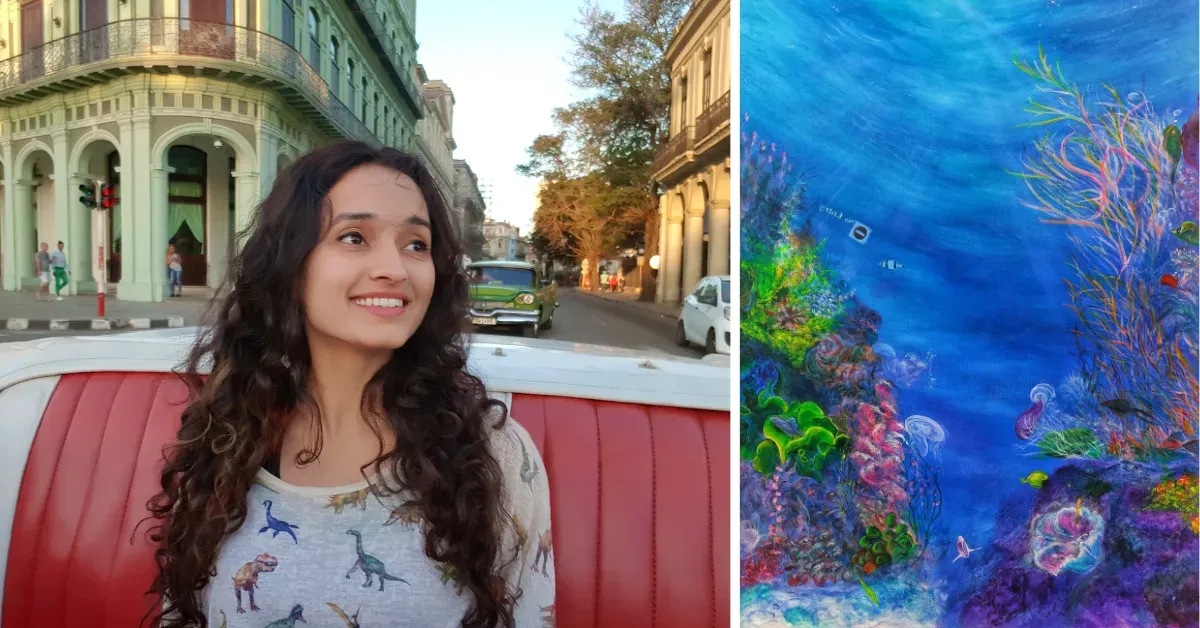
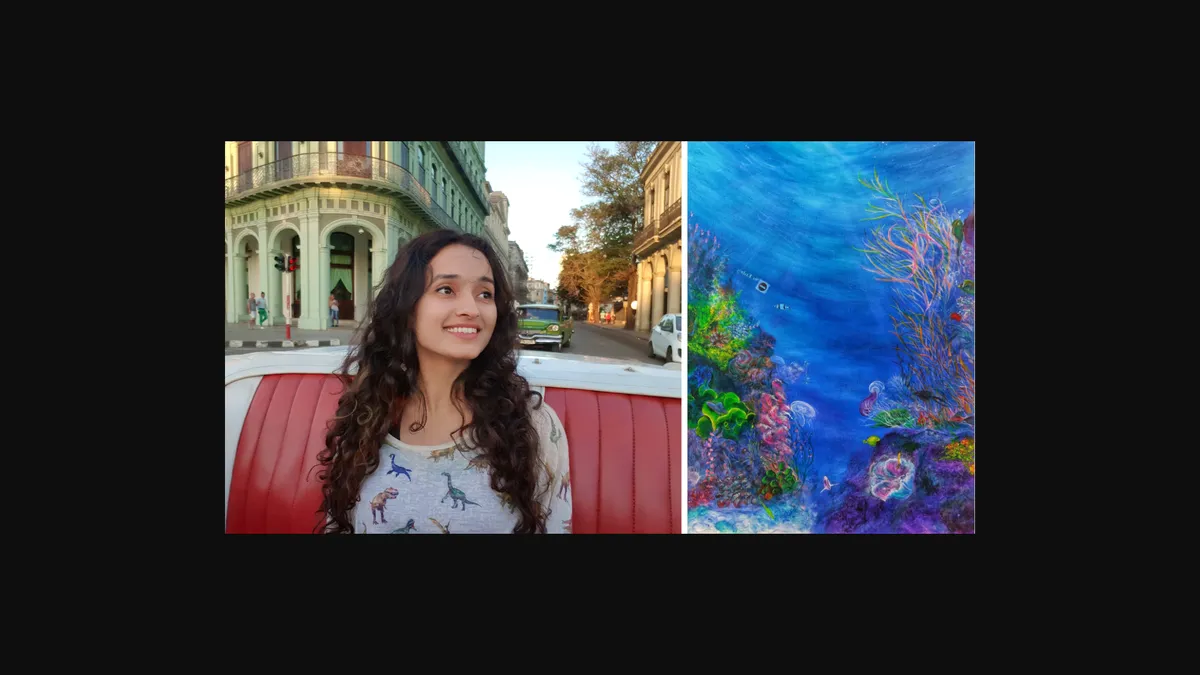
Namita Kulkarni, a self-taught artist from Bengaluru, had no formal art training. Yet, her paintings will be shown at the United Nations in New York in June and July. This opportunity came after she responded to a Facebook post in December 2021.
The International Centre for Advocates Against Discrimination (ICAAD), a human rights group in New York, commissioned her series. Namita was chosen along with four other artists globally.
/english-betterindia/media/media_files/2026/05/07/featured-img-1-2026-05-07-19-34-52.png)
We're a new kind of news feed.
Regular news is designed to drain you. We're a non-profit built to restore you. Every story we publish is scored for impact, progress, and hope.
Start Your News DetoxFrom Childhood Dream to Global Stage
Namita was seven when she first heard the word "artist." She felt strongly that she wanted to be one. More than two decades later, her dream came true.
After being selected by ICAAD, Namita spent two months studying human rights. She read extensively and created paintings that explore our connection to nature. Her work draws from indigenous perspectives on water, forests, oceans, and the earth.
Namita primarily uses watercolor and acrylics. Watercolor is her favorite because it is unpredictable and full of surprises. She believes painting helps her understand herself, heal, and turn pain into power.
Water as Family
One painting in the series was inspired by Pat McCabe, a Diné (Navajo) activist and ceremonial leader. McCabe, also known as Woman Stands Shining, views water not as a resource but as a relative. She sees it as a sister to whom one can sing prayers.
The painting shows a lone figure with open arms, embraced by the ocean. Gold dust, made from real gold leaf, rises into the night sky. Namita noted that indigenous worldviews offer profound wisdom. Reading Sand Talk: How Indigenous Thinking Can Save the World by Tyson Yunkaporta also influenced her. These ideas form the philosophical core of her series.

Life in a Dying Tree
This painting is one of the most personal and unique in the series. It features real pressed flowers blooming from a painted tree stump. A luminous watercolor forest surrounds it, and a golden spider's web catches light. Namita spent three days creating it.
The inspiration came from two sources. One was a line from Richard Powers' novel The Overstory: "A dead tree is an infinite hotel." The other was mythologist Michael Meade's idea of Apocalypsis, meaning collapse-renewal. This suggests new life is present even as things fall apart.
The painting shows a tree stump, often seen as dead, as a vibrant "infinite hotel." It teems with mushrooms, moss, insects, and petals. This illustrates that collapse and renewal happen simultaneously.

The Meaning of Yaaté
Yaaté is a Diné word that Namita learned from Pat McCabe. McCabe explained it as the feeling of awe when two people witness something magnificent in nature, like a waterfall, and share that wonder.
The painting depicts two small figures on a hilltop, arms raised towards a large blue flower against a warm sky. It represents shared wonder and the recognition that life is extraordinary.
Namita noted that in this tradition, the first greeting exchanged is an expression of awe for life. This suggests a different way of moving through the world, one focused on wonder.

One Glass of Water for 18 Countries
This painting features a crystal glass, half full, with a twig of eighteen wilting leaves. Each leaf represents one of the eighteen countries predicted to face the global water crisis first, according to the Water Poverty Index.
The title, "Thirst," is a play on "third" and "first." Namita suggests this hints that water scarcity affects everyone, regardless of wealth. Countries like the United States, United Kingdom, Zambia, Myanmar, and Paraguay are shown as fragile leaves on a common twig. They are all dependent on the same water source and running out of time.
Namita sees art as a powerful way to convey urgent messages without shouting.

Beauty That Needs No Visitors
"Once Upon a Reef" is the most visually rich painting and a quiet protest. It shows a vibrant underwater world with detailed coral, jellyfish, fish, and sea fans. The scene is breathtaking.
Hidden within the painting are two small human-made objects: a "No Entry" sign and an SOS signal. Namita says these are ironic reminders that humans do not belong in places where reverence is due.
This painting is the most hopeful in the series. It depicts a world that is still intact, luminous, and alive. It also makes an urgent plea: some things should be left untouched, allowing their wonder to simply exist.
Namita's journey shows that even without formal training, art can make a significant impact. Her work, once a personal exploration, is now reaching a global audience at the United Nations.