

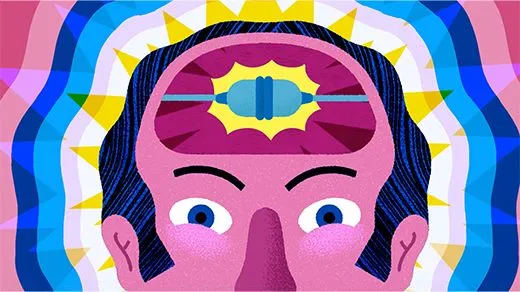
You're staring at three words—pine, crab, sauce—trying to find the fourth word that connects them all. Then suddenly, without warning, it arrives. The answer just clicks. Your brain feels it before your conscious mind catches up.
This is insight, and neuroscientists have started mapping exactly what happens in your skull when it strikes.
Maxi Becker, a cognitive neuroscientist at Duke University, became obsessed with this question after reading Thomas Kuhn's The Structure of Scientific Revolutions. "He describes how some ideas are so powerful that they can completely shift the way an entire field thinks," she says. "That got me wondering: How does the brain come up with those kinds of ideas? How can a single thought change how we see the world?"
We're a new kind of news feed.
Regular news is designed to drain you. We're a non-profit built to restore you. Every story we publish is scored for impact, progress, and hope.
Start Your News DetoxTo study insight in the lab, Becker's team used Mooney images—photographs with contrast cranked so high that the subject becomes invisible. Participants sat in an fMRI scanner over two days, viewing these scrambled images until the hidden object suddenly resolved in their mind.
What the brain does during an "aha" moment
When recognition hit, the scanner revealed a surge of activity in three regions: the ventral occipitotemporal cortex (the part that processes visual meaning), the amygdala (emotion), and the hippocampus (memory formation). The stronger this activity spike, the more certain and emotionally positive the insight felt—the more "aha" about it.
The hippocampus is particularly interesting here. It's sometimes called the brain's "mismatch detector" because it fires when reality contradicts expectation. An insight is essentially that collision: a meaningless blur suddenly becoming a coherent image, defying what your brain predicted it would see.
But here's where it gets practical. A few days later, the researchers tested whether participants remembered the Mooney images. They did—and the ones with the biggest activity spikes in the VOTC and hippocampus during the original insight remembered them best. That sudden burst of brain activity doesn't just feel good; it stamps the memory deeper.
This matters beyond neuroscience curiosity. The implication is that insight-based teaching strategies might actually work better than incremental instruction. If an insight creates stronger, more durable memories, then helping students toward those moments could change how classrooms function.
There's one caveat worth noting: insight feels good and tends to be right, but false insights exist. The certainty and pleasure of a sudden realization doesn't guarantee accuracy. Your brain can click on the wrong answer just as confidently as the right one.
Still, the research suggests insight is doing something real—creating memories that stick, building confidence, and occasionally reshaping entire fields of thought. The next time an answer arrives unbidden, your brain is doing something measurable and worth paying attention to.





