For over forty years, iceberg A-23A drifted through the Weddell Sea—spinning in ocean vortexes, nearly colliding with islands, surviving what should have killed it long ago. By early 2026, as it finally moved into warmer waters and began to break apart, this frozen giant delivered one last gift: it sparked a visible explosion of microscopic life across the South Atlantic.
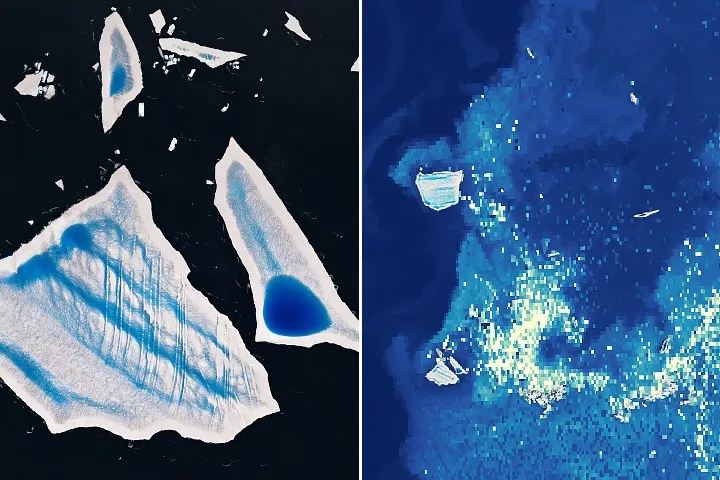
In January 2026, as A-23A fragmented, NASA satellites caught something remarkable. The disintegrating ice released plumes of meltwater that triggered a phytoplankton bloom so extensive it showed up clearly in satellite imagery—a spreading swirl of chlorophyll visible from space. These microscopic organisms aren't just pretty to look at from orbit. They form the foundation of ocean food webs and produce roughly half of Earth's oxygen. A single dying iceberg, it turned out, could reshape the living ecosystem around it.
The Iceberg as Ocean Fertilizer
The South Atlantic is a strange place for life to thrive. Sunlight and nutrients are scarce. Winds churn the water constantly, mixing phytoplankton down into darkness where they can't photosynthesize. But when an iceberg melts, it solves both problems at once.
We're a new kind of news feed.
Regular news is designed to drain you. We're a non-profit built to restore you. Every story we publish is scored for impact, progress, and hope.
Start Your News DetoxMeltwater creates a stable surface layer—calmer water where phytoplankton can stay near the light. More crucially, the ice carries nutrients locked inside it. As it melts, iron pours out—a mineral that's often scarce in these waters but essential for microscopic life. Icebergs also release manganese and compounds like nitrates and phosphates, nutrients they've accumulated over decades from windblown dust and contact with Antarctic bedrock. It's like a slow-motion fertilizer truck melting into the ocean.
Grant Bigg, an oceanographer at the University of Sheffield who has spent years studying iceberg-phytoplankton interactions in this region, watched the satellite data unfold. The bloom was "too big and too clearly spreading from the icebergs not to be strongly linked to them," he observed. While phytoplankton blooms do occur naturally in these waters, the connection between A-23A's disintegration and this surge persisted for weeks—clear evidence the iceberg had triggered the response.
When NASA's PACE satellite examined the bloom on January 25, researcher Ivona Cetinić used specialized analysis to identify which types of phytoplankton were thriving. Picoeukaryotes—tiny organisms that respond quickly to temperature and nutrient shifts—were flourishing. To the west, larger cyanobacteria called Synechococcus swirled in the water. The smaller ice fragments seemed to trigger the most intense blooms, possibly because they melted faster and released nutrients more rapidly.
But there's a hidden complexity here. Oceanographer Heidi Dierssen from the University of Connecticut notes that satellite algorithms sometimes struggle near bright ice surfaces—they might actually be underestimating phytoplankton concentrations near the largest bergs. The bloom might be even more productive than the data suggests.
A Ripple That Stretches for Months
The impact of a single melting iceberg extends far beyond the immediate weeks. Research suggests icebergs may account for up to one-fifth of the Southern Ocean's total carbon sequestration in recent years. Other studies found that water trailing an iceberg is roughly one-third more likely to show elevated phytoplankton compared to surrounding ocean. These blooms can persist for more than a month after an iceberg passes, leaving trails of enhanced productivity stretching hundreds of kilometers.
Those blooms attract fish, seabirds, and marine mammals—icebergs essentially become oases of abundance in a sparse ocean. A-23A's legacy isn't just written in satellite data. It's already rippling through food webs, nourishing creatures that depend on these pulses of life.
By early March 2026, A-23A had shrunk below the official size threshold for tracking, though NASA confirmed it continued shedding mass. How much longer it will fertilize the ocean before dissolving completely remains uncertain. But its role as a catalyst for life—one final act of a forty-year journey—is already etched in the water.