


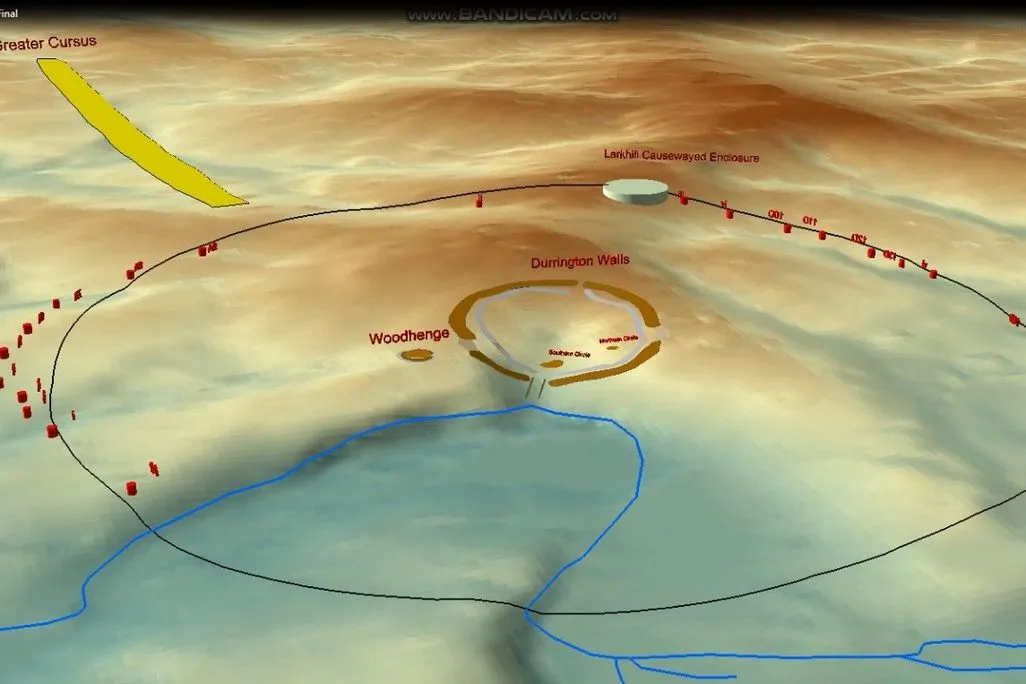
Near Stonehenge, archaeologists have spent years staring at a puzzle buried under English soil. At Durrington Walls, a Neolithic settlement in southern England, they found more than a dozen massive pits—each roughly 30 feet wide and 15 feet deep—arranged in a near-perfect circle stretching a mile across the landscape. For years, the question hung unanswered: Did humans dig these, or had nature done the work through sinkholes and geological shifts?
A new study published in Internet Archaeology settles the debate. The pits are unmistakably human-made, likely dug during the Late Neolithic period around 4,000 years ago. "They can't be occurring naturally," says Vincent Gaffney, the archaeologist leading the research at the University of Bradford. "It just can't happen. We think we've nailed it."
How they figured it out
The team didn't just walk the site and make assumptions. They returned with an arsenal of modern tools: electrical resistance tomography to map the pits' depths, radar and magnetometry to trace their shapes, and core samples analyzed for optically stimulated luminescence—a technique that reveals when soil was last exposed to sunlight. They even hunted for traces of ancient DNA. The convergence of evidence was clear: humans had engineered this landscape with intention.
We're a new kind of news feed.
Regular news is designed to drain you. We're a non-profit built to restore you. Every story we publish is scored for impact, progress, and hope.
Start Your News Detox
What makes this discovery genuinely striking is the precision involved. The pits are evenly spaced around the circle, suggesting the Neolithic people who built them had developed methods to measure and coordinate their work across a mile-wide area. "The skill and effort that must have been required to not only dig the pits, but also to place them so precisely within the landscape is a marvel," says co-author Richard Bates, a geophysicist at the University of St Andrews. For a society working without modern surveying equipment, achieving a near-perfect circular pattern across such a vast distance points to sophisticated planning and mathematical understanding.
The pits likely served as a sacred boundary marking Durrington Walls, a gathering place for Neolithic communities. Gaffney suggests the circle may have been an attempt to connect with the underworld or inscribe cosmological beliefs directly into the earth. The structures weren't hastily dug and forgotten—they were part of a "structured, monumental landscape that speaks to the complexity and sophistication of Neolithic society," Gaffney explains.
What's remarkable is that this may be one of Britain's largest prehistoric structures, rivaling Stonehenge itself in ambition and scale—yet it's been hiding in plain sight, invisible until archaeologists had the tools to see it. The next questions—who exactly built it, what rituals took place there, what deeper meaning the circle held—remain open. But the fact that these questions can now be asked with confidence marks a genuine shift in how we understand Neolithic Britain.





