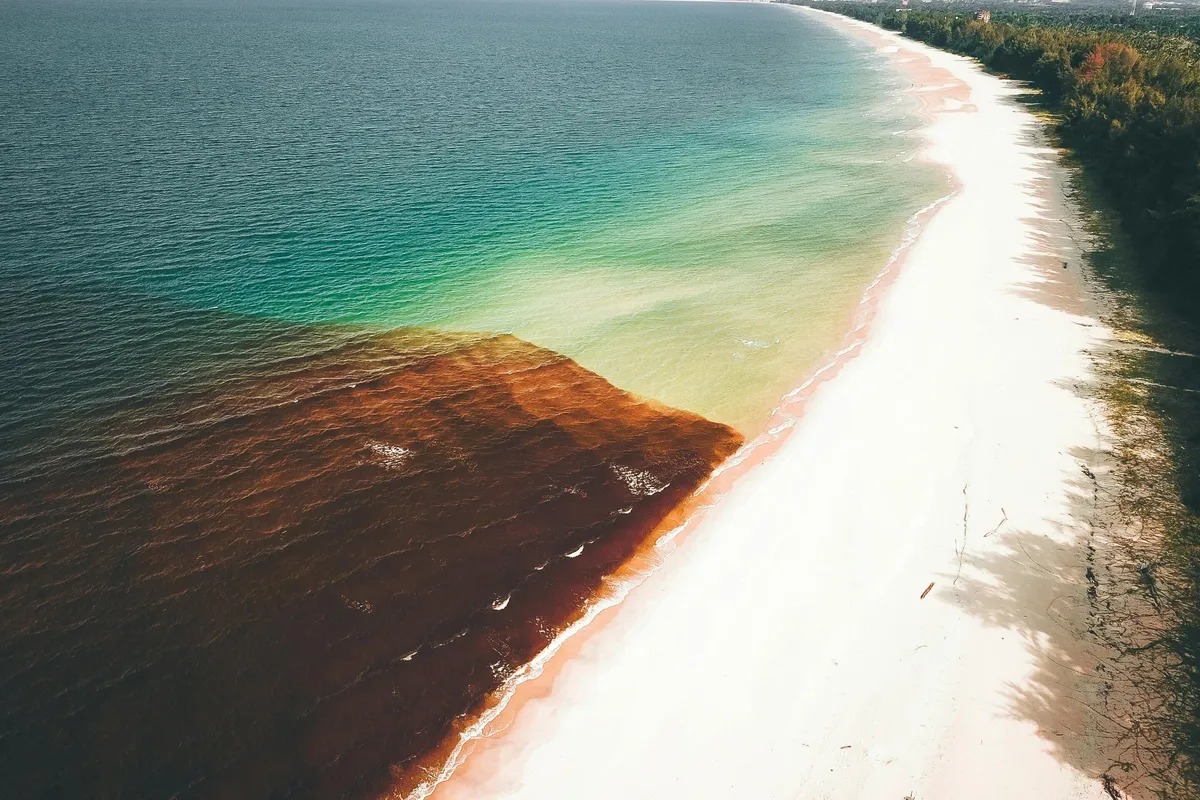
Every year, the coasts of the Caribbean, Gulf of Mexico, and West Africa get hit with a truly epic amount of Sargassum seaweed. We're talking thick, stinky mats that choke beaches, gum up fishing nets, send tourists packing, and release some truly unpleasant gases as they rot. Cleaning this stuff up costs hundreds of millions of dollars annually, which, if you think about it, is a lot of money to spend on something that just grows back.
What started as an environmental surprise has become a yearly headache. But a new study, led by CMCC scientist Annalisa Bracco, suggests this massive green problem might actually be a massive green opportunity. Their research indicates these vast Sargassum blooms aren't going anywhere — and, crucially, they're becoming predictable.
This is big, because if you can predict a problem, you can start turning it into a solution. We're talking about using all that seaweed for things like pulling carbon dioxide out of the ocean or even brewing up some biofuels.
We're a new kind of news feed.
Regular news is designed to drain you. We're a non-profit built to restore you. Every story we publish is scored for impact, progress, and hope.
Start Your News DetoxThe Belt That Just Keeps Growing
The Great Atlantic Sargassum Belt first made its grand entrance in 2011. Since then, it's ballooned into a system stretching over 8,000 kilometers from West Africa to the Caribbean. By 2025, it weighed in at over 37 million tons. To put that in perspective, that's roughly six times the total body weight of everyone living in Italy. Let that satisfyingly absurd number sink in.
While this growth has been a nightmare for coastal communities, it also means there's a colossal, natural store of carbon just floating around, captured through photosynthesis.
As Bracco points out, "Sargassum absorbs large amounts of carbon dioxide as it grows." The catch? "The main problem is that when it reaches the coast and breaks down, much of that carbon goes back into the air. If we can act before this happens, this system could actually help solve the problem."
Initially, the blooms were driven by strong winter winds stirring up nutrients. But over time, the study found, this floating city of seaweed became a self-sustaining ecosystem. It now hosts marine organisms that recycle nutrients, especially nitrogen, right within the mats. Plus, decaying algae just feed more nutrients back into the water.
Which means it's become a self-sufficient nitrogen factory, allowing it to grow even without those strong winds. Because apparently that's where we are now: giant, self-sustaining seaweed monsters.
Future Forecast: More Seaweed, With a Chance of Solutions
The researchers used satellite images and ocean data to model Sargassum changes from 2011 to 2022. Then, they successfully predicted the amounts for 2023 and 2024. This ability to forecast is a massive leap forward, turning an uncertain future into something manageable.
The study also makes it clear that a natural decline isn't on the horizon. This belt is here to stay, and it's largely sustaining itself. Which means we need long-term plans. The good news is that its predictability offers a chance to transform it from a stinky menace into a valuable resource. Imagine harvesting it offshore to store carbon deep in the ocean, or converting it into biofuels and other materials. It could cut emissions and cleanup costs. Two birds, one giant seaweed blob.
"It's a clear example of how the ocean can change itself very quickly," Bracco observed. "What started because of wind has become a self-sustaining biological system. The fact that we can now understand and predict it means we can also start thinking seriously about how to manage it."
So, for leaders, investors, and coastal nations, the science is in: the Sargassum is coming. But now, we can actually prepare, and perhaps, even profit from it.