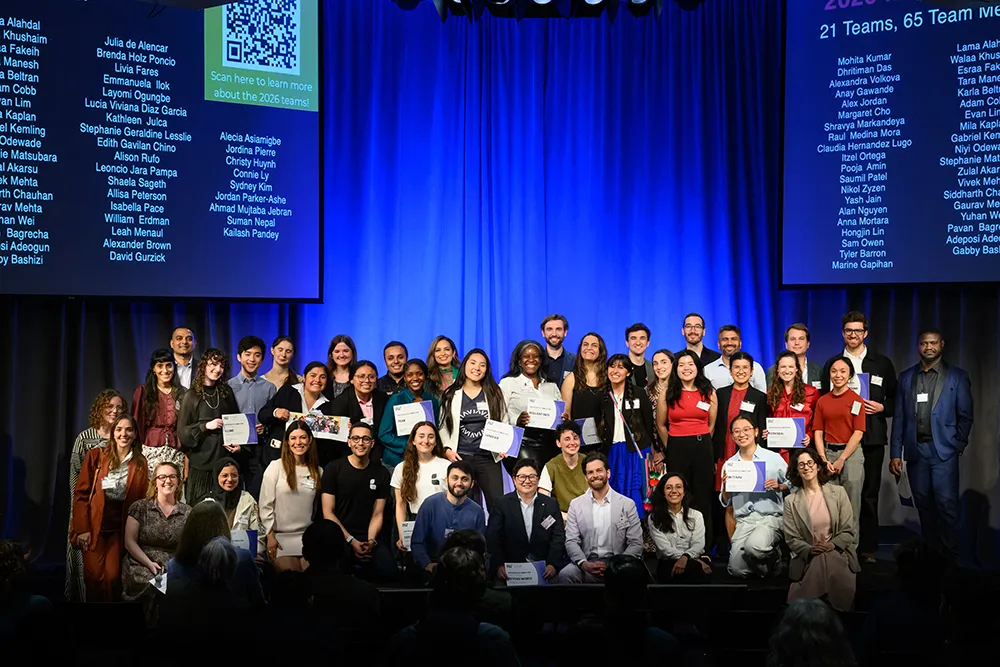
You know how sometimes a good idea starts in a dorm room? At MIT, those ideas often grow up to solve actual global problems. The IDEAS Social Innovation Incubator just celebrated its 25th anniversary, showcasing how students turn their tech smarts into real-world impact.
Over two decades, the Priscilla King Gray (PKG) Center's IDEAS Incubator has launched hundreds of social ventures in more than 60 countries. We're talking everything from energy and climate to healthcare and economic development. Because apparently, solving complex global challenges is just another Tuesday at MIT.
Lauren Tyger, assistant dean for social innovation, put it best: IDEAS teaches founders to think big — about entire systems and community-based innovation. The goal? Creating business models that are both financially stable and actually make a difference. Imagine that.
We're a new kind of news feed.
Regular news is designed to drain you. We're a non-profit built to restore you. Every story we publish is scored for impact, progress, and hope.
Start Your News DetoxFrom Pillboxes to Policy Shifts
The anniversary event wasn't just about the new crop of innovators; it was a chance to look back. Alumnus Bill Thies gave a keynote, sharing a story that sounds like something out of a medical drama, but with a much better ending.
Thies started with a simple, low-cost electronic pillbox for tuberculosis patients in India. Fast forward, and his work helped shift India's treatment policies to focus on patient autonomy. This eventually led to Nikshay, a national electronic medical records platform that now supports 150 million people. Let that satisfying number sink in. He made a pillbox, and it helped change a country's healthcare system. If that's not impact, what is?
Thies observed that these small innovations can open the door for massive changes, asking how technology can help create more human-centered policies. He also dropped some wisdom: "the projects are incubating us. We are the ones who will ultimately drive the change we hope to see in the world." Which, if you think about it, is both impressive and slightly terrifying.
Alison Badgett, director of the PKG Center, shared her vision for IDEAS: expanding social entrepreneurship at MIT and better preparing student founders for life after graduation. And because even world-changing ideas need a little seed money, she announced a $150,000 gift from the Morgridge Family Foundation. This will help build a social impact investor network at MIT, connecting future changemakers with the funds they need. Because "aspiring entrepreneur" should absolutely be a viable career path.
The Latest Crop of World-Changers
This year's top $20,000 award went to Beyond Words, an iPhone and Apple Watch app for nonverbal people. It captures biometrics, audio, and location data to share with caregivers — a genuinely clever way to give a voice to those who need it most.
Other winners included:
- AyuConnect ($10,000): Using WhatsApp for voice-first electronic health records in India. Because everyone deserves easier access to care, even without fancy apps.
- PEAR ($7,500): A hands-on STEM research program for African students, teaching them to solve community problems. Smart kids, real solutions.
- CommonGround ($5,000): Connecting Bostonians to local climate actions. Think of it as a localized LinkedIn for saving the planet.
- Sehat Screen ($5,000): An AI-powered device for cervical cancer screening, specifically for women in Afghanistan and other resource-limited countries. Practical, life-saving tech.
- Sero ($2,500): A voice-first AI tool for rural borrowers in Nepal, helping them understand loan contracts in their own language. Because financial literacy shouldn't require a law degree.
The MIT Climate Project also announced new Climate Student Innovators awards, funding teams like Q’ochas Resilientes ($15,000), which works with communities in the Peruvian Andes on climate-resilient water technology, honoring ancestral knowledge. Also, NECTICA ($15,000), addressing urban flooding in Lagos by empowering women-led cooperatives with low-tech bins for composite waste. Because climate change solutions can be simple, effective, and empowering.
And then there were the $1,000 awards, for ideas like Homeroom Hero, an AI tool for teachers that instantly grades short assessments (because teachers have enough on their plates), and Illume, which makes discreet wearables for human trafficking victims to contact trusted people. These are the kinds of innovations that don't just optimize, they truly help.
As the event wrapped, Lauren Tyger highlighted that IDEAS builds more than just social enterprises. It builds the infrastructure and community needed for lasting impact. The vision? For MIT entrepreneurship to be not just groundbreaking, but deeply, meaningfully grounded in social impact. And really, what could be more inspiring than that?