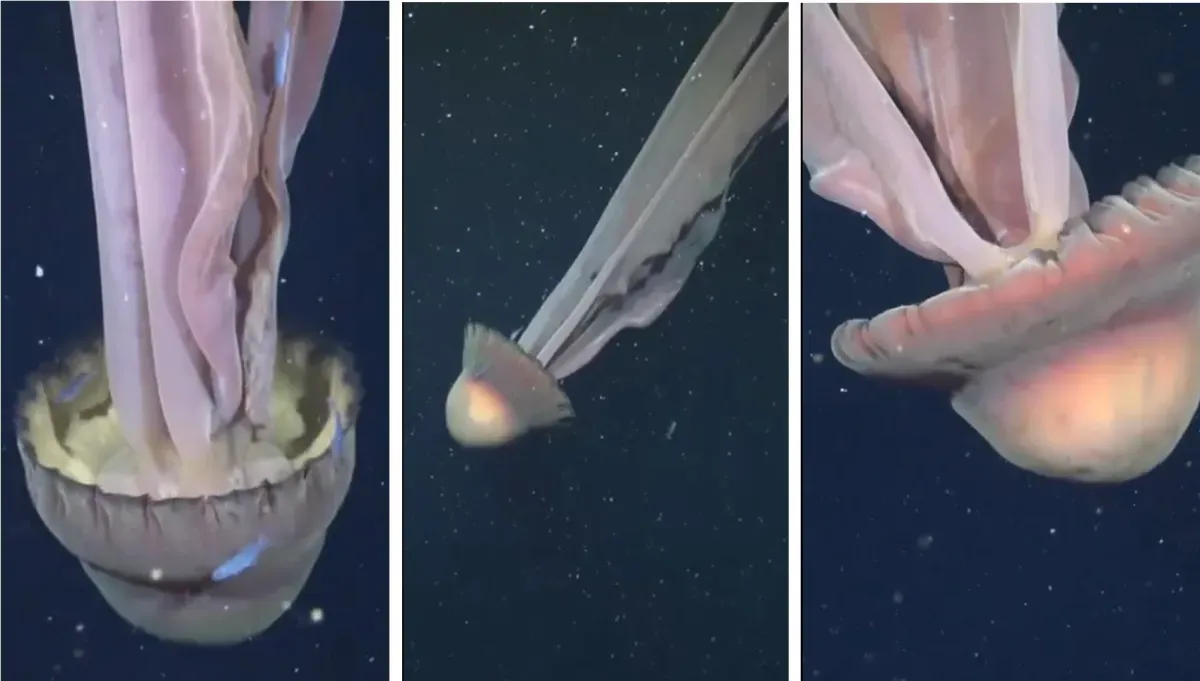
A giant phantom jelly drifting through the Pacific depths is rarer than you might think. Schmidt Ocean Institute researchers spotted Stygiomedusa gigantea—a creature so elusive that only about 118 have been documented in 110 years—hovering near the Colorado-Rawson submarine canyon wall off Argentina during a winter dive. The encounter happened roughly 830 feet below the surface, captured by a remotely operated vehicle exploring the canyon's steep walls.
These jellyfish are strange enough to justify the rarity. A giant phantom jelly can stretch 33 feet long with a body span of 3.3 feet across. Instead of the stinging tentacles most jellyfish wield, they have four long oral arms that work more like fishing nets—grabbing prey and guiding it toward their mouth. The design makes sense for the Midnight Zone, that part of the ocean between 3,300 and 13,100 feet down where sunlight never reaches and shelter is almost nonexistent.
What makes these sightings valuable isn't just the rarity. Each encounter reveals how deep-sea creatures actually live. Researchers from the Monterey Bay Aquarium Research Institute once watched a fish hovering directly above a giant phantom jelly, swimming in and out of its arms like the jellyfish was a floating apartment building. In an environment where solid ground and caves are scarce, a gelatinous body becomes real estate. Other creatures cluster around these jellyfish not out of symbiosis, but pure survival.
We're a new kind of news feed.
Regular news is designed to drain you. We're a non-profit built to restore you. Every story we publish is scored for impact, progress, and hope.
Start Your News DetoxThe phantom jelly's global distribution remains a mystery. Scientists believe they inhabit most of the world's oceans except the Arctic, yet they surface so rarely that mapping their actual range feels almost impossible. Each documented sighting—whether by accident or deliberate deep-sea exploration—adds another data point to an incomplete picture. The winter dive that captured this encounter is the kind of incremental progress that deep-sea science runs on: patient observation, rare luck, and the slow accumulation of evidence that the ocean still holds plenty of strangers.