

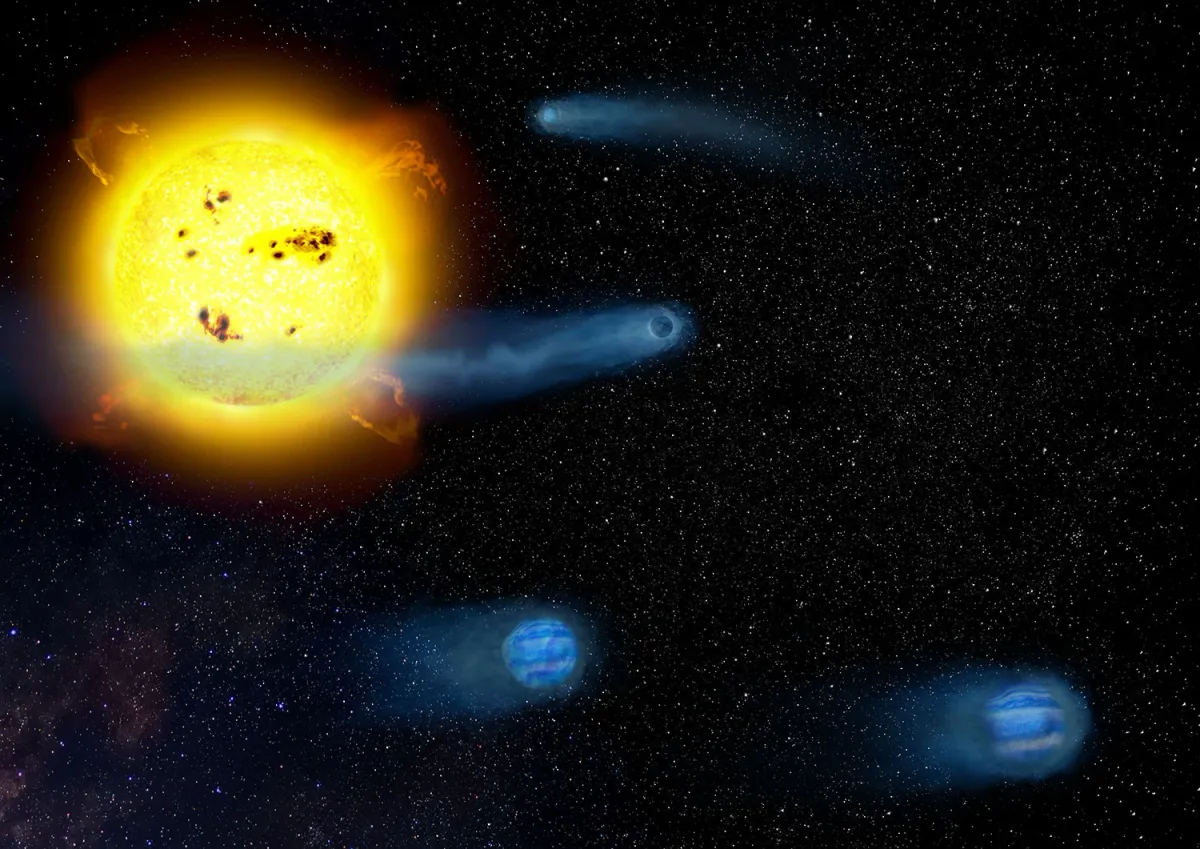
Astronomers have caught something rare: four enormous planets in the act of transforming. By watching a star system just 20 million years old—a newborn compared to our 4.5-billion-year-old Sun—researchers have finally measured what they've long suspected: these swollen worlds are losing their atmospheres and shrinking into the compact planets that fill the galaxy.
The system, V1298 Tau, orbits a young, energetic star with four giant planets circling it, each between Neptune and Jupiter in size. For a decade, researchers tracked these worlds using ground and space telescopes, watching for the moment each planet crossed in front of its star. These transits happen regularly, but the team noticed something telling: the timing kept shifting slightly. The planets' gravity pulls on each other, nudging their orbits ahead or behind the expected rhythm.
Those tiny timing shifts—called Transit-Timing Variations—gave the researchers what they needed: the planets' actual masses. And the numbers were surprising.
We're a new kind of news feed.
Regular news is designed to drain you. We're a non-profit built to restore you. Every story we publish is scored for impact, progress, and hope.
Start Your News DetoxCotton Candy Worlds
The planets measure 5 to 10 times Earth's radius, which sounds enormous. But they weigh only 5 to 15 times Earth's mass. That's the key. A dense planet would be heavy for its size. These planets are light for their size—so light they're barely there. "They are indeed exceptionally puffy," says Trevor David of the Flatiron Institute, who led the initial discovery. "This gives us a crucial, long-awaited benchmark for theories of planet evolution."
That puffiness tells a story. If a planet simply formed and cooled, it would be much smaller and denser than what the team observed. Instead, V1298 Tau's planets must have undergone something dramatic early on: they shed most of their original atmospheres in a burst, then cooled rapidly once the gas-rich disk around their young star dispersed. That loss of atmosphere is what makes them so fluffy now—like a balloon slowly deflating.
This matters because the most common planets discovered around other stars are small, compact worlds called super-Earths and sub-Neptunes. Scientists have puzzled over how those worlds form. V1298 Tau suggests an answer: they start as bloated giants and lose their outer layers over time. It's the missing link in planetary evolution—the moment between the chaotic star-forming nebulae we see everywhere and the mature, stable systems now numbering in the thousands.
"V1298 Tau is a critical bridge," says Erik Petigura of UCLA. It shows us the turbulent, transformative lives of young worlds in real time. Understanding how planets lose their atmospheres and shrink may also explain something closer to home: why our own solar system lacks the abundant super-Earths and sub-Neptunes found elsewhere in the galaxy.
The next step is clear. Astronomers will keep watching young planetary systems, looking for more snapshots of this transformation in progress.





