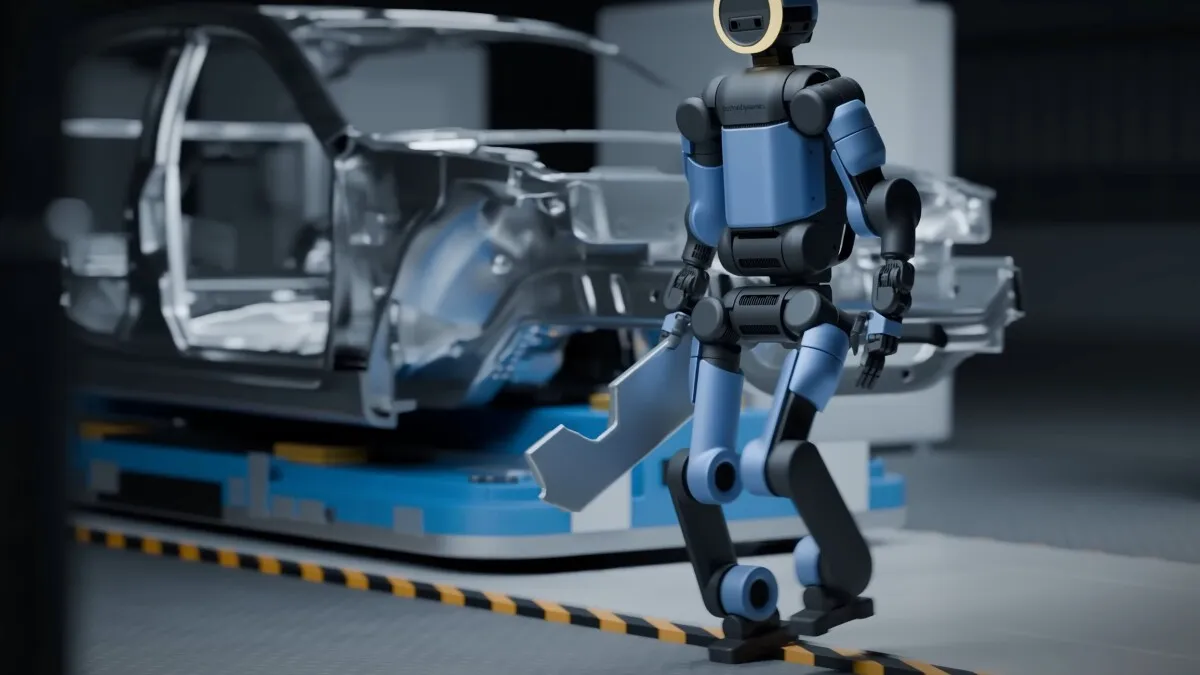
Boston Dynamics just rolled out the production version of Atlas, and it's heading to Hyundai's factories starting in 2026. This isn't a concept anymore — it's a 6.2-foot-tall robot built to actually work alongside humans on a factory floor.
Atlas can lift 110 pounds, swap its own battery in under three minutes, and operate in temperatures from -4°F to 104°F. That's the kind of spec sheet that matters when you're trying to fill a gap in a manufacturing line. The robot has 56 degrees of rotational freedom across its joints, which gives it the dexterity to handle real factory tasks — not just moving boxes, but manipulating objects with something closer to human precision.
What makes this different from earlier versions is the operating flexibility. Atlas can work autonomously, be controlled remotely by a human operator, or respond to tablet commands. Boston Dynamics partnered with DeepMind to build AI that lets the robot adapt to its environment, and here's the crucial part: new skills can be deployed across an entire fleet of robots at once. Train one Atlas to do something, and you can push that knowledge to hundreds of others.
We're a new kind of news feed.
Regular news is designed to drain you. We're a non-profit built to restore you. Every story we publish is scored for impact, progress, and hope.
Start Your News DetoxHyundai, which owns a majority stake in Boston Dynamics, is building a robotics facility capable of producing 30,000 robots annually. That's not just Atlas — it includes Spot robodogs and other systems — but it signals real manufacturing commitment. The company is betting that humanoid robots can address the labor shortages that have been squeezing automotive and electronics manufacturing globally.
Hyundai isn't alone in this calculation. UBtech, a Chinese robotics company, is already deploying its Walker S2 humanoid across automotive, manufacturing, and logistics. This is shaping up as a genuine global race to integrate humanoid robots into industrial work, with companies in South Korea, China, and the US all moving toward deployment rather than just research.
The practical question now is whether these robots can actually reduce the friction in factories where finding and retaining workers has become genuinely difficult. We'll get our first real-world answer in 2026.