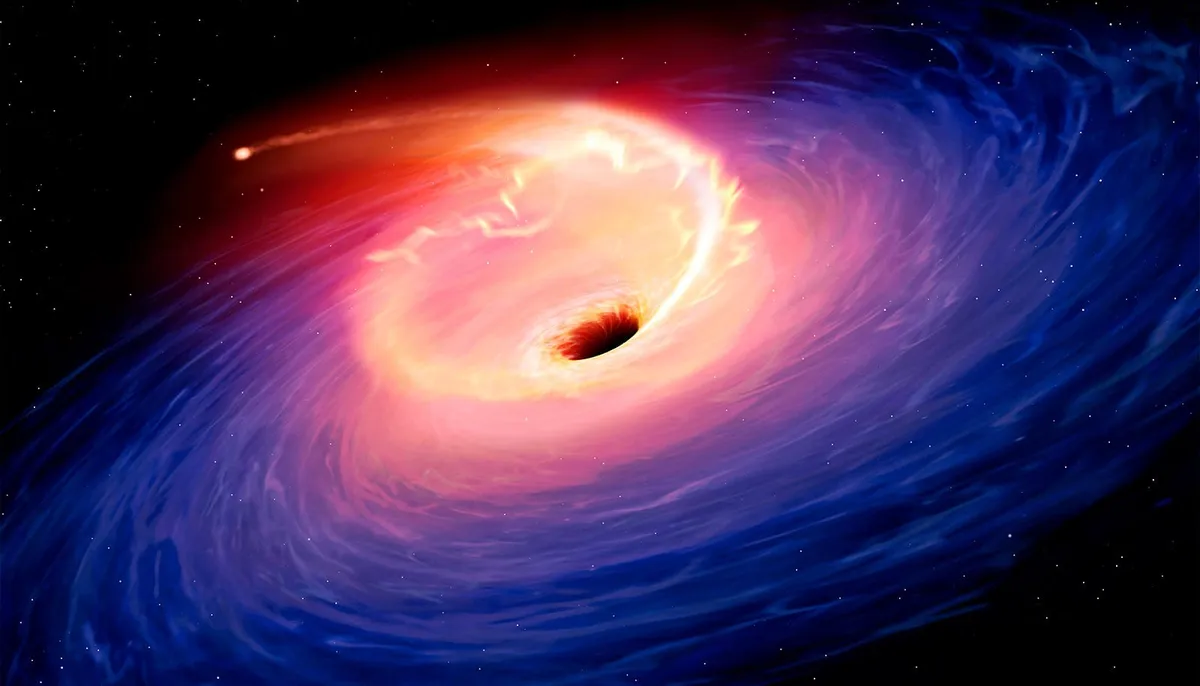
Dark matter decay might explain how giant black holes formed before the first stars. Astronomers have been puzzled by the existence of huge black holes, some as massive as a billion suns, appearing less than a billion years after the Big Bang. Standard theories suggest these black holes shouldn't have had enough time to grow so large.
Dark Matter's Role in Early Black Hole Growth
A new study, led by Yash Aggarwal from the University of California, Riverside, suggests that decaying dark matter could solve this mystery. The research, published in the Journal of Cosmology and Astroparticle Physics, shows that energy from dark matter decay could change the chemistry of early galaxies. This change might cause some galaxies to collapse directly into black holes instead of forming stars.
This idea is especially relevant now because NASA's James Webb Space Telescope is finding many unusually large black holes in the early universe. These could be examples of direct collapse black holes. Scientists previously thought this process was rare, needing specific conditions like nearby stars shining on pre-stellar gas.
We're a new kind of news feed.
Regular news is designed to drain you. We're a non-profit built to restore you. Every story we publish is scored for impact, progress, and hope.
Start Your News DetoxAggarwal's team looked beyond the usual explanations by including dark matter, which makes up about 85% of the universe's matter and helps form galaxies. They found that if dark matter decays, it can release a small amount of energy into the gas. This energy could significantly increase the rate at which direct collapse black holes form. Each decaying dark matter particle would only need to release a tiny amount of energy, far less than a single AA battery.
Aggarwal noted that this study suggests decaying dark matter could greatly impact how the first stars and galaxies developed. He believes this mechanism could help connect current theories with the observations from the James Webb Space Telescope.
Interdisciplinary Research and Future Implications
Flip Tanedo, a physics and astronomy professor at UCR and Aggarwal’s co-advisor, explained that the chemistry of the first galaxies, which were mostly hydrogen gas, is very sensitive to small energy injections at the atomic level. Tanedo, a coauthor, compared these early galaxies to "dark matter detectors," with the supermassive black holes we see today being their "signature."
The research team, including James Dent and Tao Xu, modeled how gas behaves with decaying axions, a type of dark matter. They found that dark matter particles with masses between 24 and 27 electronvolts could create the right conditions for direct collapse black holes.
Tanedo highlighted that this work came from a series of workshops that brought together particle physicists, cosmologists, and astrophysicists. He said that the right dark matter environment makes the "coincidence" of direct collapse black holes much more likely, just as interdisciplinary support made this research possible.
Deep Dive & References: Dark matter decays could be the missing ingredient explaining how giant black holes formed before the first stars - Journal of Cosmology and Astroparticle Physics, 2024