

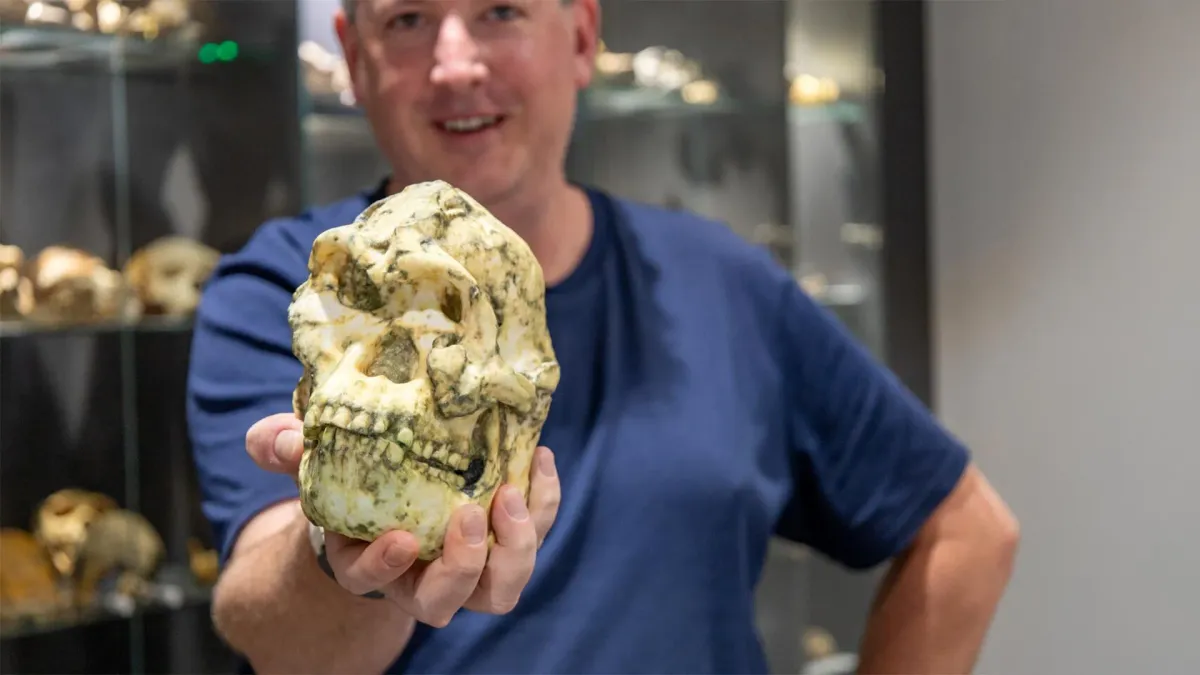
When researchers pulled a nearly complete 3.67-million-year-old skeleton from South Africa's Sterkfontein Caves in 1998, they thought they'd found a straightforward piece of the human family tree. Twenty-five years later, an international team is saying they were wrong—and that "Little Foot" might be something entirely new.
The fossil, formally catalogued as StW 573, has spent decades classified as Australopithecus, the genus of early human ancestors that walked upright across Africa millions of years ago. But when Dr. Jesse Martin and colleagues at La Trobe University in Australia examined it against known species like Australopithecus prometheus and Australopithecus africanus, the bones didn't match. Not exactly. The combination of features—the shape of the skull, the structure of the limbs, the way the skeleton was built—suggested something different. Something that might warrant its own species entirely.
This matters because Little Foot is the most complete ancient hominin skeleton we've ever found. Most fossils arrive as fragments: a jawbone here, a thighbone there, leaving scientists to puzzle together the picture. Little Foot showed up almost whole, which made it invaluable for understanding how early human ancestors actually moved and lived. But that completeness also made the reclassification harder to ignore. You can't hand-wave away an entire skeleton.
We're a new kind of news feed.
Regular news is designed to drain you. We're a non-profit built to restore you. Every story we publish is scored for impact, progress, and hope.
Start Your News Detox"Our findings challenge the current classification of Little Foot and highlight the need for further careful, evidence-based taxonomy in human evolution," Martin said in the study, published in the American Journal of Biological Anthropology. It's the first public challenge to the fossil's classification since it was formally described in 2017.
What makes this discovery particularly interesting is what it suggests about human diversity in ancient Africa. Professor Andy Herries, also at La Trobe, points out that the fossil's differences from other contemporary specimens reveal something we've been missing: early human ancestors weren't a neat, orderly progression from one species to the next. They were a tangle of related groups, adapted to different environments across southern Africa, evolving in parallel.
The old classification of Australopithecus prometheus actually rested on a flawed assumption—that these early humans made fire. We now know they didn't. That alone suggests the category needed rethinking. Little Foot's distinctiveness makes the case for something more fundamental: a whole species we haven't properly named yet.
The research involved collaborators from institutions across the United Kingdom, Australia, South Africa, and the United States—the kind of international effort that's become standard in paleoanthropology. What comes next is the careful work of describing this potential new species, examining more fossils to see if others belong to the same group, and understanding how it fits into the broader story of human evolution.
We're not rewriting the origins of humanity here. But we are getting a clearer picture of just how diverse and complex the early branches of our family tree actually were.





