Imagine designing a skyscraper today, but basing its heating and cooling systems on the weather patterns of, say, 1973. Sounds absurd, right? But for decades, that's exactly what engineers have been doing with Europe's buildings, using climate data that's often older than disco.
Turns out, the planet has changed a bit since then. So, a building meant to stand strong until 2080 and beyond is, for all intents and purposes, designed for a climate that simply doesn't exist anymore. Which, if you think about it, is both impressive and slightly terrifying.
Now, a team of researchers from Norway and Portugal has swooped in with a fix: a brand-new, open dataset of future weather. It covers over 5,000 locations across Europe and is specifically tailored to help engineers design buildings for the climate they will actually experience. Because apparently, that's where we are now.
We're a new kind of news feed.
Regular news is designed to drain you. We're a non-profit built to restore you. Every story we publish is scored for impact, progress, and hope.
Start Your News DetoxFuture-Proofing the Skyline
Historically, building energy simulations have relied on something called a "Typical Meteorological Year" (TMY). These are essentially weather averages based on past conditions. The problem, as Professor Thomas K. Thiis from the Norwegian University of Life Sciences points out, is that the climate a building will face can be 50 years different from the data used in its initial calculations. That's like building a car for horse-and-buggy roads, then expecting it to win a Formula 1 race.
Enter the "Future Meteorological Year" (FMY) data. This isn't just a slight tweak; it uses actual climate change projections to create hourly weather files for specific future periods and emissions scenarios. The best part? These files plug directly into existing simulation software, meaning engineers don't have to learn a whole new language to get with the times.
The researchers didn't just pull these numbers out of thin air. They rigorously evaluated numerous global and regional climate models, selecting only those that accurately depict summer and winter conditions across Europe. So, the FMYs are built on the most reliable projections available, covering mid-century (2036–2065) and late-century (2066–2095) with various emissions scenarios. Your design choices – like how much solar shading you'll need – now become a fascinating risk assessment.
Consistent, Coherent, and Crucial
One of the biggest wins here is consistency. These new FMYs are built on the same foundation as the team's recent historical TMY dataset. This means that for the first time ever, historical and future weather files for building simulation are fully consistent, using the same reference period, spatial resolution, and methods. Co-author Eugénio Rodrigues from the University of Coimbra notes that engineers can now trust the climate change signal in the FMYs.
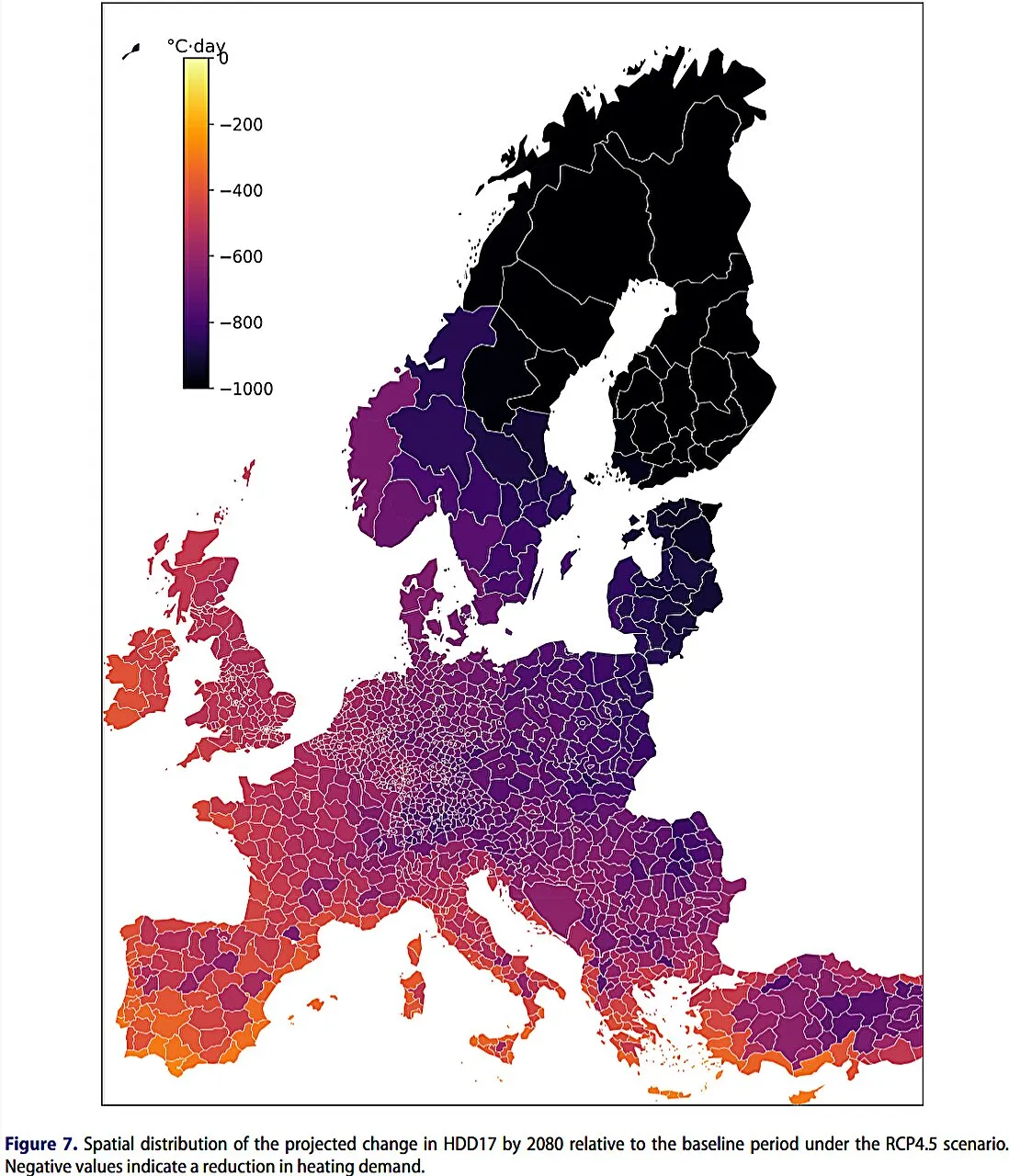
The data reveals some interesting nuances. For instance, temperature increases aren't uniform throughout the year. In northern cities like Oslo, winter temperatures are projected to rise the most, while summer temperatures see a smaller bump. This is a big deal, considering heating consumes the lion's share of energy in northern and central Europe. A small shift in average winter temperature can dramatically alter energy demand.
Thiis explains that when warming concentrates in winter, it significantly impacts energy calculations, potentially saving a surprising amount of heating energy. Researchers in Denmark, Poland, and Spain are already putting this dataset to work for building energy performance and climate adaptation. It seems the future, at least for Europe's buildings, is finally looking a bit more accurate. And thankfully, a lot less disco-era.