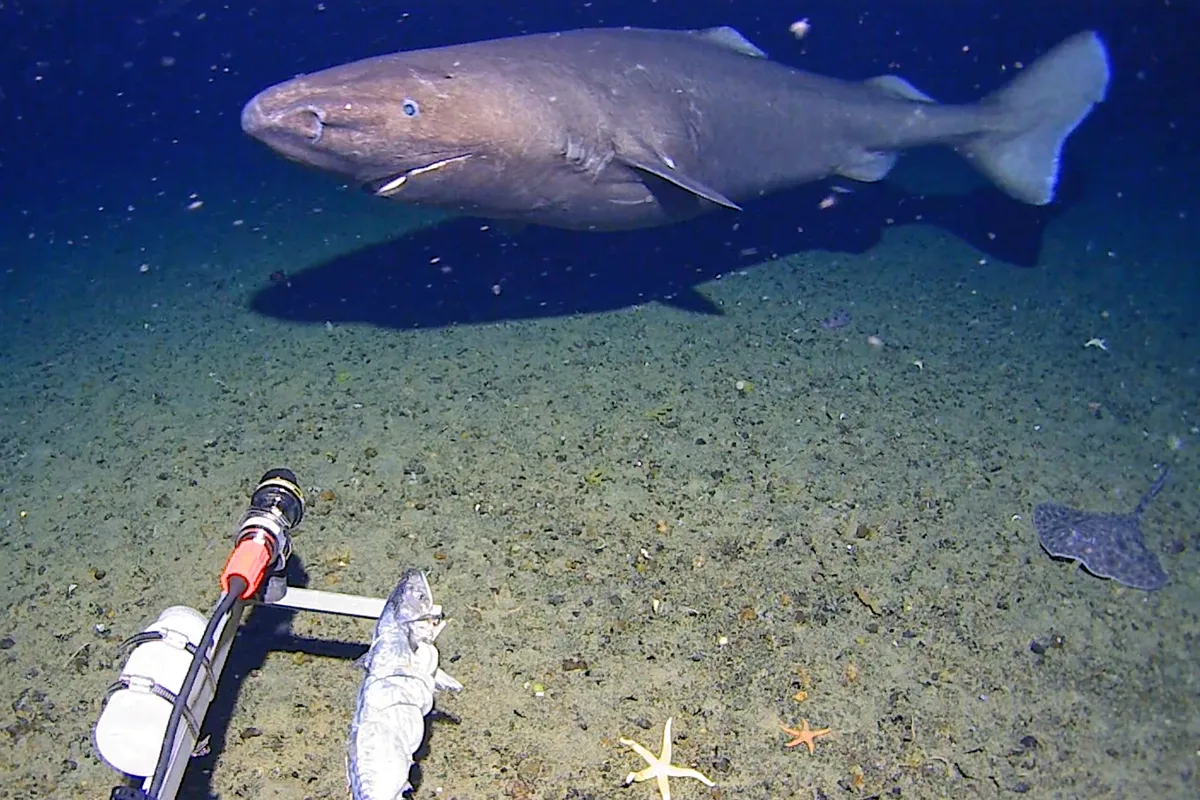
A sleeper shark the size of a small car has been caught on camera 490 meters below the Antarctic surface, in water so cold it barely stays liquid. This isn't a story about climate change pushing creatures into new territory — though that's part of the conversation. It's a story about how little we actually know about the ocean floor, even now.
The shark, estimated at 3 to 4 meters long, was filmed at 1.27 degrees Celsius (34.29°F), a temperature that would kill most animals. Yet here it was, moving through the darkness with what researcher Alan Jamieson described as an "ungainly" lurch, like a barrel with fins. "It's not even a little one either," Jamieson, founding director of the Minderoo-UWA Deep-Sea Research Centre, said. "It's a hunk of a shark. These things are tanks."
For years, marine biologists operated under a simple rule: sharks don't live in Antarctica. The Southern Ocean was thought to be too cold, too hostile, too far from the equatorial waters where most shark species thrive. This footage upends that assumption. It's the first recorded sighting of a shark this far south, and it raises an obvious question: how many others are down there, living in the darkness we can't see.
We're a new kind of news feed.
Regular news is designed to drain you. We're a non-profit built to restore you. Every story we publish is scored for impact, progress, and hope.
Start Your News DetoxA World We're Only Beginning to Map
Peter Kyne, a conservation biologist at Charles Darwin University, called the discovery "quite significant" — not because it's shocking that one shark exists, but because it happened at all. "The shark was in the right place, the camera was in the right place and they got this great footage," he said. That convergence of luck and timing matters. Antarctic research cameras operate only during the Southern Hemisphere summer. The region is remote, expensive to study, and the sleeper shark population is likely sparse. For every one filmed, there could be dozens or hundreds moving through those depths unseen.
Jamieson suspects the shark was holding at 500 meters because that's the warmest layer in a stack of water columns — still freezing by human standards, but relatively hospitable for a creature adapted to it. Down there, the shark likely feeds on what the deep ocean always provides: whale carcasses, giant squid, and other marine life that die and sink into the abyss.
Climate change could be part of the story. Warming oceans might push shark populations toward the Southern Hemisphere's colder waters as they search for their thermal comfort zone. But Kyne is cautious: there's almost no historical data on shark range changes near Antarctica because the region has barely been studied. You can't track a shift if you've never established a baseline.
What this footage really shows is how incomplete our map of Earth still is. We've sent rovers to Mars and mapped the moon's surface, yet the deep ocean remains largely alien. Every expedition down brings surprises — creatures we didn't know existed, ecosystems operating in conditions we thought impossible. The sleeper shark is just the latest reminder that the planet still has mysteries left, and some of them are swimming in the dark.