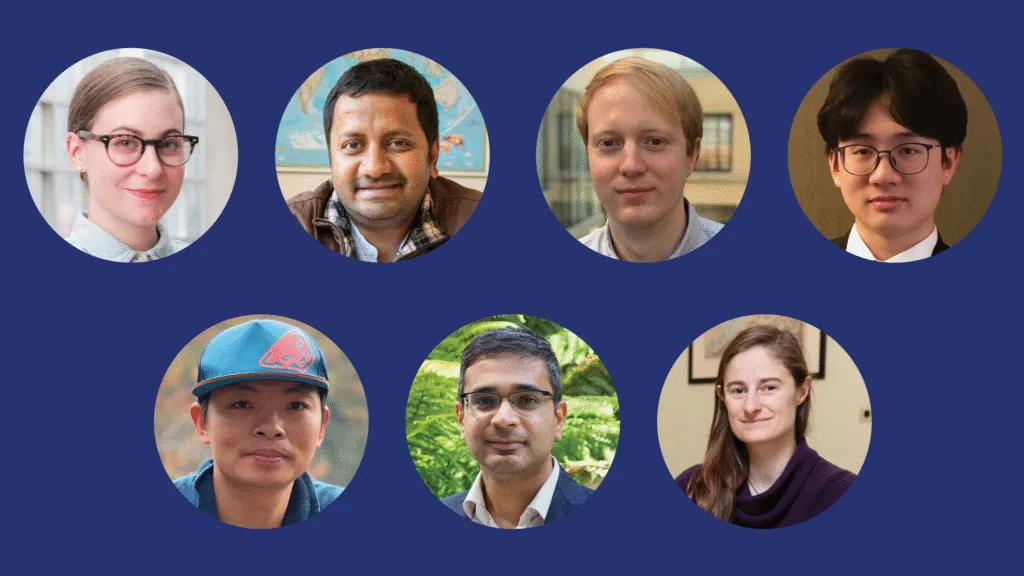
The Alfred P. Sloan Foundation has selected 126 early-career researchers for its 2026 Research Fellowships — one of the most competitive awards in science. Seven of them are from UC Berkeley, joining a lineage of fellows who've gone on to shape entire fields.
The Sloan Fellowship doesn't come with strings or specific research mandates. It's essentially the foundation saying: we believe in what you're doing, here's $175,000 over two years, keep going. For researchers in their early careers — typically five to seven years into their first independent positions — that kind of backing can be the difference between a promising idea and a full research program.
The Seven
Ashok Ajoy (chemistry) is building tools to listen to quantum spins. His work with nuclear magnetic resonance and electron spin resonance could improve quantum sensors — instruments sensitive enough to detect faint signals from biological systems or materials that behave in unexpected ways at the quantum scale.
We're a new kind of news feed.
Regular news is designed to drain you. We're a non-profit built to restore you. Every story we publish is scored for impact, progress, and hope.
Start Your News DetoxYuan Cao (electrical engineering and computer sciences) studies what happens when you take materials like graphene — single atomic layers of carbon — and stack them, twist them, layer them at precise angles. These configurations can create superconductors and other states of matter that don't normally exist. Understanding the rules governing these arrangements could unlock new materials for computing and energy.
Sarah E. Chasins (electrical engineering and computer sciences) is bridging a gap that's often overlooked: most people who could use computational tools to solve problems aren't programmers. She's designing programming languages and tools that let scientists, journalists, and policymakers apply computer science advances without needing a computer science degree.
Madison Douglas (earth and planetary science) is watching the Arctic permafrost thaw. As frozen ground melts faster than predicted, it releases methane and carbon dioxide — greenhouse gases that accelerate warming further. Her work measures the pace and consequences of these changes.
Wenbin Lu (astronomy) studies cosmic explosions: fast radio bursts, gamma-ray bursts, supernovas, and tidal disruption events where stars get torn apart by black holes. He's part of the team building NASA's Ultraviolet Explorer mission, which will map ultraviolet light from these events to understand the physics underneath.
Karthik Shekhar (chemical and biomolecular engineering) is mapping neuronal diversity in the visual system using single-cell genomics — essentially reading the genetic signatures of individual neurons to understand how they're organized and how they change. The visual system is complex enough to be interesting but tractable enough to yield real insights.
John Wright (electrical engineering and computer sciences) is a theoretical computer scientist exploring what quantum computers can and cannot do. He's developing methods to understand and test quantum systems, work that matters as quantum hardware moves from laboratory curiosities toward practical applications.
These seven researchers represent the breadth of what's happening at Berkeley right now: from the subatomic to the cosmic, from programming languages to permafrost. The Sloan Foundation's bet is that supporting people doing this kind of work — early enough, without constraints — creates space for breakthroughs that wouldn't otherwise happen.