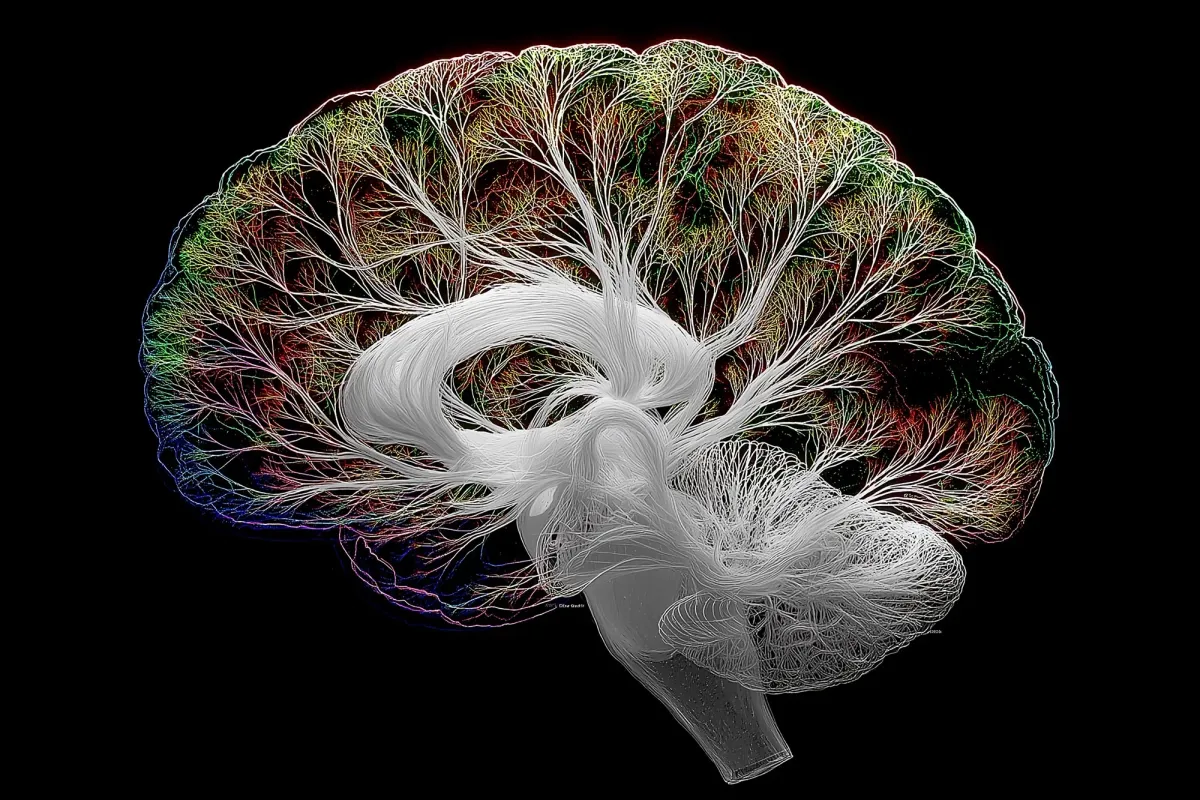
Your brain isn't just a jumble of neurons firing at random. It's wired with such precision that the pattern of connections itself tells you what that part of the brain does—whether it handles language, faces, decisions, or memory.
Researchers at Ohio State University have found the strongest evidence yet that this principle holds across the entire brain, not just isolated regions. By combining brain scans from over 1,000 people with maps of how the brain activates during different mental tasks, they discovered that connectivity patterns act like a fingerprint for brain function. A language area has a distinctly different wiring pattern than the region next to it, and that difference directly explains why one processes words and the other doesn't.
"Just like how everyone's fingerprint is unique, different brain regions have uniquely identifying connectivity fingerprints based on what mental function they perform," says Zeynep Saygin, associate professor of psychology at Ohio State. Lead author Kelly Hiersche, a doctoral student on the team, describes the approach as offering a "bird's eye view" of how brain structure supports everything from recognizing a face to having a conversation to making a choice.
We're a new kind of news feed.
Regular news is designed to drain you. We're a non-profit built to restore you. Every story we publish is scored for impact, progress, and hope.
Start Your News DetoxHow the researchers mapped this
The team used data from the Human Connectome Project—MRI scans of 1,018 people showing how brain regions connect to one another. They paired this with NeuroQuery, a tool that maps how the brain activates across 33 different mental functions: speech, decision-making, listening to music, face perception, and more. Then they built computational models linking the wiring patterns to the activity patterns.
The results were striking. Specific connectivity patterns could predict whether a region would light up or stay quiet during different tasks. The relationship held across nearly every region and cognitive domain they tested.
"It supports a broadly held hypothesis among neuroscientists that brain connectivity determines brain function," says David Osher, assistant professor and senior author, "but this has not been explicitly shown until now, and not across such a large breadth of cognitive domains."
Interestingly, the tightest link between wiring and function appeared in regions handling higher-level skills like executive function and memory—abilities that take years to develop. Sensory and social skills showed looser connections. Hiersche suggests this reflects how intensive use of these regions over time strengthens the relationship between their structure and what they do.
Why this matters
For the first time, researchers have a clear baseline of how a healthy young adult brain is typically organized. That opens the door to understanding what goes wrong in neurological and psychiatric conditions. By comparing brain connectivity in people with depression, schizophrenia, ADHD, or other conditions to this baseline, scientists can now ask: where has the relationship between wiring and function broken down? The answer could point toward new ways to diagnose and treat brain disorders.
The study was published in Network Neuroscience and represents a shift from studying isolated brain functions to understanding the brain as an integrated system governed by a single organizational principle.