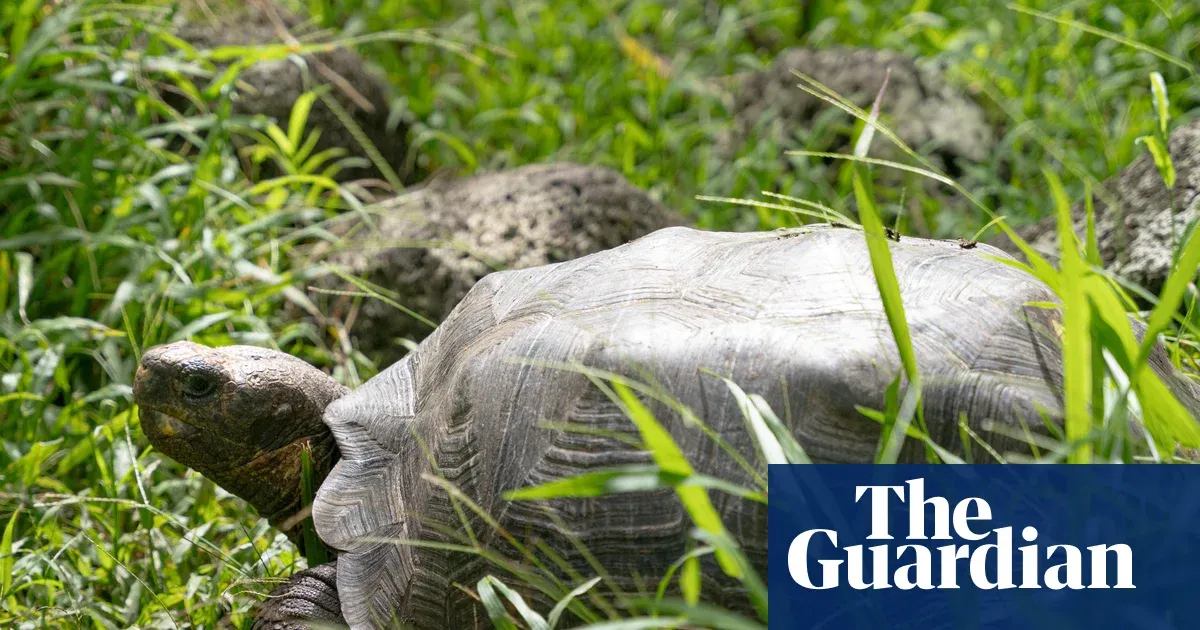
For the first time since whalers hunted them to extinction in the 1840s, giant tortoises are walking across Floreana, one of the Galápagos islands. This week, 158 juvenile tortoises descended from the Floreana subspecies were released onto the volcanic island—a moment that feels less like a single reintroduction and more like an ecosystem waking up.

The story of how these tortoises came back is almost improbable. In 2008, researchers discovered something unexpected on Wolf volcano, far from Floreana: a hidden population of giant tortoises carrying Floreana DNA in their genes. Whalers, it turned out, had inadvertently saved the species by moving live tortoises between islands as provisions for their voyages. Some were deliberately stashed on other islands for safekeeping. Others were simply thrown overboard when ships needed to lighten their load. The very practice that nearly erased the Floreana tortoise became its lifeline.
Once genetic analysis confirmed the connection, conservationists began a careful breeding programme in 2017. They selected 23 hybrid tortoises most closely related to the original Floreana population and bred them in captivity. By 2025, more than 600 hatchlings had been born. Now, several hundred are large enough—some nearly 1.5 metres long—to survive on their ancestral island.
We're a new kind of news feed.
Regular news is designed to drain you. We're a non-profit built to restore you. Every story we publish is scored for impact, progress, and hope.
Start Your News DetoxBut releasing tortoises was only half the battle. Floreana had been ravaged by invasive species: rats and feral cats that arrived with sailors and settlers had decimated native birds, reptiles, and plants. Starting in 2023, a coordinated eradication programme removed most of these invasive mammals, clearing the way for the tortoises' return. The results came almost immediately. The Galápagos rail—a bird not recorded on Floreana since Charles Darwin's visit in 1835—has reappeared. Ground finches, geckos, lizards, and native snails have surged in numbers. Local farmers have noticed harvests improving as rats disappeared.
Why tortoises matter so much
Giant tortoises aren't just charismatic returnees. They're what ecologists call "keystone species"—animals whose impact on an ecosystem far outweighs their size. As they graze, they maintain open habitats that native plants need to thrive. Their wallows create micro-habitats for smaller creatures. Most crucially, they disperse seeds across the island as they move, reshaping the landscape in ways that benefit reptiles, invertebrates, and birds that depend on healthy vegetation.
For Verónica Mora, a community representative on Floreana, the reintroduction carries personal weight. "This marks an important step toward a future where conservation and community wellbeing go hand in hand," she said, "because our livelihoods, from tourism to agriculture and fishing, depend on the health of this island." The restoration isn't something imposed from outside—it's a partnership between the Galápagos national park, conservation charities, and the island's 160 residents, all working toward the same outcome.
Floreana's restoration is the largest ecological project ever attempted in the Pacific. The next phase will attempt to bring back the Floreana mockingbird, the Floreana racer snake, the vegetarian finch, and the little vermilion flycatcher. Each species will follow a similar path: genetic recovery, careful breeding, invasive species control, then reintroduction. What started with 158 tortoises is building toward something much larger—a fully restored island ecosystem, 180 years in the making.