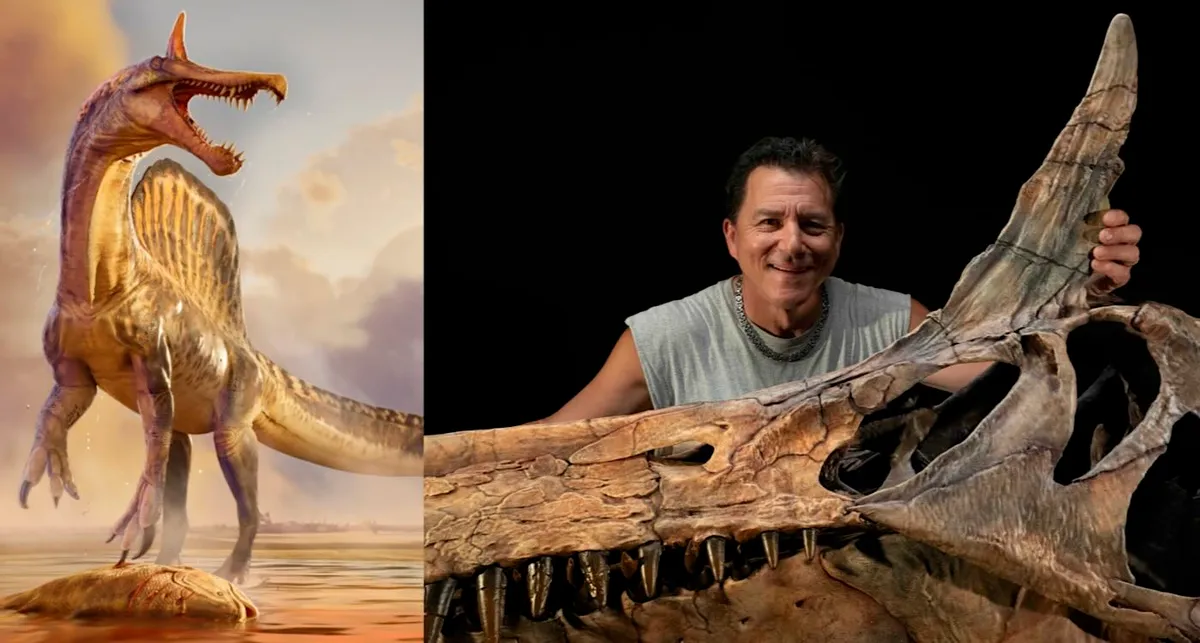
A team led by University of Chicago paleontologist Paul Sereno has announced the discovery of Spinosaurus mirabilis, a new dinosaur species that walked inland Saharan rivers 95 million years ago. The fossil—the first confirmed new Spinosaurus in over a century—emerged from desert sediments in Niger with an unexpected feature: a striking, blade-shaped bony crest that curved skyward.
The crest was so unusual that Sereno's team didn't immediately recognize what they'd found when they spotted it on the desert surface. Once excavated and studied, the bones told a story that shifts how scientists understand these massive predators. Spinosaurus mirabilis was a wader, not a fully aquatic hunter—a creature Sereno describes as a "hell heron," stalking fish in shallow inland rivers up to 620 miles from any ocean. Its interlocking upper and lower teeth formed a deadly trap for slippery prey.

Spanish paleontologist Dan Vidal examines the fossil collection, including the crest and jaw pieces of the new species
We're a new kind of news feed.
Regular news is designed to drain you. We're a non-profit built to restore you. Every story we publish is scored for impact, progress, and hope.
Start Your News DetoxThe journey to this discovery began with a single sentence. In the 1950s, a French geologist had mentioned finding a saber-shaped tooth in Egypt's Western Desert—a lead no one followed for over 70 years. Sereno's team spent 18 months searching the sand seas before a local Tuareg man on a motorbike led them deep into the Sahara's center, where he'd spotted massive fossil bones. After a full day of travel, they found teeth and jaw fragments of the new species buried in river sediments alongside long-necked dinosaurs, evidence of a forested inland habitat carved by rivers.
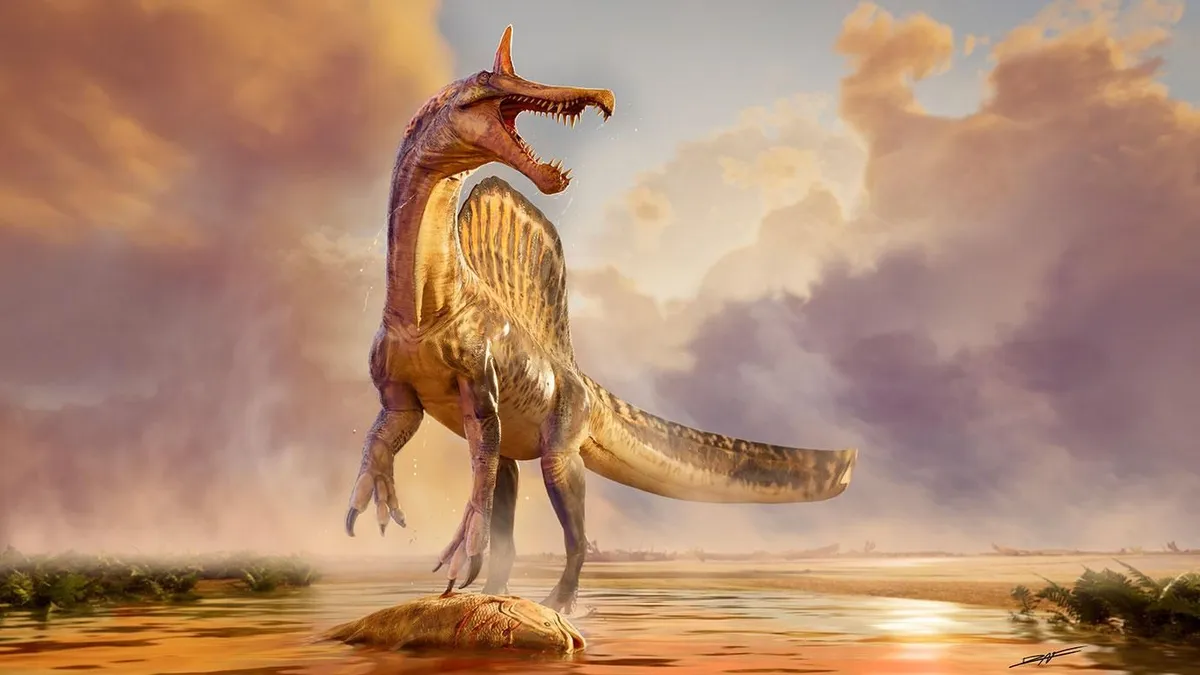
Back in Chicago, the team CT-scanned the bones and assembled digital reconstructions powered by solar panels in the middle of the desert. The crest itself—likely sheathed in bright keratin—probably served as a visual display rather than a hunting tool. Paleo-artist Dani Navarro created detailed reconstructions showing the dinosaur looming over a coelacanth carcass, bringing the ancient scene to life.
The fossil findings, published in Science, represent what researchers call a "third phase" in spinosaur evolution. Previous discoveries had come almost exclusively from coastal deposits, suggesting these predators were ocean-bound. This inland site rewrites that narrative, showing they thrived in rivers far from any sea.
The skull replica will be displayed at the Museum of the River in Niamey, Niger—a zero-energy institute Sereno founded—and touchable models of the scimitar crest will arrive at the Chicago Children's Museum in March. Sereno sees this as more than artifact preservation. "Letting kids feel the excitement of new discoveries—that's key to ensuring the next generation of scientists," he said. The Sahara, it seems, still has lost worlds waiting to be found.