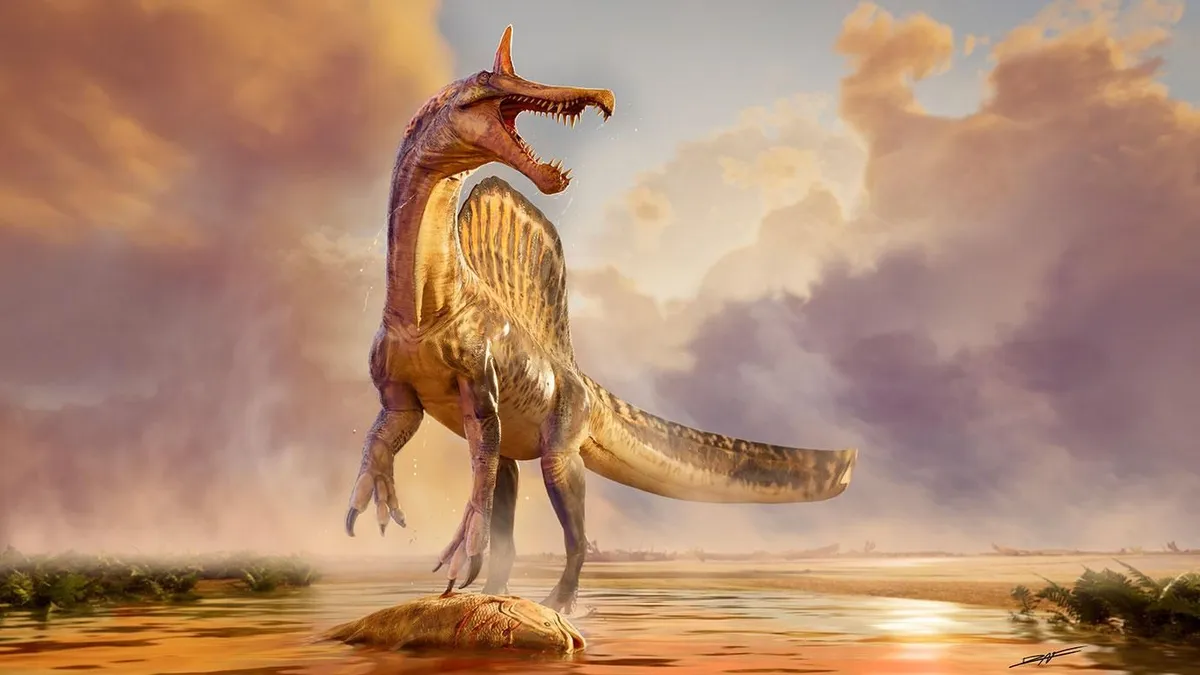
Ninety-five million years ago, a 40-foot predator with a sword-like crest and interlocking teeth stalked the rivers of what is now Niger. It wasn't a creature built for open ocean hunts. It was a wader—a massive, meat-eating dinosaur that scientists have just named Spinosaurus mirabilis, and it hunted more like a heron than a shark.
Paleontologists digging in the Sahara Desert unearthed fossils of this previously unknown species, described this month in Science. The creature weighed between 10,000 and 14,000 pounds and stood up to 46 feet tall. What makes S. mirabilis remarkable isn't just its size—it's where it was found and what that tells us about how it lived.
A Fisher Built for Shallow Water
The dinosaur's anatomy reads like a blueprint for fishing. Its conical teeth interlocked perfectly to pierce and trap slippery prey. Its nostrils sat far back on its snout, positioned so it could breathe while hunting with its mouth submerged. The 20-inch crest crowning its head was made of solid bone, probably covered in bright keratin—the protein in human hair and nails. Too delicate for fighting, researchers believe it served as a display: a way to attract mates, claim territory, or simply say "this feeding ground is mine."
We're a new kind of news feed.
Regular news is designed to drain you. We're a non-profit built to restore you. Every story we publish is scored for impact, progress, and hope.
Start Your News Detox"It's about love and life," says Paul Sereno, the paleontologist leading the research at the University of Chicago. "Attracting a mate, defending your hot feeding shallows. What else could be more important?"
The discovery challenges what scientists thought they knew about Spinosaurus. Its only known relative, Spinosaurus aegyptiacus, left fossils near ancient seas in Egypt and Morocco. That led some researchers to argue Spinosaurus dinosaurs were fully aquatic—creatures that dove and swam in open water like modern crocodiles.
But S. mirabilis was found 300 to 600 miles inland from where the nearest ocean would have been during the Cretaceous. The location, combined with its anatomy, suggests a different lifestyle: semi-aquatic hunting in shallow rivers and lakes. Sereno calls it a "hell heron"—a creature that waded into water to ambush fish, the way herons do today.
Not everyone is convinced. Some paleontologists argue that Spinosaurus dinosaurs, despite their size and relatively short legs, would have struggled to sneak up on prey while wading. Others point to skeletal features—bone density, tail shape—that suggest adaptation to open water, not shallow hunting grounds.
Matt Lamanna, a paleontologist at Carnegie Museum of Natural History, suspects the answer might be both. "What if it's wading sometimes? What if it's getting into the water and swimming around some?" he asks. "The common denominator is ambush, whether that was from shore or from the water."
More Spinosaurus fossils will eventually settle the debate. For now, S. mirabilis offers a new possibility: a massive predator that didn't need the open ocean to thrive, just enough water to hide in while waiting for dinner to swim by.