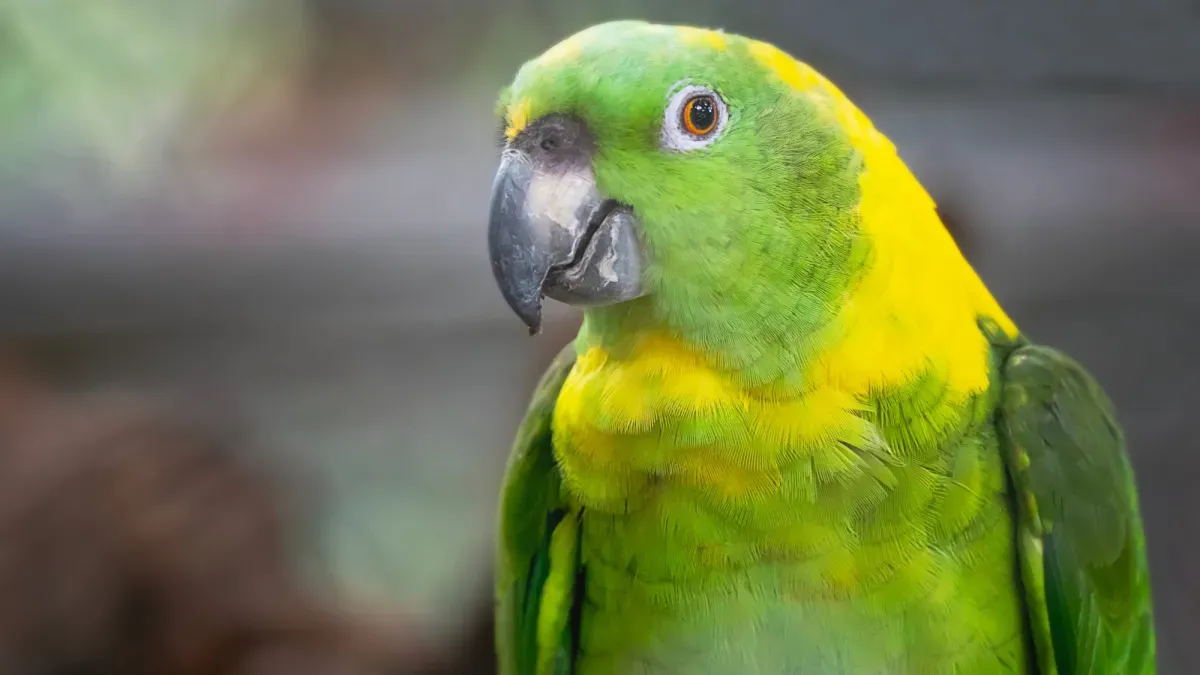
Yellow-naped amazons aren't just mimicking sounds—they're building meaning the way humans do. When biologist Christine Dahlin listened closely to the duets these Central American parrots sing together, she heard something that looked suspiciously like language.
Dahlin, a biology professor at the University of Pittsburgh Johnstown, spent years analyzing the "warble duets" that yellow-naped amazons perform. Using text-analysis software typically used on human writing, she and her colleagues mapped out 36 distinct call types. But the real discovery came when they looked at how these calls fit together.
The parrots weren't stringing sounds together randomly. Certain calls clustered predictably with others—much the way "grass" and "green" appear together in human text, or "sport" and "ball." The duets followed organizational rules. They had structure.
We're a new kind of news feed.
Regular news is designed to drain you. We're a non-profit built to restore you. Every story we publish is scored for impact, progress, and hope.
Start Your News Detox"Despite following these organizational rules, the duets were also very flexible and we observed lots of variation," Dahlin explains in her recent study, published in the Journal of Avian Biology. It's the same paradox that makes human language work: we follow grammar while still expressing ourselves in infinite ways.
This matters because it reframes what we think parrots are doing. We know they can mimic human speech in captivity—that's been obvious for centuries. But their independent vocal lives, the conversations they have with each other in the wild, have remained largely mysterious. This research pulls back that curtain. These birds are having complex exchanges, not just repeating sounds.
Yellow-naped amazons are critically endangered, hunted primarily for the illegal pet trade, though habitat loss and climate change add pressure. They're found only in Central America, and their populations are shrinking. Dahlin's hope is straightforward: if we understand how sophisticated these birds really are, we might finally treat them as the remarkable creatures they are rather than as commodities to capture.
"It is vital that yellow-naped amazons are allowed to breed in peace, that people appreciate them in their natural environment, and not try to capture them for pets," she says.
The research opens a door to understanding what goes on inside an animal's mind—not through invasive observation, but by listening to what they're already telling each other.