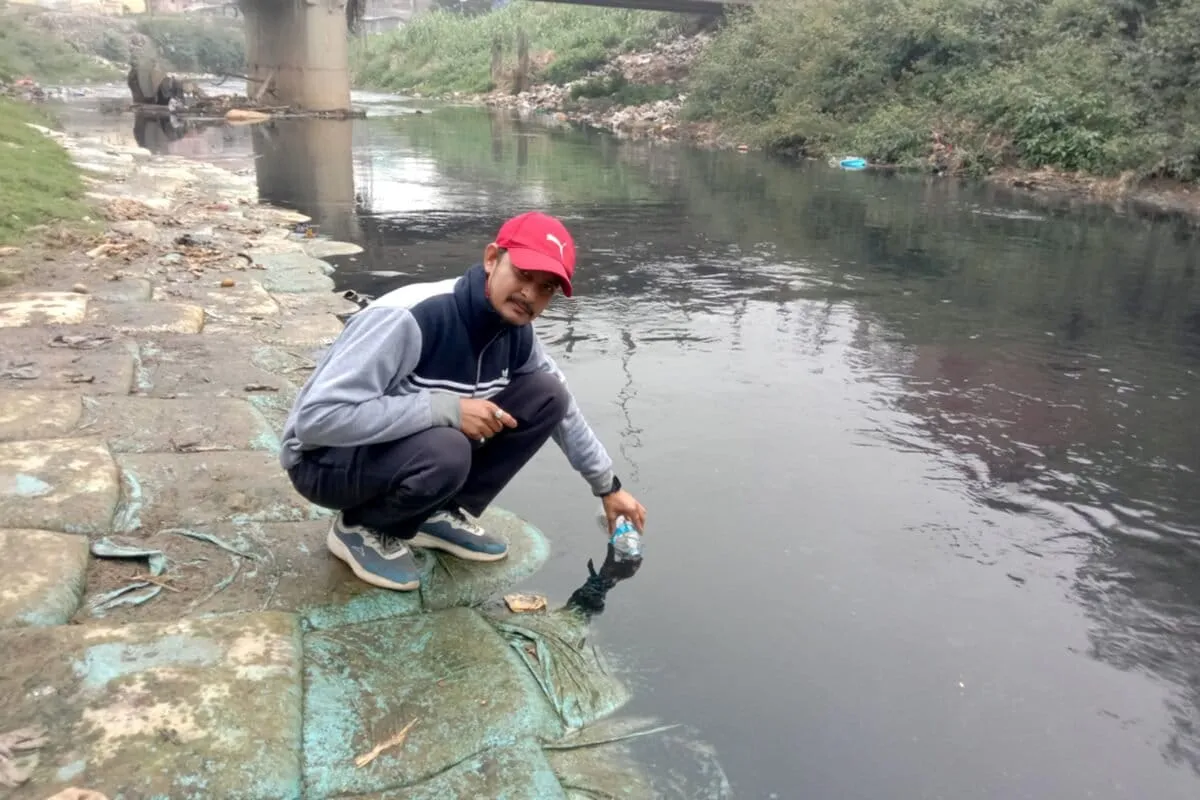
Pradeep Kumar Bishwokarma grew up swimming in the Sirsiya River during summer, watching his mother wash clothes in water families drank from without hesitation. Now, at 38, he covers his nose with a handkerchief when he passes it. The river has turned thick and black, heavy with the stench of sulfur and rotting matter—less a waterway than an open drain for factories.
"This is no longer a river," Bishwokarma said. "It has become an open sewer, and we haven't just lost a river, we've lost our self-respect."
The Sirsiya flows through Bara and Parsa districts in southern Nepal, beginning in the Ramban forest and passing directly through the Bara-Parsa industrial corridor—Nepal's largest manufacturing zone. From there, it joins one of roughly 6,000 rivers and streams that cross the Nepal-India border. What moves downstream isn't just water anymore.
We're a new kind of news feed.
Regular news is designed to drain you. We're a non-profit built to restore you. Every story we publish is scored for impact, progress, and hope.
Start Your News DetoxHow a river becomes a drain
The collapse happened because of a gap between what should happen and what actually does. Environmental regulations exist on paper, but enforcement is fragmented across agencies that don't coordinate effectively. Factories dump untreated industrial waste and sewage directly into the river because the cost of compliance exceeds the cost of pollution. There's no real consequence, so the practice continues.
This isn't unique to the Sirsiya. Industrial pollution in Nepal's manufacturing zones has degraded multiple waterways, and because of geography, much of that contamination flows downstream into India. The problem sits at the intersection of two countries' environmental challenges: Nepal's rapid industrialization without proportional regulatory infrastructure, and India's already-stressed water systems receiving additional pollutants from upstream.
For residents of border towns like Birgunj, the impact is immediate. Agricultural land fed by the river becomes unusable. Drinking water sources are compromised. The river that once anchored daily life—spiritual, practical, social—is now something to avoid.
Efforts to address the problem have begun. Environmental organizations in both countries have documented the pollution and pushed for stricter enforcement. Some factories have faced pressure to install treatment systems, though compliance remains inconsistent. The real shift would require Nepal's government to meaningfully enforce existing environmental laws and invest in industrial wastewater infrastructure, paired with cross-border coordination so that what happens upstream is no longer someone else's downstream problem.
For now, the Sirsiya remains a visible reminder of what happens when industrial growth outpaces environmental governance—and how that failure doesn't stop at borders.