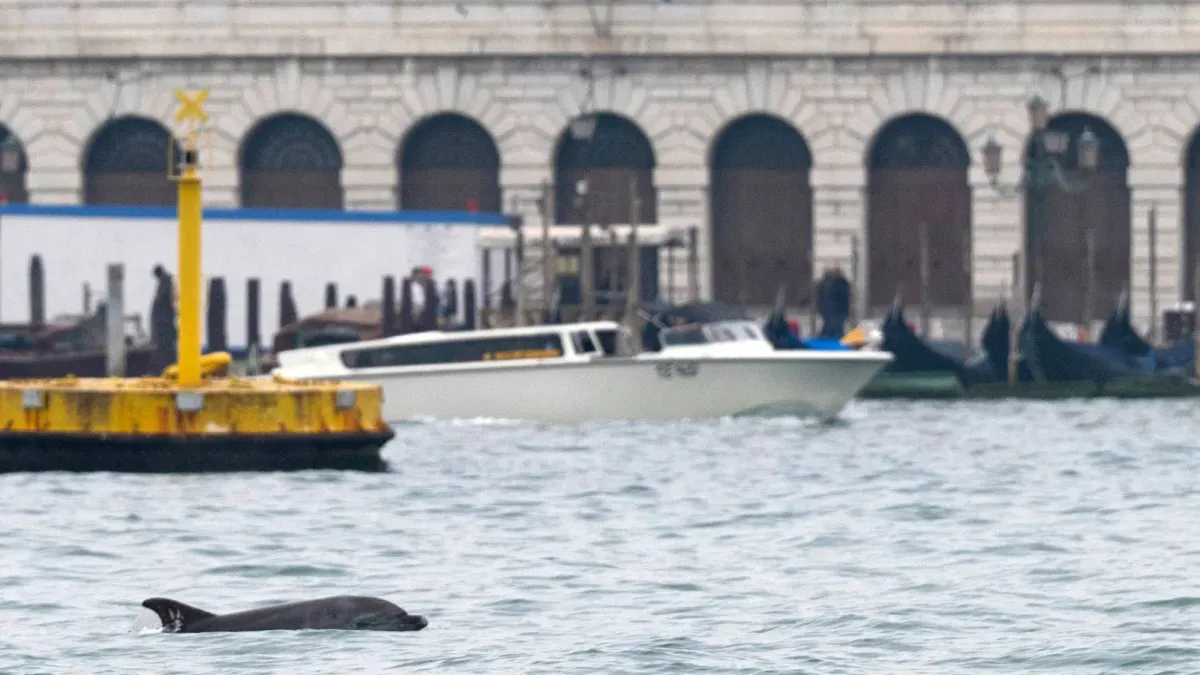
A bottlenose dolphin named Mimmo arrived in Venice's lagoon last summer and has stayed put, swimming past the Rialto Bridge and feeding on mullet in waters the species largely abandoned decades ago. Researchers who've been tracking him since June found something striking: the dolphin is healthy, behaving normally, and adapting remarkably well to one of Europe's most crowded urban waterways. The problem isn't Mimmo. It's us.
A new study published in Frontiers in Ethology by researchers at the University of Padova makes this clear. "This situation is primarily about managing human behavior rather than managing the dolphin," says Dr. Giovanni Bearzi, who has studied Adriatic dolphins for forty years. The real danger comes from boat propellers, reckless driving, and tourists who treat a wild animal like a photo opportunity.
Why Mimmo's Arrival Matters
Bottlenose dolphins once thrived throughout the Adriatic. Their cousins, common dolphins, nearly vanished by the 1970s due to fishing and human interference. Bottlenose dolphins proved more adaptable, but they've mostly stayed away from lagoons in recent decades. Mimmo's presence signals something: the species is resilient enough to return if conditions allow it.
We're a new kind of news feed.
Regular news is designed to drain you. We're a non-profit built to restore you. Every story we publish is scored for impact, progress, and hope.
Start Your News DetoxWhen researchers first spotted him in June 2025, they launched weekly monitoring from boats. Over the following months, Mimmo migrated northward through the lagoon, eventually settling near San Marco Basin—Venice's busiest waterfront and the city's most popular tourist destination. He's still there, thriving on a diet of mullet and displaying typical dolphin behavior.
Dr. Guido Pietroluongo, the conservation veterinary pathologist leading the research, noted the obvious: "Observing bottlenose dolphins in urban areas is not particularly surprising, as they are extremely adaptable and opportunistic marine mammals." What is unusual is how poorly humans handle their presence.
The Real Risk
The researchers considered and rejected the obvious interventions. Early attempts to push Mimmo back to open water using sound deterrents failed. Capturing and relocating him carries greater risks than benefits—the stress alone could harm him. Instead, they're recommending something far simpler: enforce the rules already on the books.
Italian law already prohibits disturbing protected wild animals, including touching or feeding them. Speed limits exist. Restrictions on close approaches exist. What's missing is consistent enforcement and human restraint. Boat propeller injuries are a documented threat. Irresponsible vessel traffic in San Marco Basin creates hazards Mimmo would rarely encounter in open waters.
Bearzi's conclusion carries a quiet weight: "What is truly unusual is not the dolphin's presence, but the persistent difficulty humans have in respecting such animals today." Dolphins have lived alongside human maritime activity for millennia. We've had thousands of years to learn coexistence. The fact that we're still struggling—that a healthy dolphin in a lagoon becomes a management crisis because tourists can't resist getting close—says something about us, not about Mimmo.
The path forward isn't complicated. It requires treating a wild animal as wild, respecting existing protections, and accepting that sharing space with other species means occasionally stepping back from the photo op.