
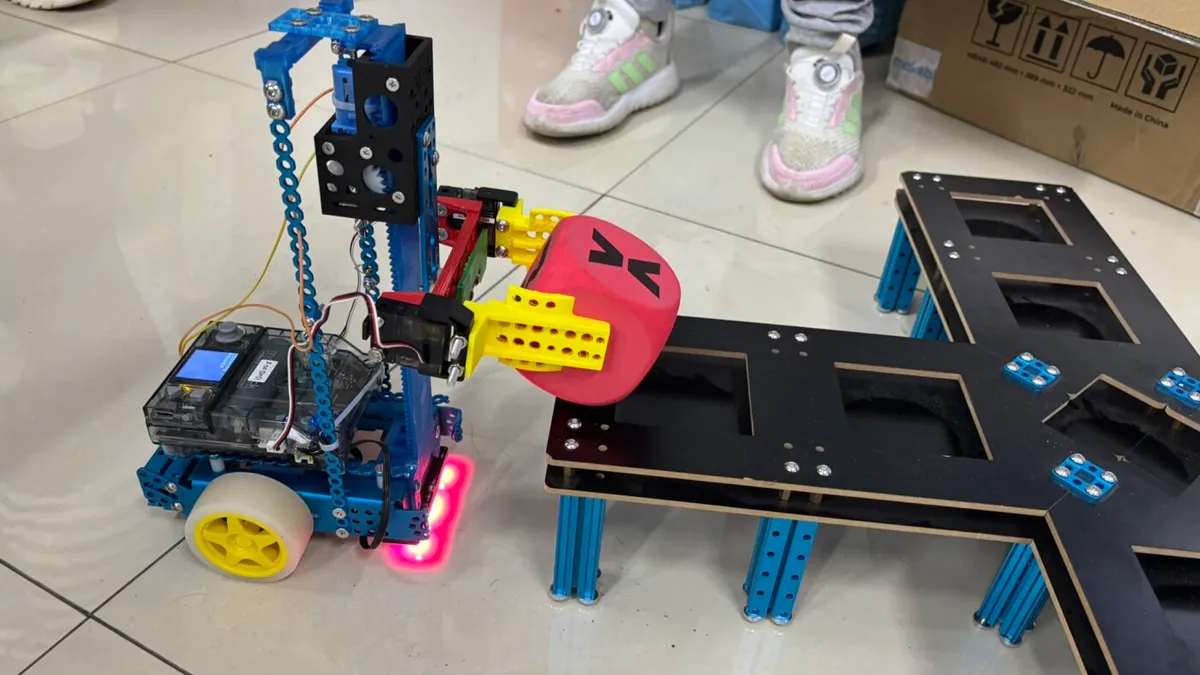
In a Beijing classroom this fall, 11-year-old Li Zichen is learning to program a small robot that lifts and moves blocks using artificial intelligence. His classmate Song Haoyue is using AI as a design tool to create competition posters. Neither of them chose these projects as enrichment. They're part of the standard curriculum now.
Starting this academic year, every elementary and middle school student in Beijing and several other Chinese districts must learn AI. It's no longer optional. The Ministry of Education has integrated artificial intelligence courses into the standard information technology requirement, a shift that reflects how quickly the technology has moved from cutting-edge to essential.
Why Now
Wang Le, a computer skills teacher at Beijing University of Posts and Telecommunications Affiliated Primary School, frames it plainly: "It's about preparing kids for life ahead, and about enhancing the country's competitiveness by securing a future pool of skilled professionals." The mandate aligns with China's stated goal to become the global AI leader within four years—a target the government sees as critical for both national security and economic strength.
We're a new kind of news feed.
Regular news is designed to drain you. We're a non-profit built to restore you. Every story we publish is scored for impact, progress, and hope.
Start Your News DetoxBut this isn't just top-down policy. Parents are thinking about the same future. Li Zichen's father, Li Yutian, actively supports his son's interest in robotics and computers. He recently took him to a Xiaomi factory to see automation in action, and he's coaching him on a practical survival strategy: find work that AI cannot do.
There are hesitations too. Song Zefeng, whose daughter is learning AI design, worries that elementary school might be too early for intensive exposure. But even skeptics acknowledge the logic. In a decade, AI literacy won't be a competitive advantage—it will be a baseline expectation. Learning it now, at 11, means these students won't be catching up later.
The real question isn't whether kids should learn AI. It's whether schools globally will move at China's pace, or whether students in other countries will start their AI education years behind.