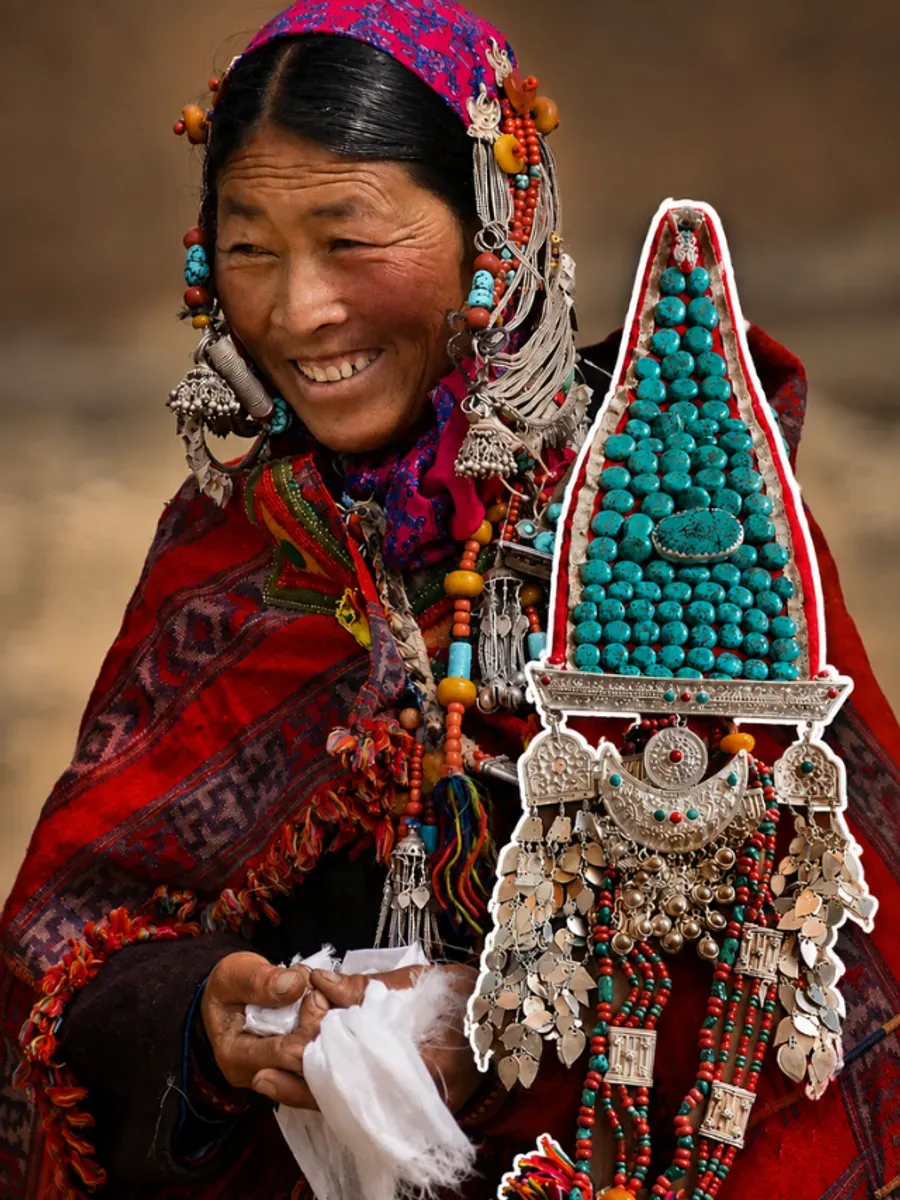
Imagine a wedding where the jewelry isn't just an accessory, but a wearable family tree, an ID card, and a bank statement all rolled into one. Welcome to Spiti, a remote valley high in the Himalayas, where silver speaks volumes without a single word.
Walk through Kaza market during a local wedding, and you'd swear the silver is dancing. Crowns, necks, wrists — it's everywhere, each clasp and bead a tiny chapter in a much larger story, waiting for its maker to translate.
The Hands That Tell the Story
These makers, known as garh or zoe, aren't just jewelers; they're historians. They train for years, hammering, filing, and setting each precious stone by hand, just as their ancestors did. Mostly based in Kaza, they embed turquoise, coral, amber, and pearls into silver — the base for every piece. That turquoise, by the way, once came from Tibet at eye-watering prices. Families guarded these pieces like others guard their actual land or gold.
We're a new kind of news feed.
Regular news is designed to drain you. We're a non-profit built to restore you. Every story we publish is scored for impact, progress, and hope.
Start Your News DetoxTake the dhagloo. This isn't just a bangle; it's a stack of thick silver bangles that climb up the wrist, a visual family crest. The bride's family, never the groom's, bestows these upon her. So, her arms literally carry the proof of her lineage. No pressure, then.
Then there's the gawoo, a small silver pendant box worn around the neck. If the dhagloo is about the family line, the gawoo is about personal tradition. Often passed down through generations, it's a deeply personal piece, a tiny, silent guardian of Spiti's cultural heart.
And for the grand finale, the berag. This isn't just a headdress; it's a statement. A turquoise-studded crown that drapes over the head and shoulders, its weight instantly felt. Mainly worn by married women at significant community gatherings, it's the kind of piece that demands attention, and probably a very strong neck.
Once a woman marries into this jewelry, it’s hers for life. Then, it moves on. Tradition dictates that only the eldest daughter inherits her mother's complete set. Younger daughters get newly crafted pieces, ensuring no two sisters walk around with identical inherited bling. Because apparently, that's where we draw the line on sharing.
From Status Symbol to Enduring Art
Historically, these pieces also broadcasted social standing. Wealthy Khangchen households could flaunt full sets with genuine Tibetan turquoise, while poorer Khing Chung families sported sparser versions. That old hierarchy has largely faded, but the craft itself? It's still clinging on.
A few garhs still work through Kaza's short summer, some even migrating to Kinnaur each winter. They keep an entire language of silver alive, on a narrow, fragile scale. Every dhagloo, gawoo, and berag quietly whispers tales of wealth, protection, and lineage, without uttering a single syllable. As Spiti evolves, what new stories will these silver heirlooms tell the daughters who inherit them next? It’s a tradition that’s both beautiful and a little bit profound.