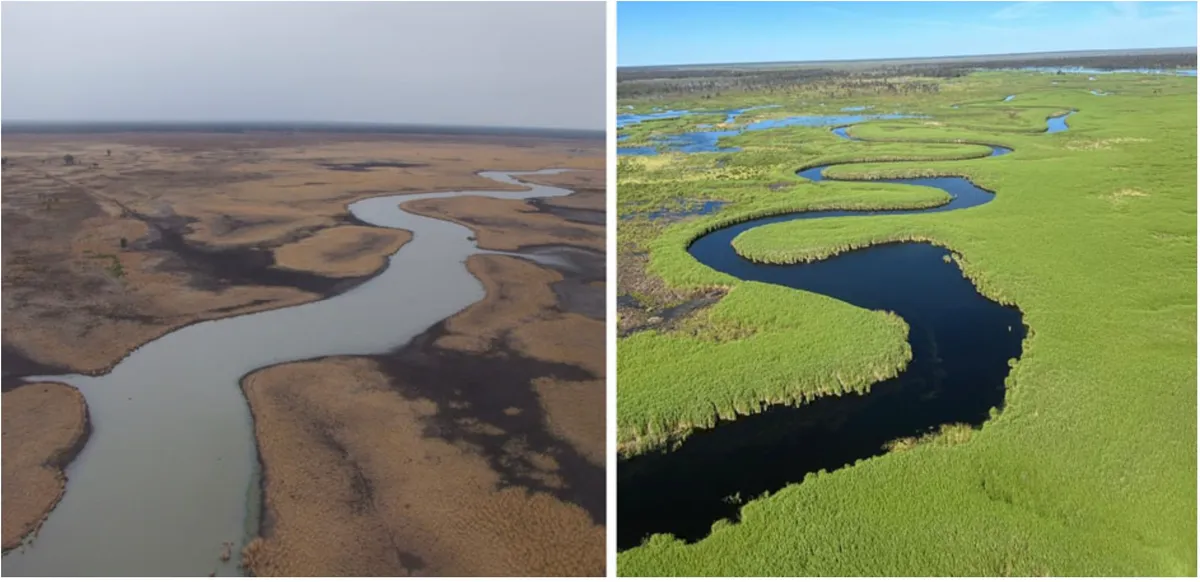
Imagine a swamp so vital that when everything else dries up, it becomes the last resort for thousands of feathered, finned, and scaled creatures. Now imagine that crucial, watery haven — 81,545 acres of it, to be precise — is now under the long-term stewardship of the very people who've understood its importance for millennia.
That's precisely what happened in Australia's Murray-Darling Basin, where the Nari Nari Tribal Council (NNTC), an Indigenous conservation group, just secured the vast majority of the Great Cumbung Swamp.

This isn't just any swamp. Located at the tail end of the Lachlan River in New South Wales, the Great Cumbung is a sprawling mosaic of open water, dense reed beds, and majestic river red gum woodlands. It's the kind of place that teems with life, offering a critical refuge for waterbirds, frogs, fish, and reptiles, especially when the brutal Australian dry spells hit.
We're a new kind of news feed.
Regular news is designed to drain you. We're a non-profit built to restore you. Every story we publish is scored for impact, progress, and hope.
Start Your News DetoxA Lifeline for Threatened Species
The NNTC, in partnership with The Nature Conservancy (TNC), managed to purchase the property in January 2026. TNC's James Fitzsimons highlighted the swamp's role as a biological lifeboat, noting its unique ability to sustain life when surrounding areas turn to dust.
And sustain it does. The Cumbung is home to threatened species like the elusive Australasian Bittern, the iconic Murray cod, and the southern bell frog. Every year, around 11,500 waterbirds flock to its life-giving waters. It's so ecologically significant, in fact, that it's being considered for Ramsar listing, which is basically the international VIP list for wetlands.

For decades, this precious land was subjected to logging and cattle grazing. But in 2019, TNC and the Tiverton Agricultural Impact Fund stepped in, buying the property to halt further agricultural expansion and environmental degradation. Grazing has already been significantly reduced, paving the way for the Nari Nari Tribal Council to now guide its future, ensuring this incredible ecosystem not only survives but thrives.