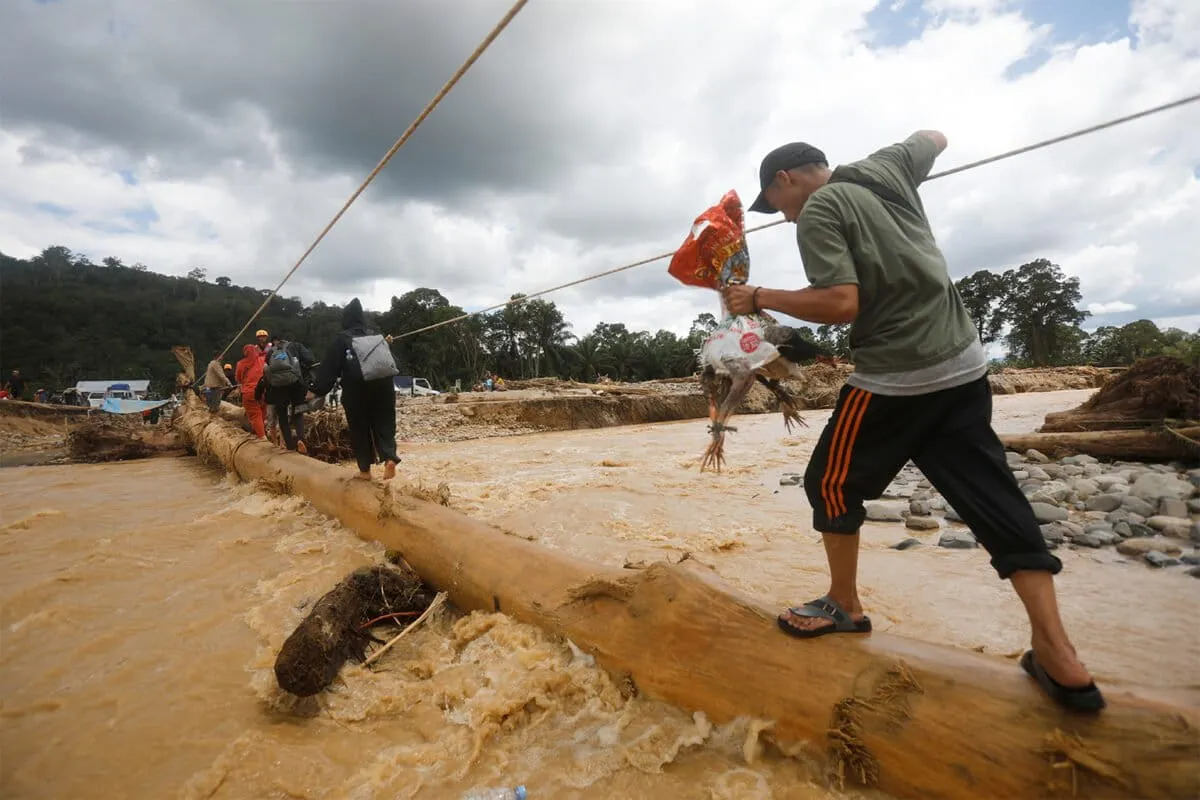
Indonesia's government has revoked permits for 28 companies following an audit into environmental violations linked to the devastating floods and landslides that swept across Sumatra in November 2025. Cyclone Senyar killed roughly 1,200 people across the island, and investigators concluded that deforestation and mining operations had made the disaster worse.
The audit was carried out by a government task force tasked with enforcing forest protection rules after major disasters. When President Prabowo Subianto reviewed the findings on January 19, he ordered the immediate revocation of all 28 permits — a rare moment of accountability in a country where environmental enforcement has historically been inconsistent.
What was revoked
The 22 forest utilization permits alone covered roughly 1 million hectares — an area about one-third the size of Belgium. These companies had been operating in natural and plantation forests. Another 6 permits for mining, plantation, and timber operations were also cancelled. The major pulpwood producer PT Toba was among the affected companies.
We're a new kind of news feed.
Regular news is designed to drain you. We're a non-profit built to restore you. Every story we publish is scored for impact, progress, and hope.
Start Your News DetoxAuthorities cited violations of Indonesia's 2009 environmental protection law, though detailed findings for each case haven't been made public. State Secretariat Minister Prasetyo Hadi announced the decision at a press conference on January 20, framing it as a direct response to the companies' role in exacerbating the disaster.
Why this matters
Permit revocations in Indonesia usually happen quietly, if at all. Linking them explicitly to post-disaster accountability is a shift in how the government frames environmental enforcement. When a cyclone kills over 1,000 people and officials can point to specific companies whose operations removed the forest cover that might have slowed the floodwaters, the political calculus changes. Deforestation leaves hillsides bare and vulnerable to collapse; mining operations can destabilize slopes further.
This isn't the first time Indonesia has faced this reckoning. Sumatra's forests have been shrinking for decades, and the island has become a flashpoint for both conservation and industrial interests. The November disaster made the cost of that trade-off impossible to ignore.
What happens next will matter more than the revocations themselves. Whether these companies actually leave their concessions, whether the government enforces the ban, and whether the freed-up land gets reforested or simply sits in legal limbo — those details will determine whether this is genuine accountability or performative action.