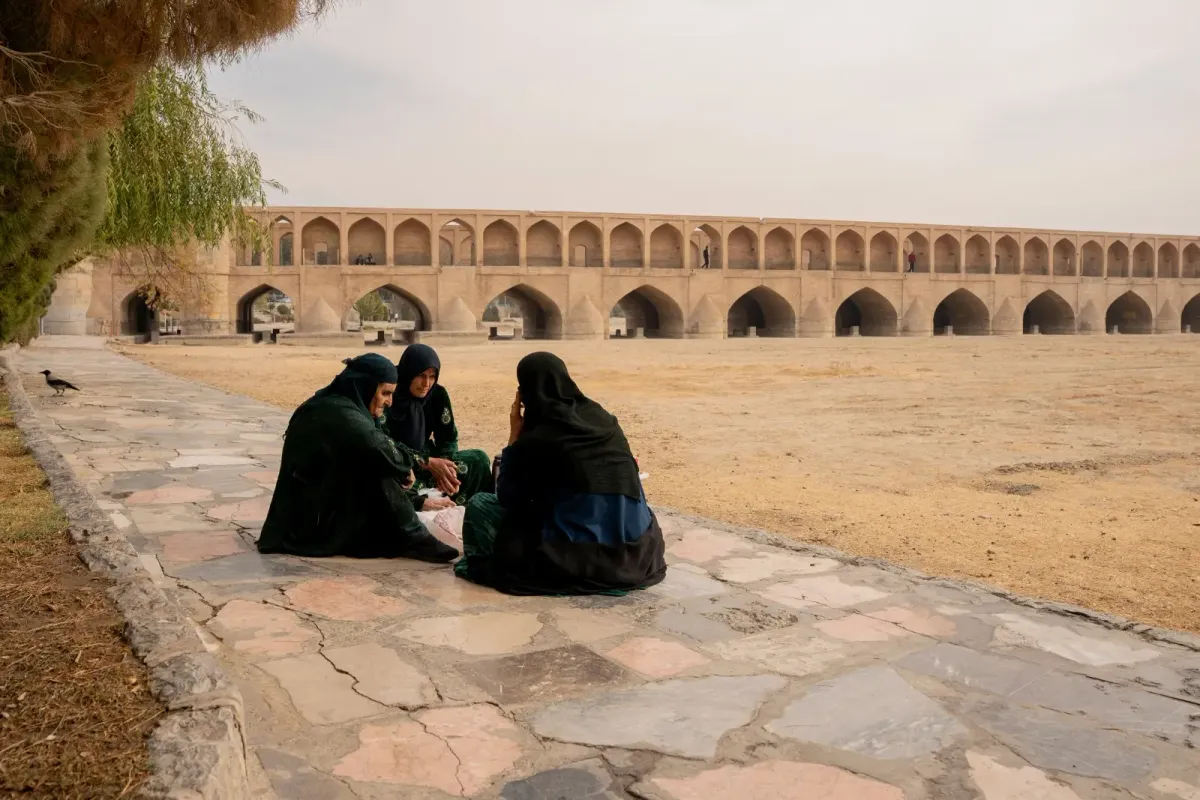
Tehran's aquifers are running dry. Lake Urmia, once one of the world's largest salt lakes, has shrunk to less than 10% of its former size. The Zayandeh River hasn't flowed in years. And in November, Iran's president warned that residents of the capital may eventually have to evacuate entirely as the ground beneath the city sinks.
This isn't just an environmental story. It's becoming a political one.
For decades, Iran's government ignored scientists, imprisoned environmental activists, and approved corrupt development projects that prioritized short-term power and profit over long-term sustainability. The result is a water crisis so severe that it's now fueling the largest protests since 2022–2023. Student activists have explicitly linked the ecological collapse to broader grievances about economic inequality and political repression. One student statement from December captured it plainly: "Crises have piled up: poverty, inequality, class oppression, gender oppression, pressure on nations, water, and environmental crises. All are direct products of a corrupt and worn-out system."
How environmental collapse became political collapse
The human toll is immediate and measurable. Tens of thousands of Iranians, including children, die prematurely each year from air and water pollution. Farmers can't plant crops because aquifers are overdrawn. Cities ration water supplies. Ordinary people worry about whether they'll have enough water to drink, bathe, or clean. Businesses have shuttered. Power outages are routine.
We're a new kind of news feed.
Regular news is designed to drain you. We're a non-profit built to restore you. Every story we publish is scored for impact, progress, and hope.
Start Your News DetoxBut the political dimension cuts deeper. Since the 1979 revolution, rural water projects have been tools of political control and legitimacy-building. Over time, this created what experts call a "water mafia" within the military establishment — a system where water itself became a prize to be diverted and controlled. Hundreds of dams were built, but not with sustainability in mind.
The diversion has created geographic winners and losers. Water that should flow to peripheral provinces — where ethnic minorities like Iran's Arab population live — has been redirected to central, Persian-dominated regions. In Khuzestan province, state-led water diversion has devastated the local economy and deepened ethnic resentment. In Sistan and Baluchestan, recent protests featured signs reading "Sistan is thirsty for water, Sistan is thirsty for attention." These aren't separate from the current uprising. They're the foundation of it.
Eric Lob, a scholar at the Carnegie Middle East Program, notes that environmental issues "tie into all the other grievances that activists and citizens and protesters have over economic and political issues." When your tap runs dry and your crops die, economic and environmental grievances aren't abstract — they're survival.
The Iranian government has responded to the protests with communication blackouts and violent crackdowns. But the underlying driver — the actual lack of water — remains. Unlike war or sanctions, which can theoretically be resolved through negotiation or policy change, a depleted aquifer is a physical fact. You cannot negotiate with geology.
As ecological conditions worsen, the regime faces a crisis it may not be able to suppress or spin. The water crisis is becoming the thing that no amount of military force or propaganda can fix.