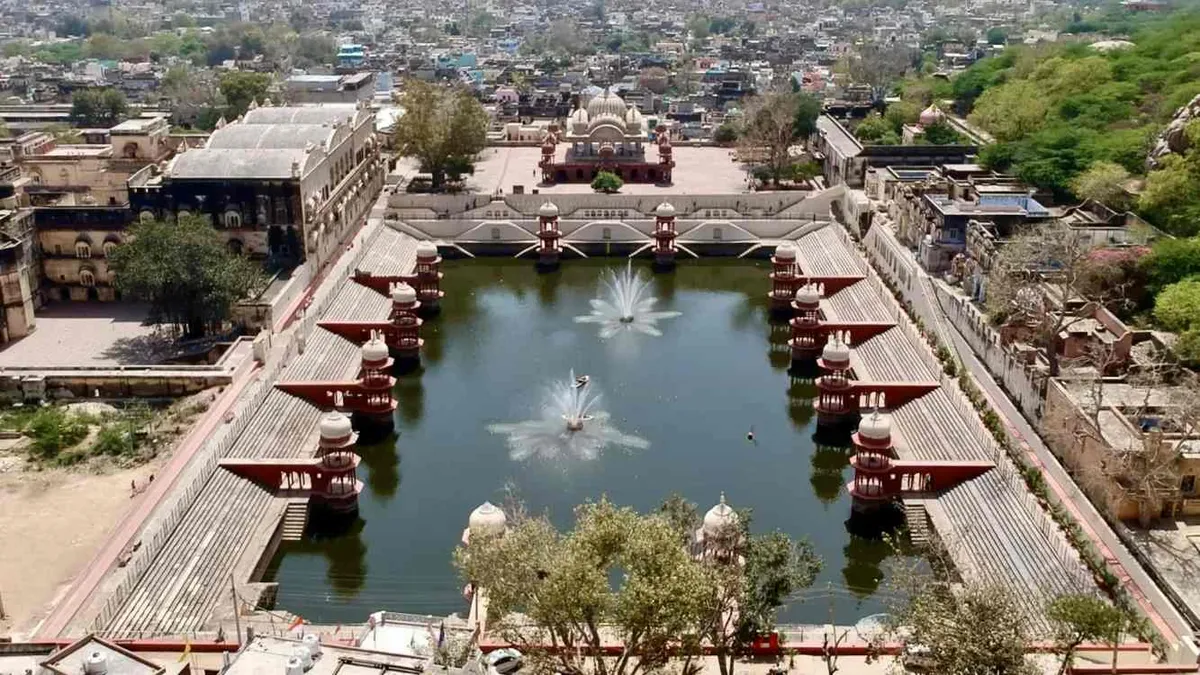
Over 3,000 stepwells dot India's landscape—intricate stone structures that once supplied entire cities with water. Most have become garbage dumps. But in Rajasthan, one nonprofit is proving they could work again.
The Moosi Rani Sagar stepwell in Alwar had been strangled by silt, overgrowth, and decades of neglect. When the Environmentalist Foundation of India (EFI) began work there, they faced months of dredging, pumping out stagnant water, and removing accumulated waste. The structure itself—fed by a 900-meter canal with its own sedimentation tank—required specialized knowledge of centuries-old construction methods to restore safely.
When it reopened, it delivered clean water directly to the local civic supply.
"Stepwell restoration is the next big implementation challenge," says Arun Krishnamurthy, EFI's founder. "These are a testament to human intelligence." Krishnamurthy's organization has already cleaned and restored over 600 water bodies across India. Two stepwells are now functional, with six more targeted for completion by 2026.
We're a new kind of news feed.
Regular news is designed to drain you. We're a non-profit built to restore you. Every story we publish is scored for impact, progress, and hope.
Start Your News DetoxWhy this matters now
India's water crisis is real—groundwater tables are dropping, rivers are drying, and cities are rationing supply. But these stepwells were engineered solutions to exactly this problem. They captured monsoon runoff, filtered it through sand layers, and stored it in underground chambers where evaporation was minimal. A single restored stepwell can supply millions of gallons to surrounding communities.
The challenge isn't the engineering—it's the expertise. Finding masons who understand traditional stone-setting techniques, sourcing period-appropriate materials, reinforcing structures without destroying their integrity. For the upcoming Devanahalli stepwell near Bangalore, Krishnamurthy had to locate local experts trained in heritage restoration. The Hinduja Foundation and Prince Albert II de Monaco Foundation have backed the work, recognizing both the water security and historical preservation value.
What's emerging is a template: identify abandoned stepwells, assess structural integrity, bring in heritage specialists, restore them as functioning water sources. It's slower than drilling new boreholes, but it solves two problems at once—it adds water storage to communities that need it, and it rescues architectural history from becoming rubble.
The next phase will determine whether this scales. EFI's pipeline suggests it might.