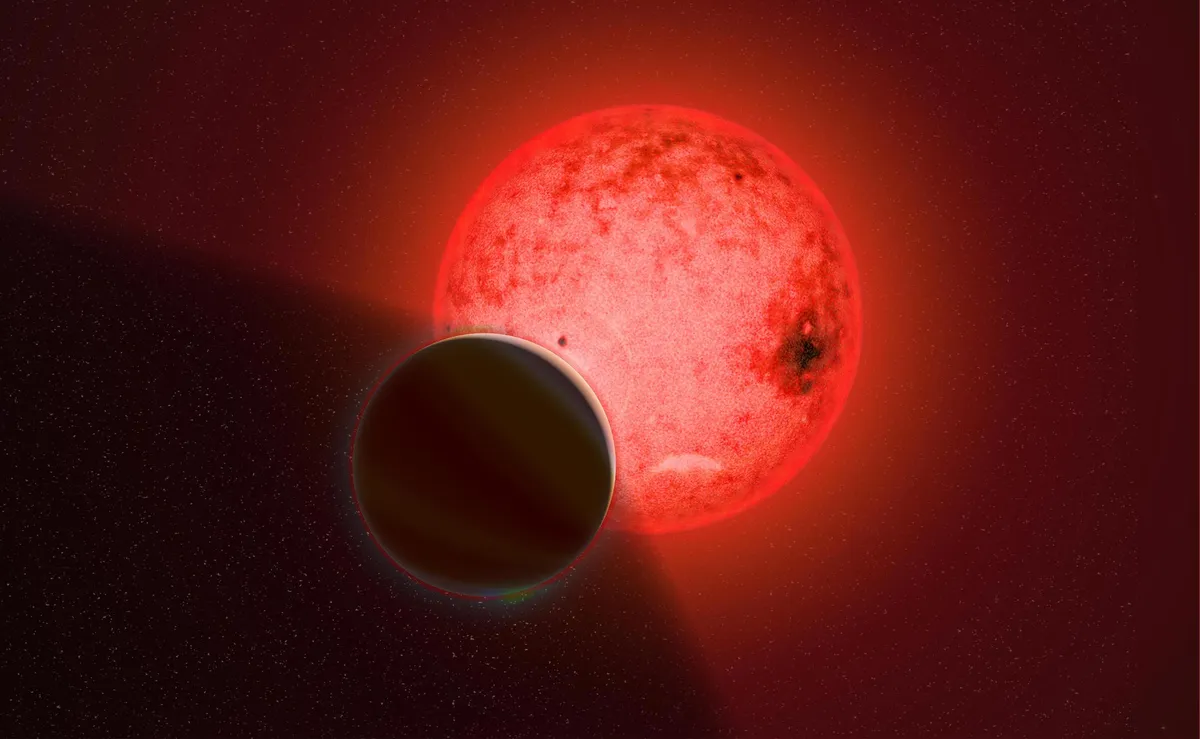
Imagine a pea-sized star with a planet the size of a bowling ball orbiting it. That's essentially what astronomers just found: a planet, TOI-5205 b, that's roughly Jupiter-sized, but its star is only about four times Jupiter's diameter. It's like a cosmic impossibility, a planet that, by all current rules, shouldn't exist.
Thanks to the James Webb Space Telescope (JWST), scientists peering at this giant exoplanet discovered its atmosphere is surprisingly — and bafflingly — devoid of heavy elements. This flies directly in the face of everything we thought we knew about how massive planets are supposed to form. It’s the kind of astronomical plot twist that makes scientists rethink their entire textbooks.
Caleb Cañas from NASA’s Goddard Space Flight Center led the study, published in The Astronomical Journal, with key contributions from Shubham Kanodia of Carnegie Science. Because apparently, the universe loves to keep us on our toes.
We're a new kind of news feed.
Regular news is designed to drain you. We're a non-profit built to restore you. Every story we publish is scored for impact, progress, and hope.
Start Your News DetoxTOI-5205 b is roughly the size of Jupiter, while its pint-sized star is only 40% the mass of our Sun. When this colossal planet passes in front of its tiny star, it blocks a whopping six percent of the starlight. This isn't just a pretty show; it's how scientists get a detailed readout of the planet's atmospheric composition.
A Cosmic Head-Scratcher
Planets typically coalesce from swirling disks of gas and dust around young stars. And while giant planets are supposed to grow in these disks, systems like TOI-5205 b are the cosmic equivalent of trying to fit a square peg in a very, very round hole. A gargantuan planet snuggled up to such a small, cool star simply doesn't compute with existing formation models.
Kanodia first confirmed TOI-5205 b in 2023 using data from NASA’s Transiting Exoplanet Survey Satellite (TESS). Now, with the JWST, his team has completed the first detailed atmospheric study, and it’s throwing curveballs.
Observations from three different transits showed that TOI-5205 b's atmosphere has significantly fewer heavy elements (relative to hydrogen) than Jupiter. Even more bizarre? It has fewer heavy elements than its own star. This is completely unexpected, as giant planets typically accumulate more heavy elements than their stellar parents. Methane (CH₄) and hydrogen sulfide (H₂S) were detected, too, because why not add more layers to the mystery?
To make sense of this, researchers Simon Muller and Ravit Helled from the University of Zurich ran planetary structure models. Their findings suggest that while the planet's atmosphere is metal-poor, the planet as a whole is about 100 times richer in metals. This implies a serious case of internal segregation: heavy elements must have migrated inward during formation, leaving the planet's interior and atmosphere largely unmixed. Basically, this planet is keeping its good stuff hidden.
Kanodia notes that these results point to an atmosphere that's surprisingly rich in carbon and poor in oxygen. All of which makes TOI-5205 b less a planet and more a cosmic enigma, daring us to rewrite the rules of the universe. And honestly, it’s kind of thrilling.