

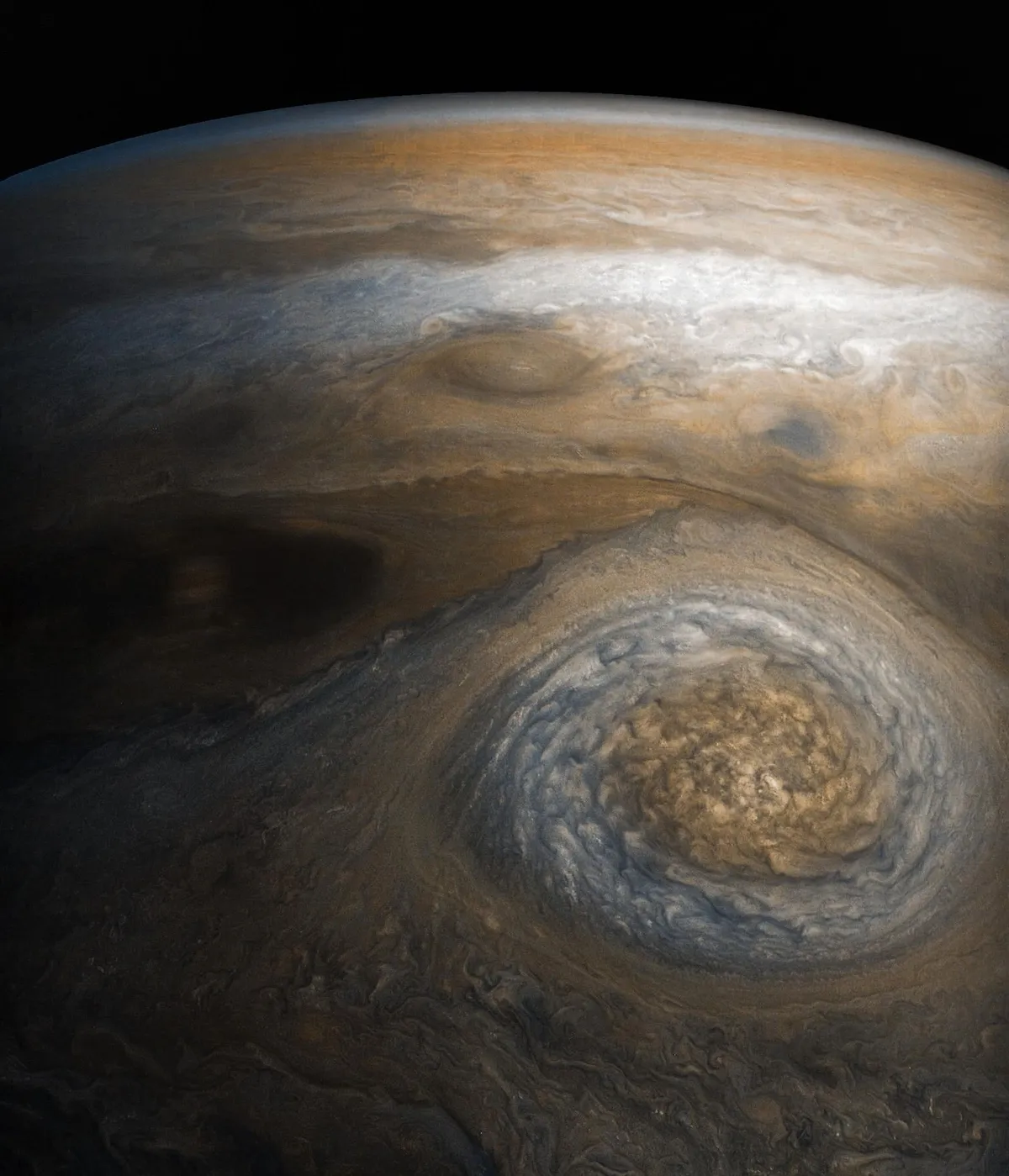
Jupiter, the largest planet in our solar system, has massive storms. These storms can last for centuries and unleash powerful lightning bolts. For a long time, it was hard to understand how strong these strikes were because of Jupiter's thick clouds.
Now, new data from NASA's Juno spacecraft has given scientists a clearer picture. They found that Jupiter's lightning flashes are about 100 times more powerful than those on Earth. These findings, published in AGU Advances on March 20, can help us better understand the gas giant's storms.
Uncovering Jupiter's Powerful Lightning
Previous missions had detected lightning on Jupiter, but they could only see the strongest flashes on the planet's dark side. In 2016, the Juno spacecraft began orbiting Jupiter. It has an instrument that can pick up radio waves from these powerful zaps, even though it wasn't specifically designed for lightning studies.
We're a new kind of news feed.
Regular news is designed to drain you. We're a non-profit built to restore you. Every story we publish is scored for impact, progress, and hope.
Start Your News DetoxJupiter's atmosphere is very turbulent, with many storms happening at once. This made it hard for Juno to figure out which storm caused the lightning it detected. It was like hearing many firecrackers at a parade and not knowing if they were close by or far away, explained Michael Wong, a planetary scientist at the University of California, Berkeley, and a co-author of the study.
However, Wong and his team got lucky in 2021 and 2022. Storms in a part of Jupiter's northern region calmed down. This allowed researchers to focus on one storm at a time using the Hubble Space Telescope, Juno's camera, and images from citizen scientists. Wong noted that having a precise location allowed them to directly measure the power of the lightning.
Juno analyzed four storms and found they averaged three lightning strikes per second. The spacecraft detected 613 pulses in total. Their power ranged from that of an Earth bolt to 100 times or more that energy. To compare, an Earth lightning flash releases about one billion joules of energy, enough to power about 200 homes for an hour.
Wong told Space.com that it was satisfying to see their Juno data capture most lightning pulses at radio wavelengths. He added that before, there was a question about whether they were only catching the strongest pulses.
The Bigger Picture of Jovian Lightning
These new measurements might even be an underestimate. Jovian bolts likely release other types of energy, such as heat, sound, and chemical energy. Researchers believe Jupiter's bolts could be up to 10,000 times as powerful as those on Earth. Wong compared it to only seeing part of the Loch Ness Monster and having to guess its full size.
Scientists still need to figure out exactly how Jupiter generates lightning. However, these findings can help them understand how heat moves from the lower atmosphere to the upper regions through a process called convection.
On Earth, moist air is lighter than dry air because it contains water, which is lighter than nitrogen. This allows moist air to rise easily. Jupiter's atmosphere, however, is rich in hydrogen, which is lighter than water. This means moist air is harder to move upward. So, more energy is needed to start a storm on Jupiter than on Earth. When a storm does happen at the top of Jupiter's atmosphere, it releases much more energy.
This research also has implications for the search for life. The energy from lightning bolts can trigger chemical reactions that might lead to organisms. While Jupiter likely cannot support life as we know it, similar flashes on a more habitable world could potentially spark life. Some scientists think this is how microbes first appeared on Earth.
Daniel Mitchard, a lightning physicist at Cardiff University, noted that complex chemistry needs either volcanoes or lightning. He added that more energetic lightning produces more chemistry.
Deep Dive & References
- Lightning bolts on Jupiter pack more than 100 times the power of Earth’s flashes - Berkeley News, 2026
- Lightning on Jupiter could be up to 1 million times stronger than on Earth - Space.com, 2026
- Jupiter’s weather forecast: Cloudy with a chance of nukes - Science, 2026
- AGU Advances - March 20, 2026





