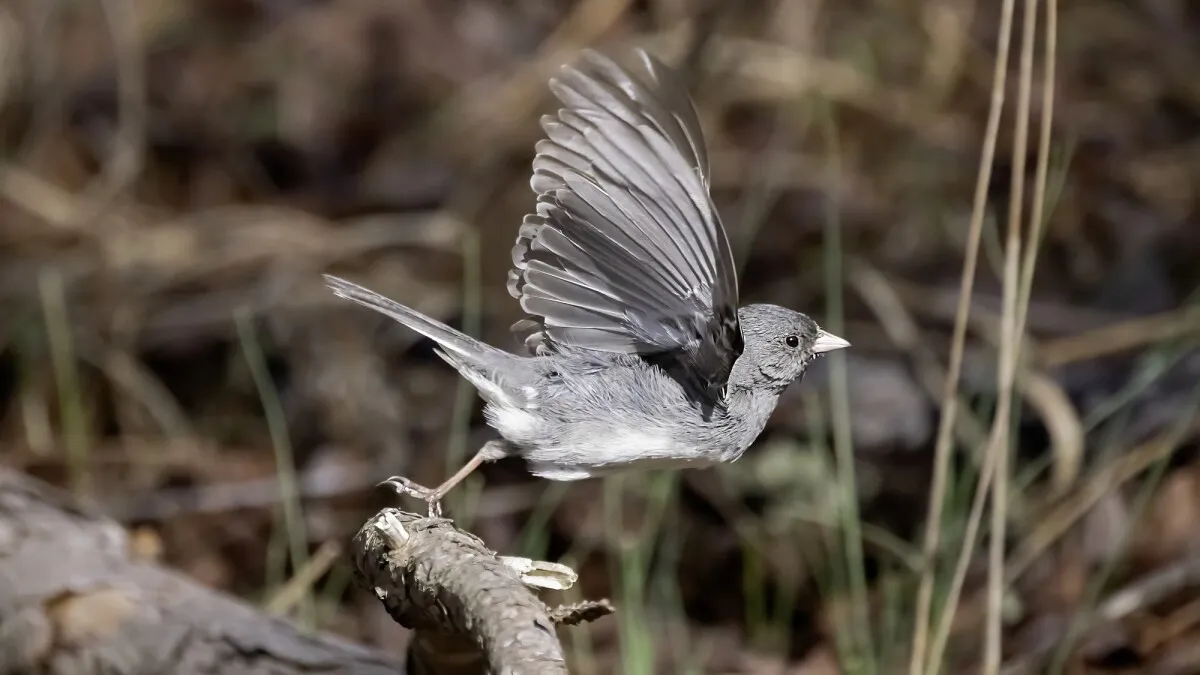
When Los Angeles emptied during lockdowns, something unexpected happened in the juncos—small gray sparrows living on the UCLA campus. Birds hatched during 2020 and 2021 developed noticeably longer, more slender beaks. By 2024 and 2025, as the city filled back up, those beaks shortened again.
This isn't evolution unfolding over millennia. Researchers tracked dark-eyed juncos from 2018 to 2025 and watched physical traits shift within years, then reverse just as quickly. The mechanism is almost certainly not genetic mutation—there wasn't time. Instead, it's a window into how tightly urban wildlife is bound to human behavior, and how fast that relationship can reshape living things.
Why beaks changed
Urban juncos have always looked different from their wildland cousins. City birds evolved shorter, thicker beaks—tools built for cracking open human food waste, seeds from bird feeders, and scraps from outdoor dining. It's a shape that works brilliantly in a city full of people and their leftovers.
We're a new kind of news feed.
Regular news is designed to drain you. We're a non-profit built to restore you. Every story we publish is scored for impact, progress, and hope.
Start Your News DetoxWhen lockdowns closed restaurants and cleared the streets, that food supply vanished almost overnight. Dining facilities shut down. Outdoor gathering spaces emptied. The organic waste that had sustained generations of urban juncos simply wasn't there anymore. Birds that had relied on human abundance suddenly faced a choice: leave the city or adapt.
They adapted. Juncos born during lockdown developed longer, more slender beaks—the kind suited to natural food sources like seeds and insects. These beaks resembled those of juncos living in nearby wildland areas, where people and their waste had never shaped the food landscape. The shift happened in a single generation, which tells you something important: the change wasn't about new genetic mutations spreading through the population. It was about selection acting on variation that already existed. Some birds in the population already carried genes for longer beaks. When short beaks suddenly became a liability, those longer-beaked birds thrived and passed on their traits.
What happened next
As humans returned to the city and restaurants reopened, the pattern reversed. Juncos born in 2023 and 2024, as normal urban life resumed, developed shorter beaks again. The ecological landscape had shifted back. The food landscape had shifted back. The birds followed.
This reversibility is what makes the finding so striking. We're not watching evolution carve permanent change into a species over generations. We're watching a population respond to immediate conditions, then respond again when those conditions change. It's adaptation in real time, visible in the span of a few years.
Researchers acknowledge they can't rule out other possibilities—birds from surrounding wildland populations might have moved into the quieter city during lockdown and interbred with urban juncos, though they consider this unlikely. But the most straightforward explanation is that selection on existing genetic variation did the work.
What this means
The study, published in Proceedings of the National Academy of Sciences, doesn't prove that evolution is happening—at least not yet. It proves something more immediate: urban wildlife lives on a knife's edge of human activity. Change the food, change the noise, change the foot traffic, and the animals shift their behavior and their bodies to match. These shifts might lay the groundwork for genuine evolutionary change over longer timescales, but that's a question for the next decade or two.
For now, the juncos of Los Angeles offer a rare, clear-eyed look at how quickly nature responds when we change the rules. When we emptied the city, they adapted. When we came back, they adapted again. The next question is what happens when the next disruption arrives—and whether these rapid shifts hint at how urban wildlife might survive the larger changes ahead.