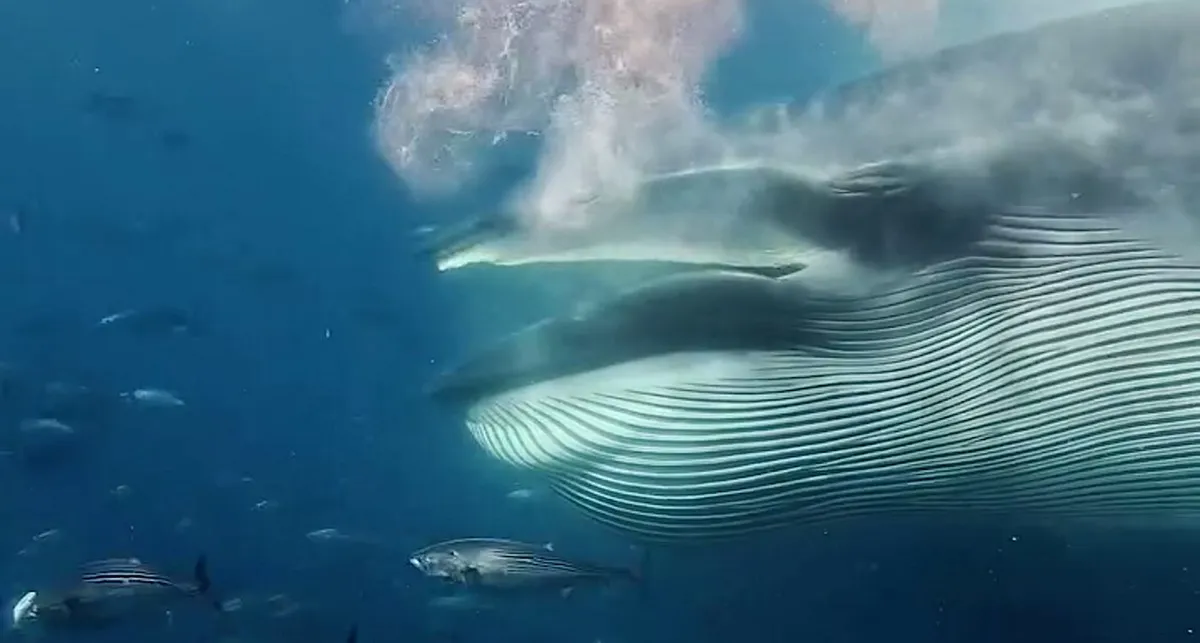
Emily Marzilli was underwater near Magdalena Bay in Baja California Sur, watching striped marlin circle a shimmering bait ball the size of a car, when the water suddenly shifted. A Bryde's whale—weighing 20 to 30 tons—surfaced without warning and took a single massive bite out of the sardine mass before disappearing back into the depths.
The entire encounter lasted two minutes.
"Out of nowhere, this Bryde's whale came and just took a huge bite out of the baitball and just swam away," Marzilli, a free-diving instructor, said afterward. The shock wasn't just from seeing a whale that close. It was the scale of the thing—expecting to document fish behavior and suddenly finding yourself face-to-face with an animal the weight of three cars.
When the Ocean Reveals Itself
Magdalena Bay during sardine season is where the ocean's feeding dynamics play out with almost theatrical intensity. Millions of sardines bunch into dense, glittering spheres as a survival tactic—predators can only eat from the outside, so the ball itself becomes a kind of collective shield. But that shield only works against fish-sized hunters. When a baleen whale arrives—a creature with no teeth but two rows of filter plates designed to gulp entire schools in one mouthful—the equation changes instantly.
We're a new kind of news feed.
Regular news is designed to drain you. We're a non-profit built to restore you. Every story we publish is scored for impact, progress, and hope.
Start Your News DetoxBreyde's whales belong to the same baleen family as blue whales and humpbacks. They're built for exactly this kind of feeding: surface, open their enormous mouths, take in thousands of gallons of water and fish, then filter the water back out through those baleen plates, trapping the sardines inside. It's efficient, brutal, and over in seconds.
For Marzilli and her fellow divers, the moment crystallized something most people never experience. "Those are interactions that you can only dream of and wish to happen," she reflected. Not a documentary moment carefully framed by a camera crew. Not a photograph in a magazine. Just the raw, unfiltered reality of predator and prey at the scale the ocean actually operates at.
After the whale left, the bait ball was gone—consumed by both the marlin circling above and the whale that had just passed through. The divers returned to their boat carrying something no video could quite capture: the memory of being small, for a moment, in a very large world.