For years, lidar — the 3D 'eyes' of self-driving cars and drones — has had a bit of a spatial awareness problem. It could map the world in incredible detail, but only within a limited scope. Try to expand its view, and things got noisy. Turns out, staring at the world without bumping into yourself is harder than it looks.
But now, MIT engineers have whipped up a new chip that finally fixes lidar's long-standing field-of-view issue. And they did it by essentially teaching tiny antennas how to stop talking over each other.
The Price of Vision
Traditional lidar sensors are big, bulky, and expensive. They rely on moving parts, which, as anyone with a car knows, eventually wear out. Not ideal for something that's supposed to keep a robotaxi from swerving into a ditch.
We're a new kind of news feed.
Regular news is designed to drain you. We're a non-profit built to restore you. Every story we publish is scored for impact, progress, and hope.
Start Your News DetoxEnter silicon photonics: a tech that uses semiconductors to control light, not electricity. This promises lidar sensors that are smaller, cheaper, and way more durable. The catch? These chip-based systems have always had a narrow field of view. Think of it like a very high-res camera with tunnel vision. Expand that view, and you get interference, or 'crosstalk,' which muddies the whole picture.
MIT's solution, published in Nature Communications, involved designing an array of integrated antennas that drastically cut down this crosstalk. Suddenly, a lidar chip can scan a much wider area without sacrificing the precision needed for things like autonomous vehicles and detailed aerial mapping. Which, if you think about it, is both impressive and slightly terrifying.
How to Stop Antennas From Gossiping
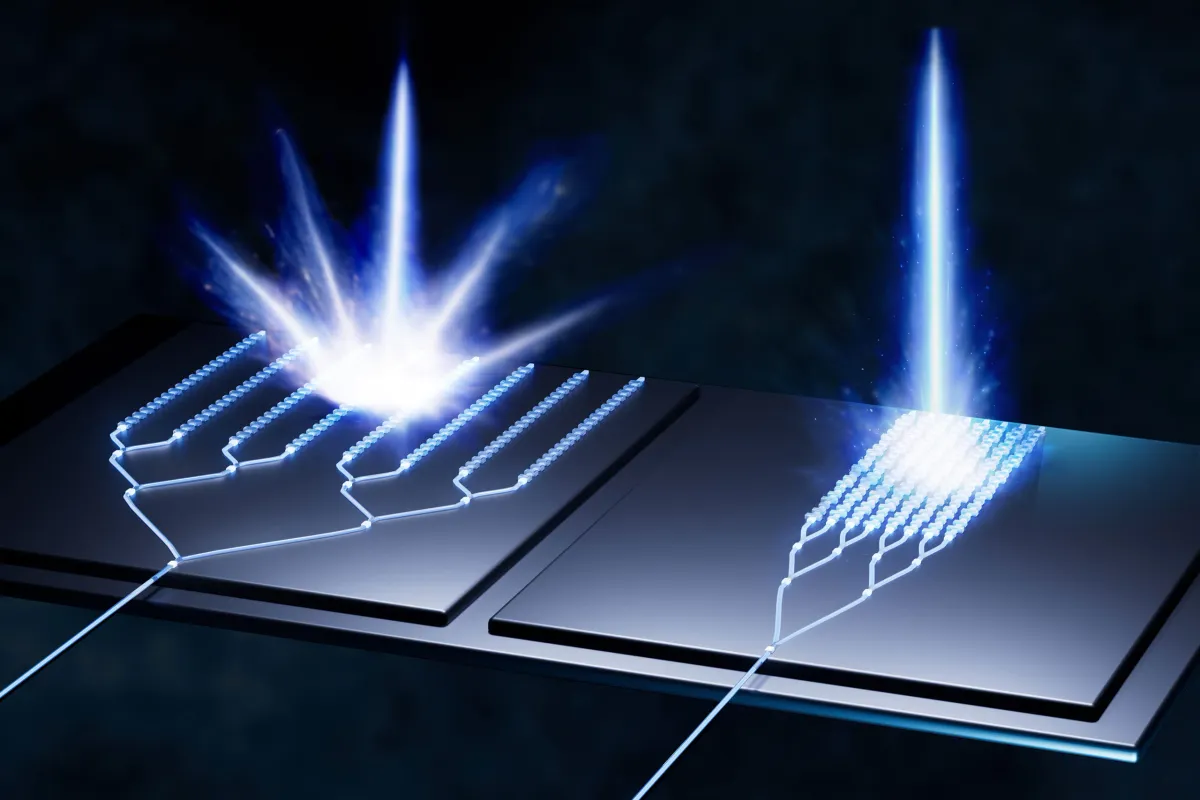
Old-school lidar often uses a spinning unit to send out light pulses. The silicon-photonics version, however, steers light electronically using an integrated optical phased array (OPA). No moving parts, no wear and tear. An OPA works by having a bunch of tiny antennas with ridges that scatter light upward and outward. By tweaking the light's 'phase' to each antenna, researchers can steer the beam electronically.
Here’s where the drama starts: if these antennas are too close, they interfere with each other, distorting the light. Spread them out, and you get a different problem called 'grating lobes' — basically, multiple copies of the light beam at different angles. This makes it impossible to tell which beam is the real one, confusing the sensor and wasting energy. As co-author Andres Garcia Coleto put it, those duplicate beams can really mess with an autonomous vehicle's ability to see the world.
The MIT team’s genius move was to design antennas that reduce crosstalk, allowing them to be packed much closer together without all the interference. They used three different antenna designs with varying widths and ridge patterns. Each design has a unique 'propagation coefficient,' which changes how light moves through it.
Garcia Coleto explained that because these antennas have such different coefficients, they essentially don't 'see' each other when placed close. It’s like putting three people with vastly different native languages in a room; they’re less likely to interrupt each other mid-sentence.
Of course, getting these disparate antennas to emit light uniformly was a whole other headache. They had to emit the same amount of light, direct the beam at the same angle, and shift that angle consistently as the beam was steered. Henry Crawford-Eng, the lead author, called it 'very difficult.' They had to develop a whole new theory on how light modes interact before they could even design and simulate the antennas. Because apparently that’s where we are now: designing theories before designing the actual thing.
The results are pretty stark: in a standard OPA, coupling (interference) would be around 100%. In the MIT system, it plummeted to about 1%, all while producing a single, precise beam across a wide field of view. No grating lobes. Just pure, unadulterated vision.
So, self-driving cars might just see the world a whole lot clearer very soon. And maybe, just maybe, they’ll stop looking quite so much like they’re wearing blinders. Which is good news for anyone who plans on sharing the road with them.