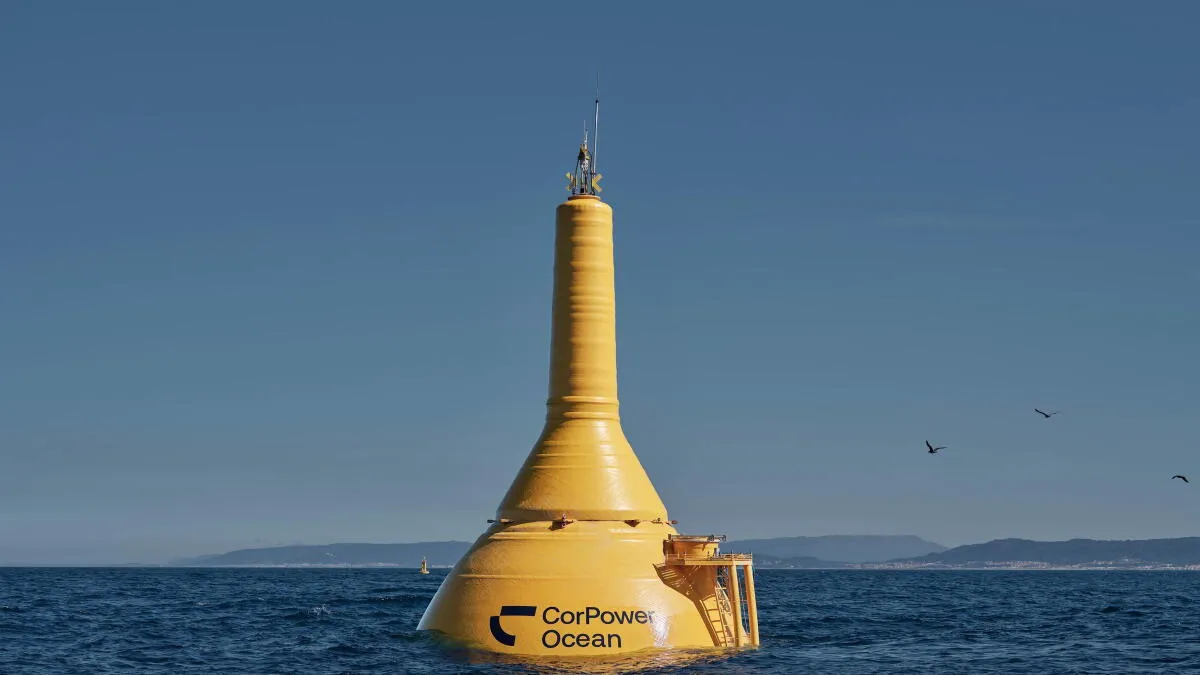
A Swedish device that turns ocean waves into electricity has passed a major safety test. This hurdle has kept wave power from becoming a widespread energy source for decades. CorPower Ocean's C4 buoy has now earned the strictest safety certificate in the marine energy industry.
The company is now working towards building what could be the world's first commercial wave power plant.
A New Standard for Wave Energy
The CorPower C4 is the first wave energy converter to get a full certificate from DNV. DNV is a Norwegian company known as the top standard for offshore energy certification. The review took seven years. It looked at everything from the initial design to how the structure handles stress and how it survives real storms.
We're a new kind of news feed.
Regular news is designed to drain you. We're a non-profit built to restore you. Every story we publish is scored for impact, progress, and hope.
Start Your News DetoxThis approval is very important for an industry that has struggled for 50 years to get investors. Large funders usually won't support marine energy projects without this kind of certification.
Patrik Möller, CorPower Ocean's co-founder and CEO, called this a "historic milestone." He said it changes wave energy from a promising idea to a proven and reliable technology.
How the C4 Buoy Works
The C4 buoy is shaped like a teardrop. It is 9 meters (30 feet) wide, 18 meters (59 feet) tall, and weighs about 100 tons. A strong cable tethers it to the seabed. When a wave pushes the buoy up, the cable pulls it back down with equal force. This is like a stretched elastic band snapping back.
This constant up-and-down motion spins a set of wheels connected to a gearbox. The gearbox spreads the mechanical load across several smaller parts. This reduces wear and tear. The spinning then drives a generator, which sends power to shore through undersea cables.
The buoy's clever part is its phase-control system, called WaveSpring. It works like a spring that makes the motion stronger, similar to how a heart valve pumps in sync with blood flow. On calm days, a wave just 1 meter (3.3 feet) tall can make the buoy move 3 meters (10 feet). This triples the energy captured.
During storms, the system does the opposite. It loosens up, letting waves pass through with little resistance. This allows the buoy to survive waves up to 18.5 meters (61 feet) without damage.
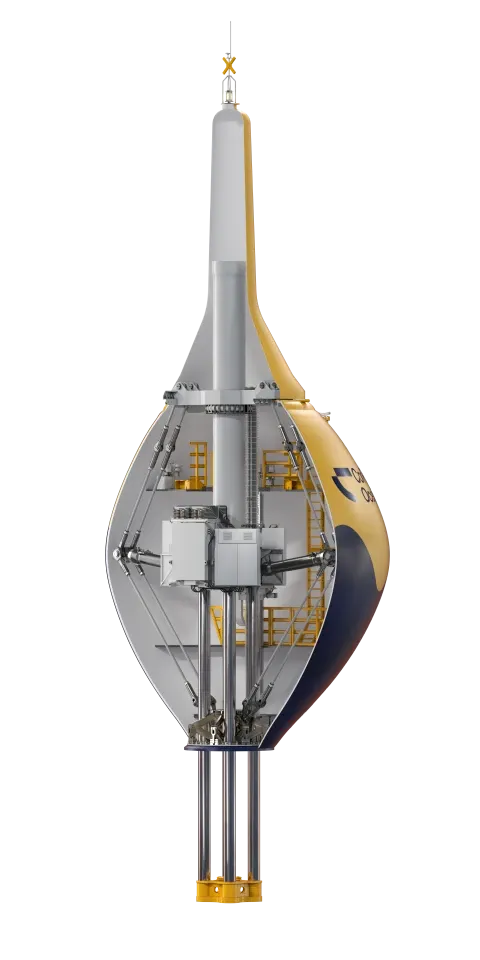 Its WaveSpring phase-control system works like a spring that amplifies wave motion, letting a 1-m wave move the buoy up to 3 m
The Future of Wave Power
One buoy alone doesn't generate much power. CorPower plans to group dozens of buoys into arrays called CorPacks. Each CorPack could produce hundreds of megawatts, enough to power hundreds of thousands of homes.
Unlike wind or solar, waves roll around the clock, making the power output steadier. Waves are built up by weather systems over several days across entire oceans. This smooths out the energy before it reaches the coast. This steady output could help balance the power grid. It could reduce the need for backup storage or extra wind and solar capacity.
A prototype has been operating off Aguçadoura in northern Portugal since 2023. It sits 4 kilometers (2.5 miles) offshore at a depth of 45 meters (148 feet). It has run on its own, sent power to Portugal's grid, and survived Atlantic storms. This includes a record 18.5-meter (61-foot) wave during Storm Domingos in November 2023. Surviving this storm without damage helped convince DNV to give its approval.
CorPower is now moving towards its first two commercial-scale arrays in Portugal and Scotland. The goal is to make wave power the world's third-largest renewable energy source, after wind and solar. If these projects work as planned by 2027-2029, they will show that wave power can be a reliable part of the grid.
Claudio Bittencourt Ferreira, Project Manager at DNV Renewables Certification, praised CorPower's commitment. He noted that this certificate is an important step towards making commercial wave energy a reality.
Deep Dive & References: CorPower Ocean