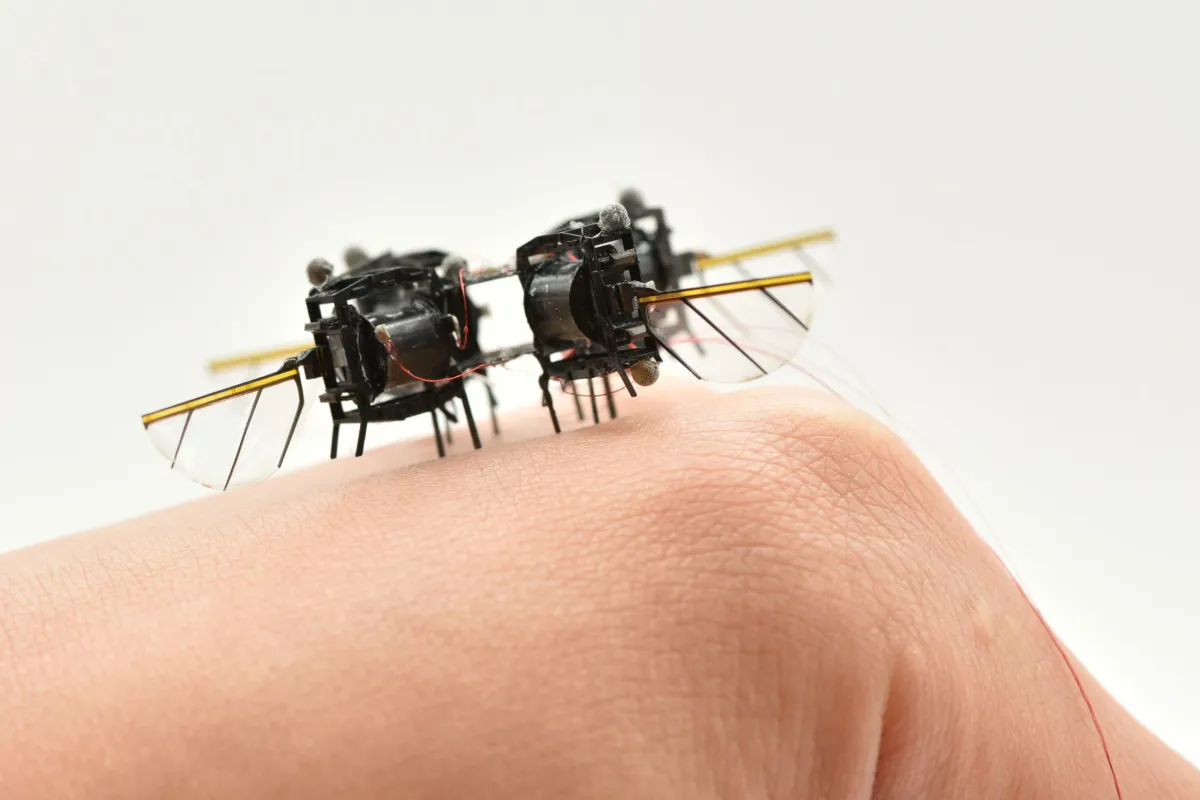
MIT researchers have created tiny flying robots that can move like real insects. These microrobots could one day help in search-and-rescue missions. They are small enough to fit into tight spaces where larger robots cannot go.
AI Gives Robots Insect-Like Moves
Previously, these tiny robots could only fly slowly. Now, MIT has developed a new AI-based control system. This system lets the robots perform complex flight moves, like repeated flips.
The new control system is very efficient. It made the robot 450% faster and 250% quicker at accelerating.
We're a new kind of news feed.
Regular news is designed to drain you. We're a non-profit built to restore you. Every story we publish is scored for impact, progress, and hope.
Start Your News DetoxThe robot successfully did ten flips in 11 seconds. It stayed in control even when wind tried to push it off course.
Kevin Chen, an associate professor at MIT, explained that these robots can now fly as well as insects in terms of speed and agility. This is a big step toward using them in real-world situations.
The research was published in Science Advances.
How the Robot Works
The robot is about the size of a microcassette and weighs less than a paperclip. It has soft artificial muscles that power its flapping wings at high speeds.
The team had improved the robot's physical design. But the control system, its "brain," needed an upgrade. It was hard to manually tune the system to handle fast, complex movements.
To fix this, Chen's team worked with Jonathan P. How's team. They created a two-step, AI-driven control system. This system is reliable for fast moves and efficient enough to work in real time.
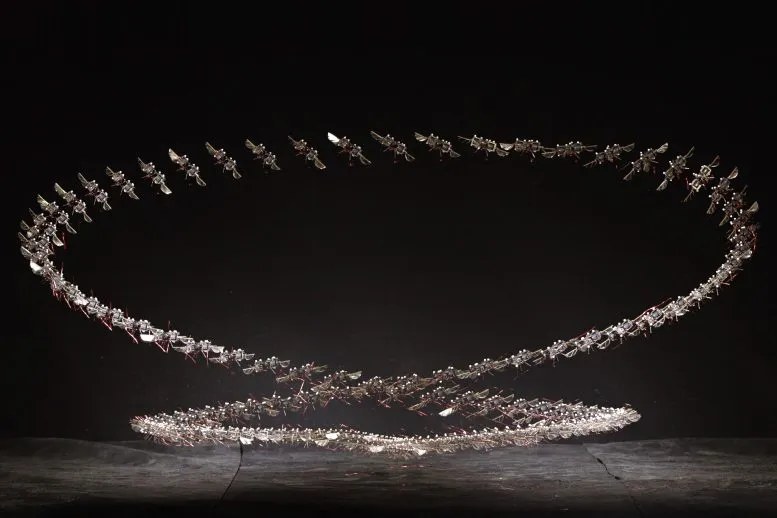 “Now, with our bio-inspired control framework, the flight performance of our robot is comparable to insects in terms of speed, acceleration, and the pitching angle,” says Kevin Chen. Credit: Courtesy of the Soft and Micro Robotics Laboratory
The first part of the system is a model-predictive controller. It plans the robot's movements, like somersaults and sharp turns. It also makes sure the robot stays in control and avoids crashes.
This planner is powerful but needs a lot of computing power. So, the researchers used it to train a "policy" based on deep learning. This policy acts as the robot's decision-maker during flight.
This "imitation learning" transfers the planner's abilities into a faster AI model. This model can then operate in real time.
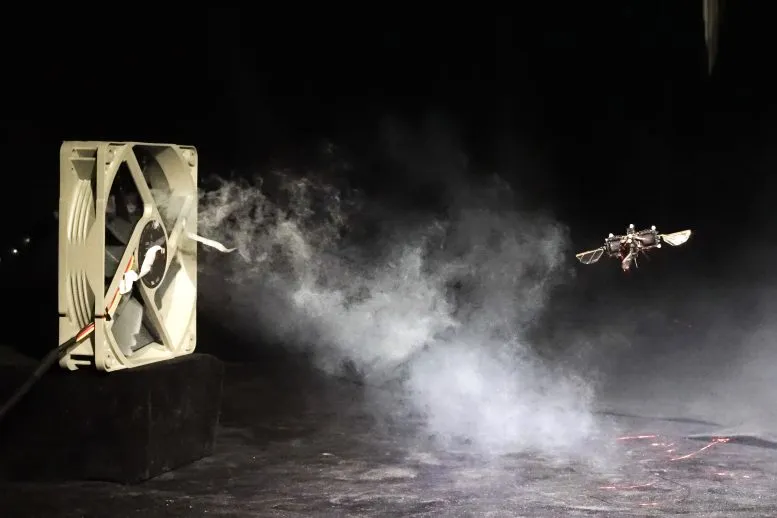 Even when wind disturbances threatened to push it off course, a speedy robot was agile enough to complete 10 consecutive somersaults in 11 seconds. Credit: Courtesy of the Soft and Micro Robotics Laboratory
The robot also performed a "saccade" maneuver. This is when insects tilt sharply, speed up, and then pitch back to stop. This helps them find their position and see clearly.
What's Next for the Tiny Robots
The next step is to add cameras and sensors to the microrobots. This will allow them to navigate outdoors without needing a special motion capture system.
The researchers also want to see if sensors can help groups of robots work together. This would allow them to coordinate movements and avoid collisions.
Kevin Chen hopes this research will inspire new control systems for microrobots. He believes it shows that these small robots can be both high-performing and efficient.
Deep Dive & References
Aerobatic maneuvers in insect-scale flapping-wing aerial robots via deep-learned robust tube model predictive control - Science Advances, 2025