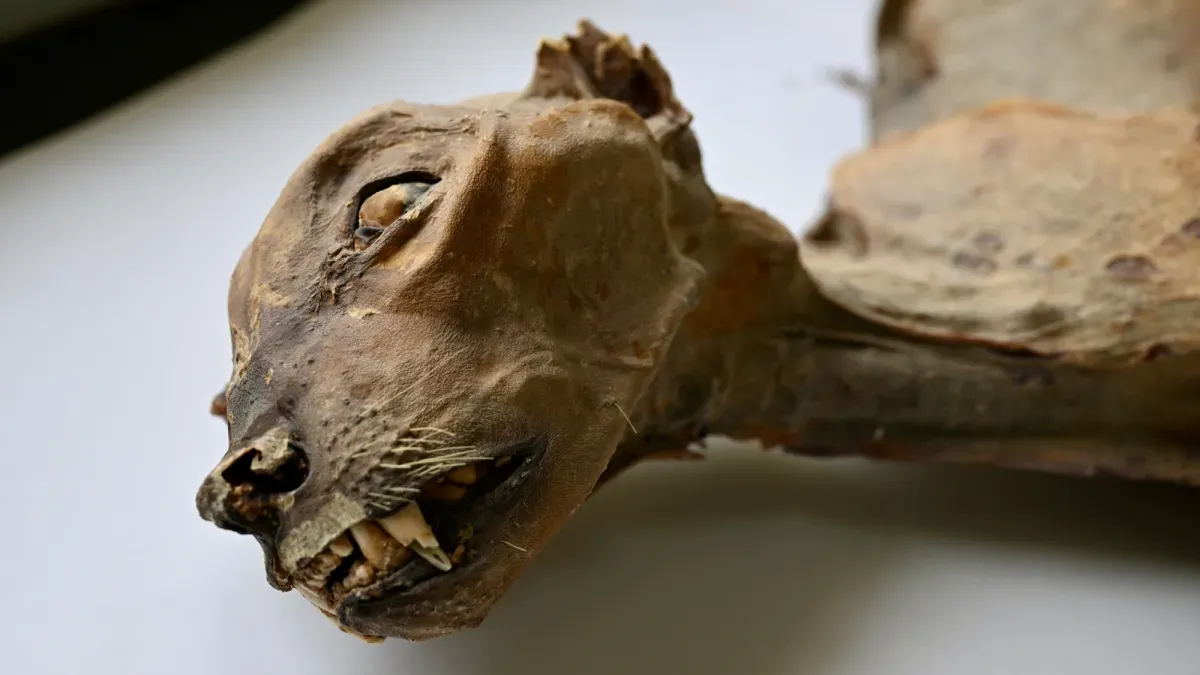
Seven naturally-mummified cheetahs, preserved in Saudi Arabian caves for over a thousand years, have just handed conservation scientists an unexpected blueprint for bringing the species back to a region where it's been gone for centuries.
The discovery came during excavations near Arar in 2022 and 2023, when researchers from Saudi Arabia's National Center for Wildlife unearthed skeletal remains of 54 other cats alongside the seven remarkably preserved cheetahs. The mummified specimens ranged from 130 to 1,870 years old—old enough to tell a story about what cheetah populations actually looked like in this part of the world, and what genetic tools might now be available to restore them.
Cheetahs once roamed across most of Africa and Asia. Today, their range has contracted by 98% over the past several thousand years. The Asiatic cheetah subspecies that once hunted across the Arabian Peninsula is now locally extinct there, and the entire species is critically endangered. This is the context for why three complete genome sequences extracted from the mummified remains, published this week in Communications Earth & Environment, matter so much.
We're a new kind of news feed.
Regular news is designed to drain you. We're a non-profit built to restore you. Every story we publish is scored for impact, progress, and hope.
Start Your News DetoxWhat the bones reveal
The genetic analysis showed something unexpected: the most recent mummified cheetah—from around 150 years ago—was closest to the Asiatic subspecies. But two older specimens carried genetic signatures more similar to the Northwest African cheetah, a different critically endangered subspecies. This overlap suggests that ancient Arabian cheetah populations were genetically more diverse than anyone expected, and it opens a practical door for rewilding.
Because cheetah subspecies can interbreed and produce fertile offspring, conservationists now have a wider genetic toolkit to work with. Rather than trying to source animals from a single, dwindling population, they could potentially draw from multiple subspecies to rebuild a population with greater genetic resilience—something that would have been pure speculation without ancient DNA.
The researchers emphasize that these mummified remains aren't just curiosities. They're a template for how paleontological findings can directly inform modern conservation strategy. By understanding what genetic diversity actually existed in a region centuries ago, scientists can design reintroduction programs that are more likely to succeed.
That said, the path forward isn't straightforward. Habitat destruction remains ongoing across the Arabian Peninsula, and any reintroduction effort would need to address that reality first. The cheetahs can't return to a landscape that can't sustain them. But for the first time, conservationists have a clear genetic map of what's possible—and that map comes from the past.