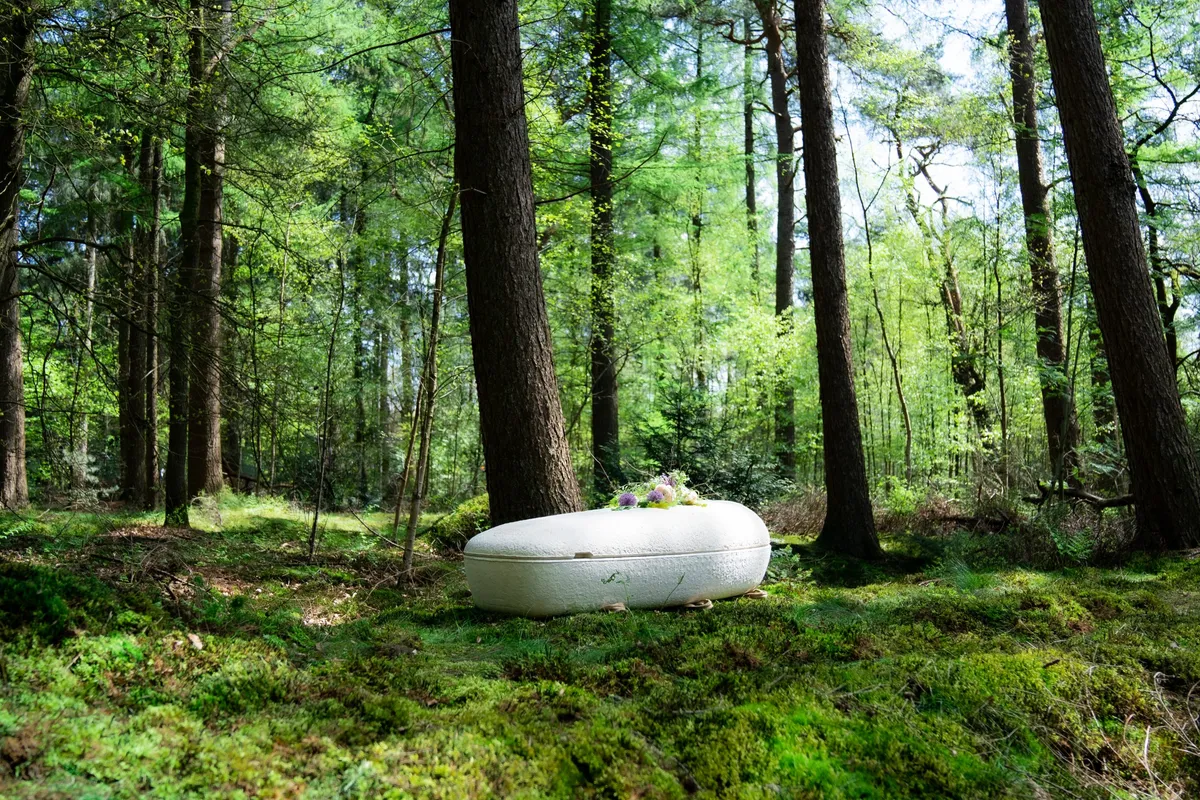
Mark C. Ancker's final wish was simple: to rest in the woods he loved and feed the land around him. On a hillside in rural Maine, his family made that happen—not with traditional wood and concrete, but with a casket grown from mushroom mycelium that will break down completely within 45 days and enrich the soil beneath.
This was North America's first burial using a Loop Living Cocoon, a fully biodegradable casket developed by Dutch company Loop Biotech. The casket is grown in a week, requires no embalming or reinforced vaults, and turns decomposition into something generative. "He wanted his final resting place to nourish the land and plants he cherished," said Marsya Ancker, Mark's daughter. "That was always who he was."
The Ancker family's choice on private land in Industry, Maine, might seem radical. It isn't. Loop Biotech has already facilitated more than 2,500 burials across Europe using mushroom caskets. In North America, the Green Burial Council has certified over 250 providers and recorded 400+ green cemeteries since 2005—a trajectory that accelerated sharply in the last decade as families began asking harder questions about what happens after death.
We're a new kind of news feed.
Regular news is designed to drain you. We're a non-profit built to restore you. Every story we publish is scored for impact, progress, and hope.
Start Your News DetoxWhat conventional burials actually cost
The math is worth sitting with. In the U.S. alone, conventional burials consume roughly 20 million board feet of wood, 4.3 million gallons of embalming fluid, and 1.6 million tons of concrete every year. That's not moral failure—it's just what happens when an industry standardizes around materials designed to preserve rather than return.
Green burial flips the premise. No embalming. No hardwood caskets. No steel-reinforced concrete vaults. Just the body, the earth, and time. The mushroom casket is one option among many; others include cardboard, woven willow, or simply a shroud. What matters is the principle: letting death feed life instead of fighting it.
Bob Hendrikx, Loop Biotech's founder, frames it differently. "We created the Loop Living Cocoon to offer a way for humans to enrich nature after death. It's about leaving the world better than we found it." That's not poetry—that's the actual mechanism. The mycelium breaks down the body and converts it into nutrient-rich soil that supports new growth.
The cultural shift is real. The Global Green Burial Alliance, founded in 2022 and entirely volunteer-run, connects families with green providers and helps people reclaim agency in end-of-life decisions. What started as a fringe choice in the 1990s is becoming mainstream enough that funeral directors are now fielding regular questions about it.
The Ancker family's choice won't transform the industry overnight. But it's one more data point in a growing pattern: people reconsidering what a good death looks like, and discovering that sometimes the most profound final act is simply stepping aside and letting the earth do what it does.