Researchers at Kumamoto University have found something unexpected in pomegranate leaves: a natural compound that can dismantle the protein tangles responsible for a rare but serious heart and nerve disease.
The condition is called transthyretin amyloidosis, or TTR. It happens when a transport protein in the body loses its shape and stacks into rigid fibers that lodge in organs, slowly damaging them. Existing treatments try to slow down the buildup or stabilize the protein — but they don't remove what's already there. Once those deposits form, the damage keeps accumulating.
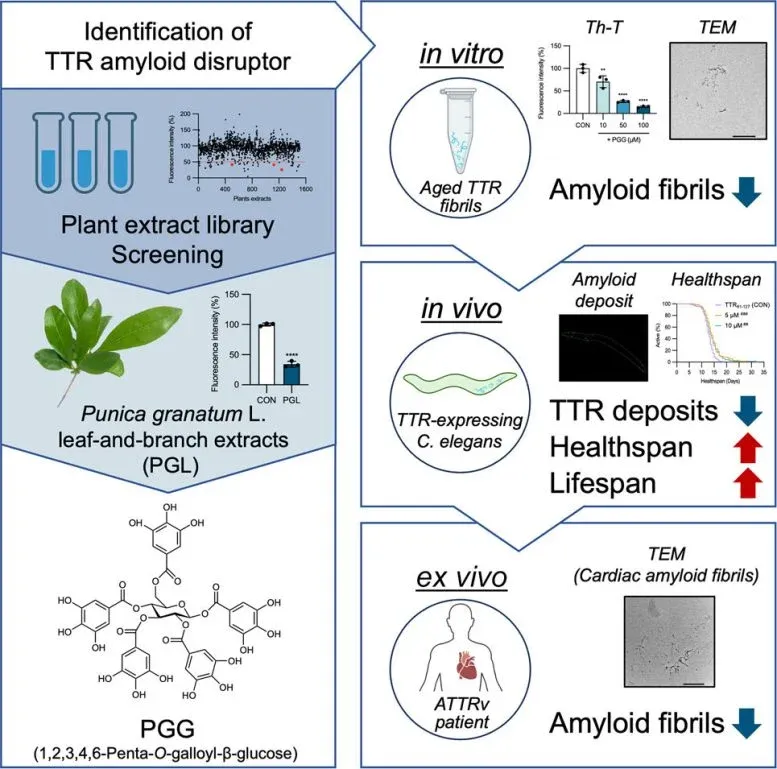
The Kumamoto team screened 1,509 plant extracts looking for something that could actually dismantle existing deposits. Pomegranate leaves and branches stood out. They narrowed down the active ingredient to a compound called PGG (1,2,3,4,6-penta-O-galloyl-β-D-glucose), and what they found was striking: in lab conditions, PGG broke apart amyloid fibrils from both mutant and normal forms of the protein. Importantly, it didn't attack amyloid structures linked to Alzheimer's disease — it was selective, targeting TTR specifically.
We're a new kind of news feed.
Regular news is designed to drain you. We're a non-profit built to restore you. Every story we publish is scored for impact, progress, and hope.
Start Your News Detox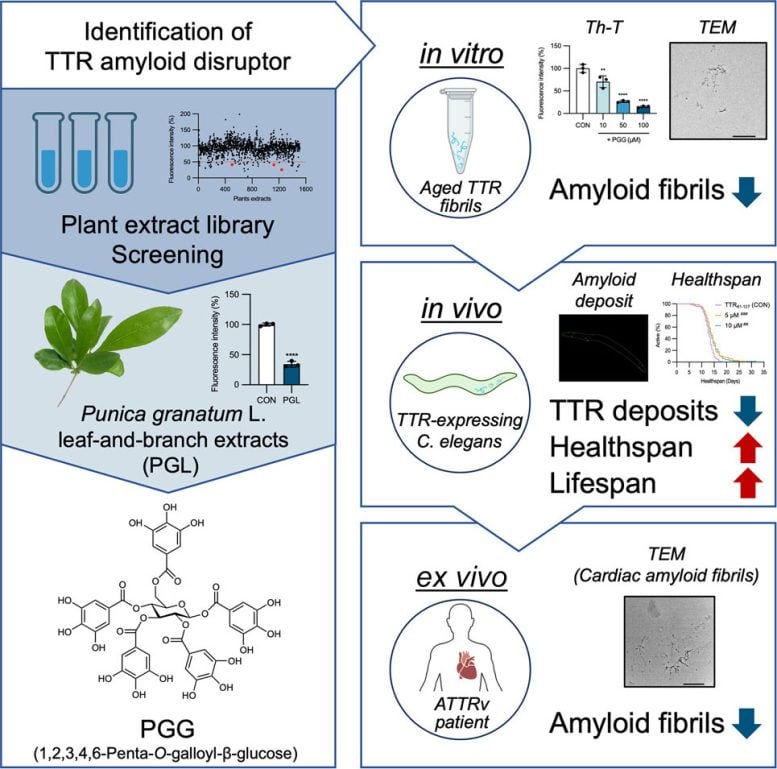
When they tested PGG in worms engineered to produce human TTR fragments, the results were harder to ignore. Animals treated with the compound showed fewer protein deposits and lived longer — both their lifespan and their healthspan improved. The team then tested something closer to reality: amyloid fibrils extracted directly from heart tissue of a patient with hereditary TTR amyloidosis. PGG dismantled those real patient samples too.
Moving Toward Human Treatment
Structural analysis revealed that multiple galloyl groups attached to a glucose core are what makes PGG work. This kind of molecular detail matters because it shows how the compound interacts with amyloid fibrils at a precise level — it's not just random disruption, but targeted action.
TTR amyloidosis affects somewhere between 50,000 and 100,000 people worldwide, and hereditary forms can strike in middle age. The disease is progressive and there's no cure. A compound that can actively remove existing deposits, rather than just slow new ones from forming, would address something doctors have been unable to tackle.
The research published in iScience doesn't claim PGG is ready for patients yet. Safety and efficacy in humans still need testing. But the findings suggest that plant-derived molecules could become the basis for a new class of therapies — ones that actively clean up the damage instead of just preventing more.
Study: Glycosidic scaffold bearing multiple galloyl moieties from pomegranate disrupts transthyretin amyloids - iScience, November 20, 2025