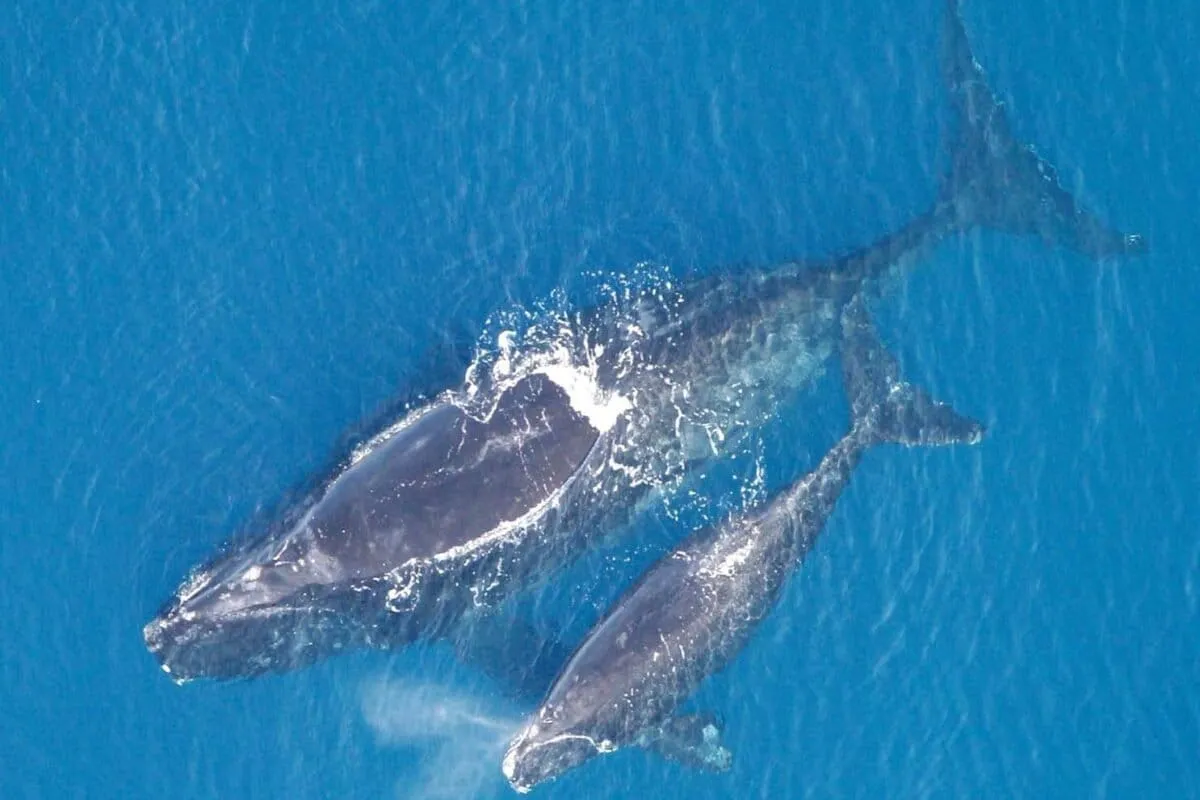
Fifteen calves born this winter. It's a small number in absolute terms, but for North Atlantic right whales, it marks a shift that scientists have been waiting for.
The population has been in freefall for years. By the early 2020s, these massive marine mammals — some weighing 70 tons — had dwindled to around 358 individuals. But the latest count from the North Atlantic Right Whale Consortium puts the number at 384 by the end of 2024. That's a 7% increase since 2020, and while it might sound modest, it's the first sustained upward movement the species has seen in nearly a decade.
What makes this winter's births particularly significant is who is reproducing. Scientists have identified first-time mothers entering the breeding pool for the 2025-2026 calving season. Some females are also calving at shorter intervals than before — meaning the reproductive females that remain are working harder to rebuild the population. These aren't just abstract population statistics. They're individual whales making the biological choice to have calves, in an ocean that has become far more hostile than their ancestors ever knew.
We're a new kind of news feed.
Regular news is designed to drain you. We're a non-profit built to restore you. Every story we publish is scored for impact, progress, and hope.
Start Your News DetoxThe fragile nature of recovery
But here's where the cautious part comes in. The U.S. National Oceanic and Atmospheric Administration (NOAA) estimates that around 50 calves per year, sustained over many years, would be needed to put the species on a genuine path to recovery. Fifteen is a long way from fifty.
The core problem hasn't changed. Right whales can live for more than a century in theory, but in the modern North Atlantic, many don't. Their median lifespan is measured in decades — not because of biology, but because of entanglement in fishing gear and collisions with large vessels. These aren't abstract environmental problems. They're the reason a whale born today faces odds that would have been unthinkable to its great-grandmother.
With so few reproductive females remaining, reaching 50 calves annually isn't just a conservation target. It's a threshold that requires not just the whales to cooperate, but the entire ecosystem around them to change. Fishing practices need to shift. Shipping lanes need rerouting. The ocean needs to become safer for animals that have no way to protect themselves from steel hulls and tangled rope.
The 15 calves born this winter aren't a solution. They're proof that the species hasn't given up, and that the females still swimming the North Atlantic are doing what they can. Whether humans do the same remains the real question.