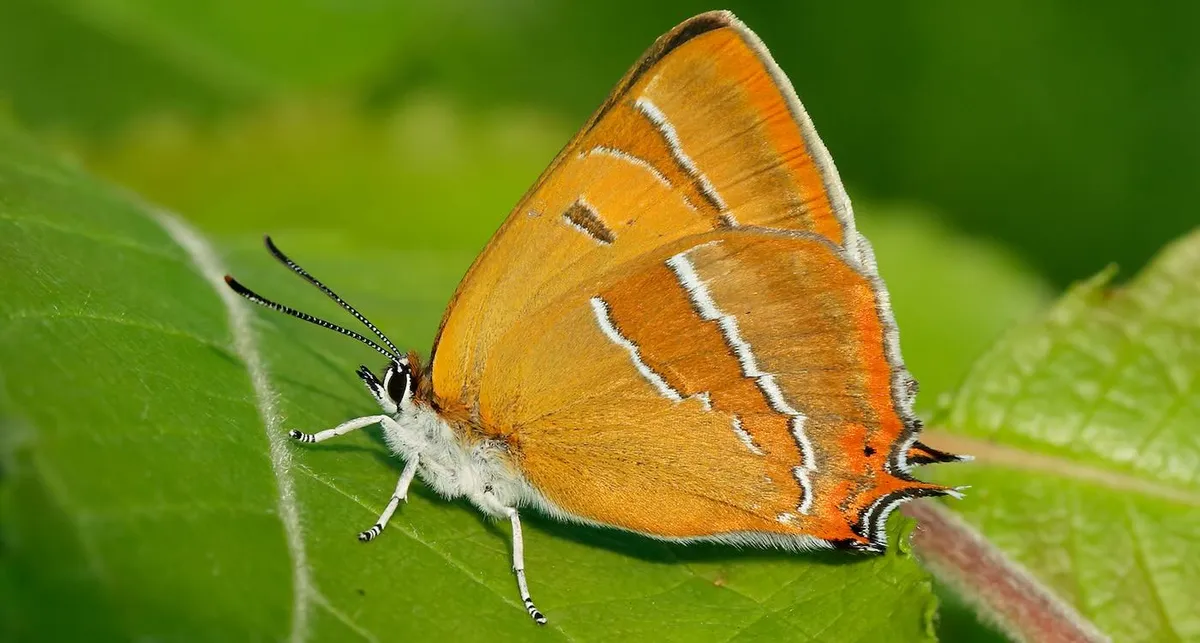
A Welsh valley has recorded more rare butterfly eggs than ever before—simply by letting hedges grow. Volunteers with Butterfly Conservation counted record numbers of Brown Hairstreak eggs this winter in Carmarthenshire, a turnaround that feels almost improbable after a decade of near-total disappearance.
The Brown Hairstreak once thrived across the UK, but declined steeply as farmers and landowners trimmed their hedgerows with a practice called 'flailing'—cutting them back hard each year. The problem: these butterflies lay eggs exclusively on new shoots of blackthorn bushes, and aggressive cutting destroys them before the caterpillars can feed. Since 2010, the species had virtually vanished from the Tywi valley.
Then in 2021, volunteers found a small pocket of survivors just west of Llandeilo. They partnered with two landowners—the National Trust's Dinefwr estate and the South Wales Trunk Road Agency—who agreed to stop the annual flailing and actively protect blackthorn growth. The shift was radical in its simplicity: let the hedges be.
We're a new kind of news feed.
Regular news is designed to drain you. We're a non-profit built to restore you. Every story we publish is scored for impact, progress, and hope.
Start Your News Detox
Richard Smith, a Butterfly Conservation volunteer for over 30 years, watched the recovery unfold. "After a decade of heartache for Brown Hairstreaks in Carmarthenshire's Tywi valley, there is at last signs of an upturn," he said. The numbers tell the story: protected land saw 50% increases in egg counts this winter alone, with volunteers spending hours each season combing hedges for the tiny white eggs.
What makes this work is neither expensive nor complicated. Dan Hoare, Butterfly Conservation's Director of Nature Recovery, points out that cutting hedges once every two or three years instead of annually would make an enormous difference—not just for Brown Hairstreaks, but for dozens of other species that depend on dense, mature growth. "We don't want to stop anyone managing their hedgerows," he says, "but we would love more landowners to try cutting back on their cutting back."
The Brown Hairstreak has become a kind of canary in the coal mine for healthy hedgerow management. When these butterflies thrive, it signals that the balance between human stewardship and natural growth is right—and when they do, everything else in that ecosystem tends to follow. As more landowners recognize this, the Tywi valley's recovery could become a blueprint for hedgerow restoration across Britain.