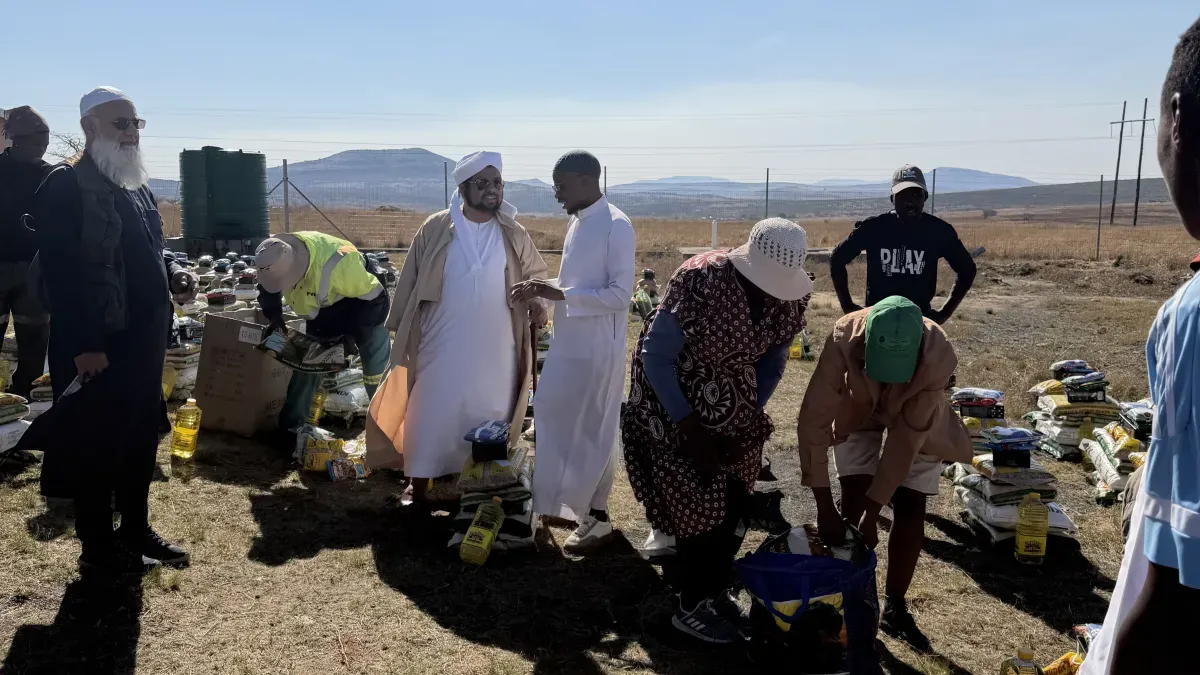
When Zwelibi Jack Ngubane died at 105, he had a clear wish: to be buried as a Muslim. His family honored this in Nquthu, a rural part of northern KwaZulu-Natal. This area is mostly Christian and traditional African beliefs. Muslims are a very small group here.
Ngubane converted to Islam late in life after seeing his young grandson practice the faith. His funeral followed Muslim rites. He was then buried in his family plot. For many in the community, the funeral was new, but it caused no problems. This is important in South Africa today.
Recently, anti-Muslim messages have grown online. These messages mix with debates about immigration. Some posts claim Muslims want to take over South Africa. Others question their place in the country. They also accuse Muslim groups of using charity to convert Black South Africans.
We're a new kind of news feed.
Regular news is designed to drain you. We're a non-profit built to restore you. Every story we publish is scored for impact, progress, and hope.
Start Your News DetoxOne post complained that Gift of the Givers, a humanitarian group, was "pushing their Muslim beliefs." Another said, "Most foreigners in South Africa are Muslim." It also claimed "most countries experiencing war are Muslim countries." Some accuse Muslims of "targeting poverty-stricken communities."
But in Nquthu's villages, the situation is different.
Samukelisiwe Ngubane first met Muslims through Indian shopkeepers. She said, "We have never had a problem." She added that people are curious but there are no issues.
Her brother, Khethukuthula Dlame, converted to Islam in 2012 as a teenager. This was not a big deal. Dlame, now 26, is one of the few Muslims in his village. His neighbors know him well. His Islamic clothing is a source of jokes, not anger. One neighbor teases him about wearing a dress.
Dlame said, "In these communities, there’s harmony and respect." He noted that people truly respect his religion. He stood by his grandfather’s gravesite as he spoke.
This difference raises a question. Is Islamophobia rising in South Africa? Or is social media making a small issue seem much bigger?
Muslims are a small group in South Africa. The 2022 census counted less than one million Muslims. This is about 1.6% of the population. Muslim leaders give higher numbers, from two million to five million people.
Islam has been in South Africa for centuries. Muslims came to the Cape as enslaved people and political exiles. They arrived from Asia and the Indian Ocean world under Dutch rule from the 1600s. Shaykh Yusuf of Macassar, a Muslim scholar, arrived in 1694. Muslims were already there before him.
Today, the Muslim community includes many groups. There are descendants of enslaved Muslims. There are South Africans of Indian background. There are Black African Muslims, converts, and recent migrants.
Dlame believes efforts to turn people against Muslims do not come from rural areas.
He said, "The move to orchestrated hate towards Muslims is not at a community level." He noted that those mobilizing are not from villages. They are from cities and hostels.
He added, "The people behind this understand the flash points." He explained that tribal talk is used to cause division. People in hostels are targeted because their living conditions are poor.
South Africa has seen xenophobic violence since apartheid ended. Migrants from other African countries often suffer the most. The question is if some anti-migrant talk is now aimed at Muslims.
No Widespread Islamophobia
Thembisa Fakude is a South African political analyst and journalist. She is also Muslim. She told Al Jazeera that fears of widespread Islamophobia are too high.
She argued, "There is no widespread or any orchestrated, well-planned Islamophobia directed towards Muslims."
Fakude admits there is anti-Muslim talk online. But she says this does not mean South African society is Islamophobic.
She noted, "It’s true, but it’s not only South Africa. This is global." She added that South Africa has bigots and ultra-nationalists.
Fakude also believes Muslim communities should address claims of racism and unfair labor practices within their own groups. They should not call every criticism religious prejudice.
She called it "a storm in a teacup." She worries about Muslims seeing themselves as victims. She thinks this is very dangerous.
Online Talk Can Spread
Moulana Sulaiman Ravat is a Muslim religious leader. He told Al Jazeera that most South Africans are not Islamophobic. But he is careful about what might happen.
He said, "On the ground, South Africans in the main are not Islamophobic." He noted many things show this.
Ravat warns that online talk can change attitudes over time.
He explained, "We must understand that there are certain global political realities." He said the Islamophobia project fits with these global plans. If people ignore it, what they see online could affect how they think.
Ravat believes Muslim identity is sometimes used to suggest someone is less South African. He thinks this idea is wrong.
He said Muslims are "deeply religious and deeply patriotic." He sees no conflict between the two.
His own children are fifth-generation South African Muslims of Indian heritage.
He noted, "They don’t speak the language any more. They are as South African as anyone else."
Two Different South Africas?
In Nquthu, Islam comes through neighbors, not social media. Dlame's mother cooks a halal meal for guests. At a community meeting, Dlame explained that Muslims also believe Jesus was a prophet. Villagers listened and sang Zulu songs praising God.
For now, there is a big gap between online talk and life in places like Nquthu. But Ravat says the chance of deeper hostility should not be ignored.
He advised, "Better be proactive than reactive." He called it a global reality for the last 20 years. He said it is unlikely but possible for it to grow in South Africa and have serious effects.