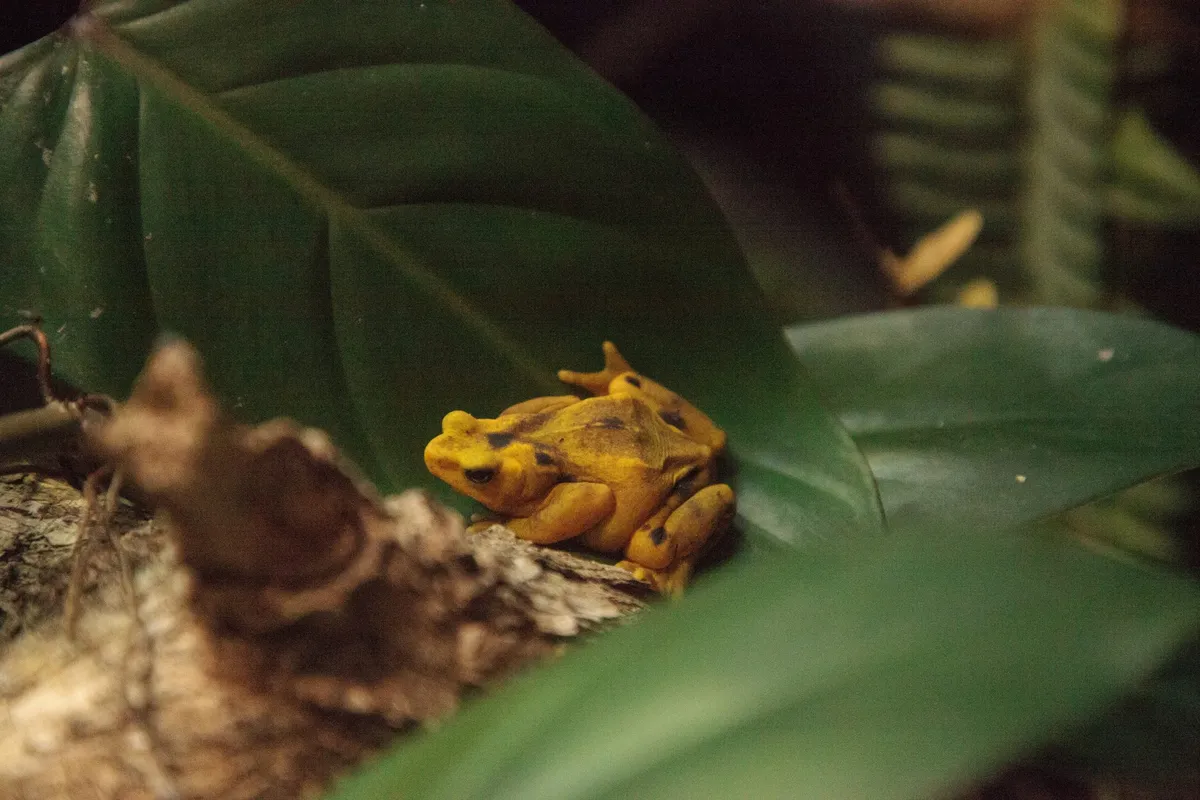
For the first time in nearly two decades, bright yellow flashes are moving through Panama's forest streams again. The Panamanian golden frog is being released back into the wild 17 years after a fungal epidemic erased it from its native habitat—a milestone that required years of captive breeding, disease research, and carefully staged trials to navigate one of the most destructive wildlife pathogens ever recorded.
The crisis began in the late 1980s when an invasive fungus called Batrachochytrium dendrobatidis (Bd) swept through Central America. The pathogen spreads easily through water, which proved catastrophic for amphibians living along rivers and streams. Golden frogs, which stay close to flowing water, were sitting ducks. Bd infects amphibian skin and causes chytridiomycosis—a disease that disrupts electrolyte balance and often triggers heart failure. By 2004, the fungus reached El Valle de Anton, the last refuge of Panama's golden frogs. By 2009, they were gone entirely from the wild.
Extinction was averted only because the Panama Amphibian Rescue and Conservation Project (PARC), a Smithsonian-affiliated initiative, began collecting and breeding golden frogs in controlled facilities. Maintaining stable captive populations meant years of careful genetic management and disease monitoring. Only recently did those populations grow robust enough to support reintroduction—a shift that reflects both confidence in the breeding work and a deeper understanding of how to manage the fungus in natural habitats.
We're a new kind of news feed.
Regular news is designed to drain you. We're a non-profit built to restore you. Every story we publish is scored for impact, progress, and hope.
Start Your News DetoxRewilding in the age of fungus
Releasing golden frogs back into Panama's ecosystems required a cautious, data-driven approach. The chytrid fungus remains present in parts of the country, so reintroduction sites had to be chosen with precision. During an initial 12-week soft release, researchers estimate that about 70 out of 100 frogs died from chytridiomycosis. The losses were substantial, but the trial generated crucial information about survival patterns and environmental conditions.
Temperature and microclimate appear to be the key variables. Conservation biologist Brian Gratwicke explained the insight: "Our earlier modeling suggested there may be release sites we can select that will be climatic refuges—places that are suitable for the frogs but too hot for the fungus." By identifying areas less favorable to the fungus, conservationists hope to improve long-term survival rates. This is the kind of adaptive learning that separates modern conservation from older approaches—rather than simply hoping conditions work out, researchers are mapping the precise environmental windows where frogs and fungus cannot coexist.
Golden frogs are not alone in benefiting from this work. In the past year, PARC successfully reintroduced three additional species: the crowned tree frog, Pratt's rocket frog, and the lemur leaf frog. Each release contributes to a growing body of knowledge about amphibian conservation in the era of chytrid fungus—knowledge that could eventually help other countries facing the same crisis.
The Panamanian golden frog carries weight beyond its ecosystem role. It's viewed as a national symbol associated with good fortune, and its disappearance left a visible absence in both the landscape and public consciousness. The species is also a reminder that nature's warning systems work: the striking yellow color is not just beautiful—it's a signal. Golden frogs produce potent defensive toxins, meaning their brightness is an honest advertisement of danger. Visitors who encounter one along a forest stream should admire from a respectful distance.
The reintroduction does not eliminate the threat posed by chytridiomycosis. The fungus remains a global challenge for amphibian populations worldwide. But Panama's golden frogs are no longer confined to conservation facilities. They are once again part of the country's living landscape—a development made possible through sustained research, adaptive management, and long-term investment in biodiversity protection. As climate conditions shift globally, the lessons learned from releasing frogs into carefully selected microclimates may become increasingly relevant for other species facing similar pressures.